
How to Electrify Your Home in the UK: The Right Order, Real Costs and Grants
Solar, a battery, a heat pump and an EV can take your home off gas and petrol for good. Do them in the wrong order and you'll overspend. Here's the sequence that makes sense, what each step costs in 2026, and where to start depending on your home.
Quick answer: Electrify in this order: cut your energy use first (insulation, controls), switch to a time-of-use tariff, add solar, then a battery, then a heat pump when your boiler is due for replacement, and an EV when you next change car. Doing it this way means each step makes the next one cheaper or more effective. A full home costs roughly £12,000–£29,000 after grants (not counting the car), so almost nobody does it in one go. If you rent, plug-in solar, smart controls and the right tariff are your route in.
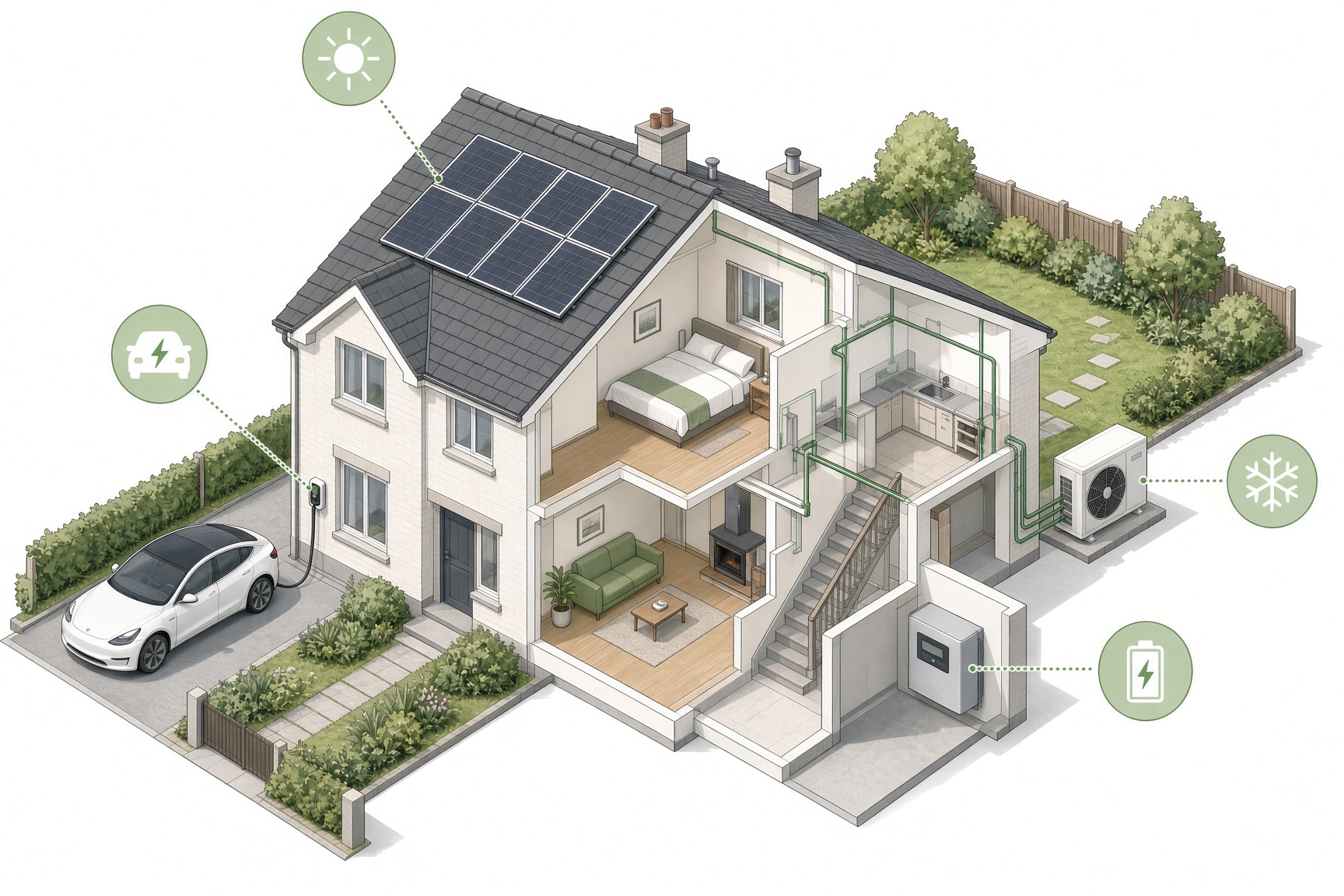
Why Electrify Your Home?
Electrifying your home means replacing gas and petrol with electric technology, ideally powered partly by your own solar. The main reasons people do it:
- Protection from gas price spikes. Ember's September 2026 report found fully electric homes are up to ten times better protected from energy price shocks. You can see it in this quarter's bills: from 1 October, gas rises around 8.7% while electricity is almost flat.
- Lower running costs. Home-generated solar is the cheapest electricity you can use, and off-peak tariffs let you charge a battery or car at a fraction of the standard rate.
- Grants and tax breaks. The Boiler Upgrade Scheme and 0% VAT on solar, batteries and heat pumps make 2026 an unusually good time to start.
The catch: Electricity costs about three times more per kWh than gas (26.32p vs 7.97p under the October 2026 cap). Electrifying only saves money when your technology is efficient enough to make up that gap. That means a well-installed heat pump, a good tariff and ideally your own solar. Swapping a gas boiler for direct electric heaters would cost you more, not less. See what electric heaters cost per hour.
The Right Order to Electrify Your Home
Order matters because each step changes the numbers for the next. Here's the sequence that works for most UK homes:
Why not a heat pump first? You can, and if your boiler has just failed you should. But doing the efficiency work first can mean a smaller, cheaper heat pump. Solar and a battery then soften its extra electricity use. The exception is oil or LPG homes, where a heat pump usually pays back fastest and should come first.
What It Costs to Electrify a Home in 2026
| Step | Typical cost | Grant / tax relief | Typical saving |
|---|---|---|---|
| Efficiency & controls | £0–£500 | ECO4 (if eligible, ends 31 Dec 2026) | Varies; fastest payback |
| Time-of-use tariff | Free | n/a | Off-peak ~8–9.4p/kWh |
| Solar (4kW) | £6,500–£8,000 | 0% VAT to 31 Mar 2027 | About £690/yr with export |
| Battery (retrofit) | £3,950–£11,500 | 0% VAT to 31 Mar 2027 | £300–£600/yr on a time-of-use tariff |
| Air source heat pump | £500–£7,500 after grant | £7,500 BUS (£9,000 oil/LPG off mains gas) | ~£150–£300/yr vs gas on a heat pump tariff, plus £108 with no gas standing charge |
| EV home charger | £800–£1,200 | Up to £500 (flats, renters and homes with on-street parking) | Far cheaper per mile than petrol |
Added together, electrifying a typical home costs roughly £12,000–£29,000 after grants, not counting the car. That's why most people do it over several years, timing each step with when something needs replacing anyway. Run your own numbers with the solar, battery, heat pump and EV charging calculators.
Where to Start, Depending on Your Home
You rent or live in a flat
Smart controls, a better tariff and compliant plug-in solar (with your landlord's OK). If you drive, the up-to-£500 chargepoint grant is aimed at you.
Your boiler is under 10 years old
Efficiency first, then solar and a battery. Plan the heat pump for when the boiler reaches the end of its life, rather than ripping out a working one.
Your boiler is failing
This is the moment to get heat pump quotes before replacing like for like. A new gas boiler locks you into gas for another 12–15 years. See are heat pumps worth it.
You're on oil or LPG
Heat pump first. You get the larger £9,000 grant and usually the fastest payback, often under 10 years. Ember counts 4.8 million off-gas-grid homes as the biggest opportunity.
You already have solar
A battery is your best next step, followed by an EV. Your panels make both pay back faster.
No solar, and none planned
A battery on a time-of-use tariff can still work by charging overnight. See battery storage without solar.
Deadlines Worth Knowing
| Date | What changes |
|---|---|
| 28 October 2026 | Autumn Budget: decision on extending the 0% VAT on electricity bills |
| 31 December 2026 | ECO4 scheme closes for free insulation and heating upgrades |
| 31 March 2027 | 0% VAT on solar, batteries and heat pumps ends unless extended; the electricity bill VAT cut also ends |
Before you commit:
- Use MCS-certified installers for rooftop solar, batteries and heat pumps. It's required for the Boiler Upgrade Scheme and for Smart Export Guarantee payments.
- Get at least three quotes. Prices for the same system vary widely.
- Savings figures here are typical ranges. Yours depend on your home, usage, roof and tariff.
- Check your home insurance before any new installation. Insurers' rules differ, including for plug-in solar.
Frequently Asked Questions
Related Guides
Published 1 October 2026, updated 23 October 2026. Costs and savings are typical 2026 UK ranges from our own guides and are estimates only. Energy prices from the Ofgem price cap for 1 October 2026 and Octopus Energy's tariff data on 23 October 2026. Solar payback from the Energy Saving Trust. Grant details from the Boiler Upgrade Scheme and OZEV chargepoint grant. Price shock findings from Ember, The Electro-fortification of Britain (23 September 2026).
Which kind of quote suits you?
"I'd rather deal with one good installer" Get a fitted price from Blue Ape Renewables, the installer we work with. MCS-certified and NAPIT-accredited, fitting solar panels, batteries, heat pumps and EV chargers across England, Wales and Scotland. Get a fitted price →Tell us about your project and local installers will quote
Both are free and there's no obligation. We earn a commission if you go ahead with Blue Ape or with one of the installers you are matched with.