
Energy Saving · Drying Clothes Indoors
Best Heated Clothes Airer UK 2026: Running Costs Compared
A heated airer costs 5p to 8p an hour to run, but it runs for hours. Here is what a load really costs, how that compares with a tumble dryer and a dehumidifier, and the six airers worth buying.
Last updated: 17 October 2026
Affiliate disclosure: some links on this page are affiliate links. If you buy through them we earn a small commission at no extra cost to you. It doesn't affect what we recommend.
Every heated airer, or electric clothes airer as some brands call it, is sold on the same line: pennies an hour against a pound for the tumble dryer. The pennies are true. What the box leaves out is how many hours it runs, and where the water goes. This guide works out the cost per load, then picks the airers that give you the most drying for the least electricity.
Quick answer: the best heated airer for most homes is the Minky SureDri 4-Tier (£159.99), which has the most drying space per watt, a timer and a cover in the box. The best value is the Black+Decker 3-Tier at £99.99, with the same 300W and 21 metres as airers costing £60 more. On running costs, a heated airer beats a vented or condenser tumble dryer on small loads, roughly matches it on full ones, and loses to a heat pump dryer. It also puts about two litres of water into the room per load, so ventilation or a dehumidifier is part of the deal.
On this page:
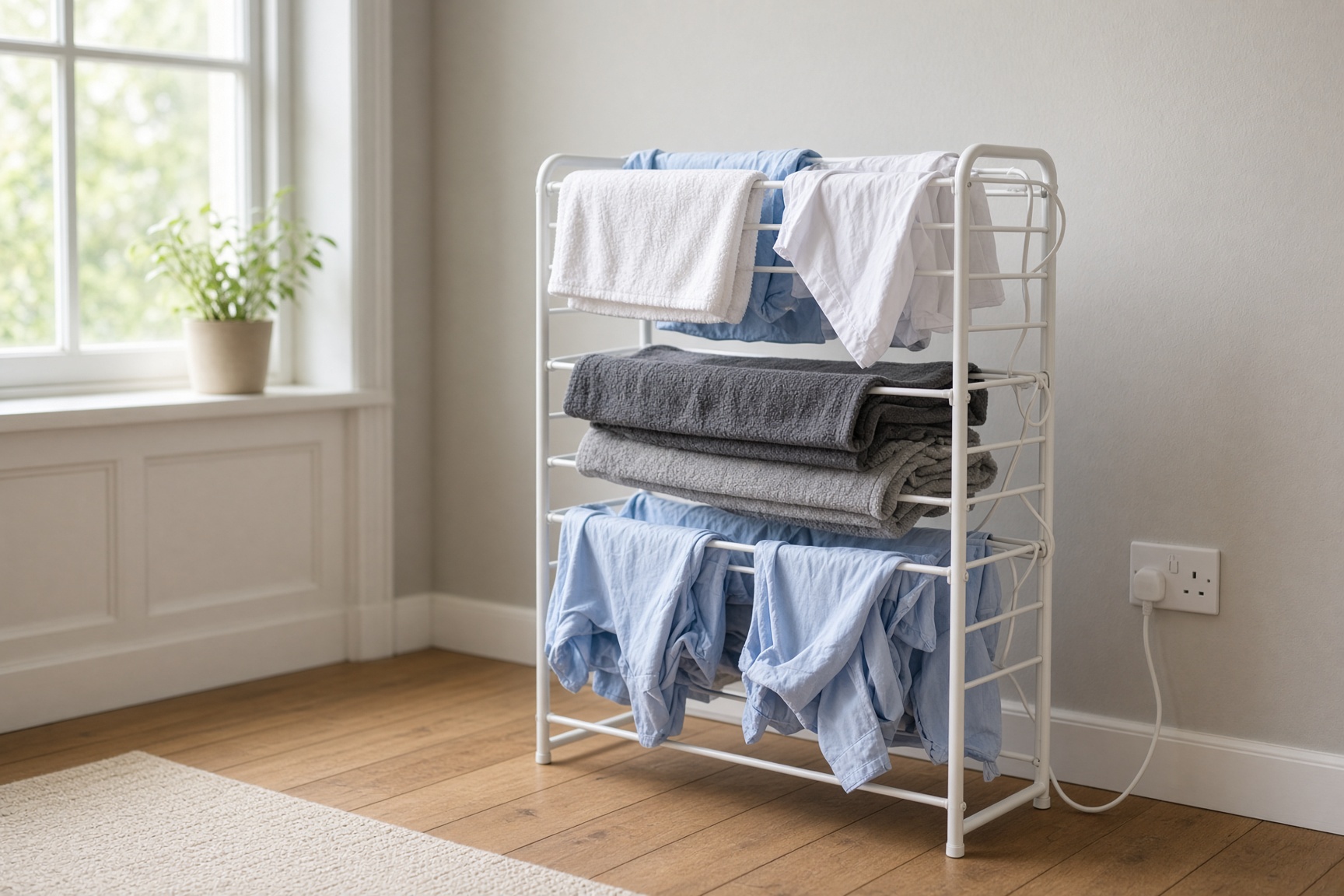
Are electric clothes airers expensive to run?
Not per hour, but they run for a long time. A heated airer costs 5p to 8p an hour, but a full load can take around eight hours, so a dry load costs about 37p for a small one and up to 63p for a full one. That is close to a condenser tumble dryer on a full load, and more than a heat pump dryer.
At the October 2026 price cap of 26.32p per kWh, a 300W tower airer costs 7.9p an hour and a 230W winged one costs 6.1p. Those are the figures on the box. The figure that matters is the cost of a dry load, and that depends on how long it takes.
Which? timed heated airers on a small cotton load of 2.15kg. Tower airers took about 4 hours 40 minutes. Winged airers took about 5 hours 54 minutes. A full family wash takes longer, and eight hours is typical. Here is what that means in pence, next to the other ways of drying a load indoors.
| Method | Energy per load | Cost per load | Cost a year, 4 loads a week | Removes the moisture? |
|---|---|---|---|---|
| Unheated airer, window open | None | 0p | £0 | Partly, and it lets heat out |
| Unheated airer plus dehumidifier | 0.6–2.1 kWh | 16–55p | £33–£114 | Yes |
| Heat pump tumble dryer | 1–1.5 kWh | 26–39p | £55–£82 | Yes |
| Heated airer, small load | About 1.4 kWh | About 37p | About £77 | No |
| Heated airer, full load | 1.8–2.4 kWh | 46–63p | £96–£131 | No |
| Hot-air drying pod, small load | About 2.3 kWh | About 60p | About £125 | No |
| Vented or condenser tumble dryer | About 2.5 kWh | About 66p | About £137 | Yes |
What the numbers say. A heated airer is not the cheapest way to dry clothes. An unheated airer beside a dehumidifier usually costs less and deals with the damp. A heat pump dryer costs less per load too. Where the heated airer wins is the price of the thing itself, at £50 to £200 against £400 or more for a heat pump dryer, and on small loads, where it runs for under five hours.
One thing works in its favour in winter. All the electricity it uses ends up as heat in the room, so your boiler has a little less to do. With gas heat costing about 8.7p per kWh, that offsets roughly a third of the running cost while the heating is on. It doesn't apply in a room you wouldn't otherwise heat.
From January: the price cap is forecast to rise to about 30.28p per kWh (Cornwall Insight's forecast for January to March 2027). At that rate a 300W tower airer costs about 9.1p an hour, a small load about 42p and a full one 55p to 73p, against about 76p for a vented or condenser dryer cycle. The gap between them stays about the same.
Are heated airers worth it?
For some homes, yes. A heated airer does work: it dries a small load in about five hours, well ahead of an unheated airer in a cool room. Whether it is worth the money depends on what you would use otherwise.
| Your situation | Worth it? | Why |
|---|---|---|
| No tumble dryer and nowhere to dry outside | Yes | It is the cheapest way to buy faster drying, at £50 to £200. Pair it with ventilation or a dehumidifier |
| Small loads, a few times a week | Yes | A small load costs about 37p, against about 66p in a vented or condenser dryer |
| You own a vented or condenser dryer and do full loads | Only just | A full load saves 3p to 20p. At four loads a week that is £6 to £42 a year, so a £100 airer pays back slowly |
| You own a heat pump dryer | No | The dryer costs less per load and takes the water away |
| You already have condensation or mould | Not on its own | It adds two litres of water to the room per load. Fix the damp, or run a dehumidifier beside it |
On electricity, a tower or winged airer does not use a lot at any one moment. At 200 to 300 watts it draws about a tenth of what a kettle does. Hot-air pods are the exception, at 850 to 1,000 watts. The cost adds up because an airer runs for hours: a full load on a tower uses 1.8 to 2.4 kWh, close to the 2.5 kWh of a condenser dryer cycle.
Six heated airers compared
Prices are the makers' or a named retailer's on 5 October 2026 unless stated. Amazon's price may be different, and the buttons below go to Amazon. Cost per hour is our own calculation from each airer's power rating.
| Airer | Type | Power | Cost an hour | Drying space | Timer | Price |
|---|---|---|---|---|---|---|
| Minky SureDri 4-Tier | Tower | 300W | 7.9p | 23m | Up to 9 hours | £159.99 |
| Black+Decker 3-Tier | Tower | 300W | 7.9p | 21m | No | £99.99 |
| Dry:Soon Deluxe 3-Tier | Tower | 300W | 7.9p | 21m | 1 to 12 hours | £199.99 |
| Dry:Soon Mini 3-Tier | Slim tower | 198W | 5.2p | 13m | No | £129.99 |
| Status Winged | Winged | 230W | 6.1p | 20 rails | No | About £50 |
| JML DriBUDDi Compact | Hot-air pod | 850W | 22.4p | 18 hangers | Not confirmed | About £79 |
The best heated clothes airers
Minky SureDri 4-Tier Heated Airer
Tower · timer and cover included · 20kg load limit
The energy pick. It spreads the same 300W as its rivals over four tiers and 23 metres, the most drying space per watt of any tower here, so one run can take a load that would need two on a smaller frame. Which? counted 37 T-shirts on it, the most of the towers it tested. The timer switches it off for you, which stops the commonest waste: an airer left heating clothes that are already dry. The cover comes in the box.
The guarantee is one year, against three for Lakeland's Dry:Soon. At 147cm it is also the tallest here.
Black+Decker 3-Tier Heated Airer
Tower · 15kg load limit · folds flat
The same power and the same 21 metres as the standard Dry:Soon for £60 less. It costs exactly the same to run. What you give up is the timer and the longer guarantee. A smart plug with a timer adds an automatic switch-off for a few pounds, and shows you what each load used. A version with a cover and wheels is also sold.
£99.99 was Robert Dyas's price when we checked. Other shops vary.
Lakeland Dry:Soon Deluxe 3-Tier
Tower · built-in timer · 3-year guarantee · folds to 8cm
The original, and the one to buy if you want it to last. It has 36 heated bars, a timer you can set from 1 to 12 hours, and Lakeland's three-year guarantee. It uses no less electricity than the Black+Decker, so the extra £100 buys build quality, the timer and the guarantee. The standard Dry:Soon 3-Tier is £159.99 without the timer.
A pricing quirk on Lakeland's own site when we checked: the Deluxe with its cover was £194.98, less than the airer alone.
Lakeland Dry:Soon Mini 3-Tier
Slim tower · 60cm wide · 3-year guarantee · folds to 8cm
The lowest power draw of the towers and the smallest footprint, at 60cm by 63cm. It suits a flat, or one person's washing. Thirteen metres holds about one load, and Ideal Home's tester found it dried more slowly than the full-size models because the clothes sit closer together. So it costs less per hour and not much less per load.
Status Winged Heated Airer
Winged · 20 heated rails · folds flat
The cheapest way in. A winged airer lays clothes flat in a single layer, so it holds one small load and takes longer: about 5 hours 54 minutes in Which?'s test of winged models, against 4 hours 40 for towers. It draws less power while it does, so the cost per small load comes out about the same, around 36p. Long items hang off the ends and dry last. The Minky winged airer, at £61.99 with 12 metres of rail, is the well-known alternative.
JML DriBUDDi Compact
Hot-air pod · zip-up cover · holds 18 hangers
A different machine. A fan heater in the base blows hot air up through clothes on hangers inside a zipped cover, and shirts come out with fewer creases. It is quick, at one to three hours. It is also the dearest way to dry on this page: Which? found a standard heated airer costs around half as much to run as a pod, and its figures work out at about 60p for a small load at today's prices. Buy one for speed, not savings. Lakeland's Dry:Soon Drying Pod (1,000W, £79.99) works the same way.
The fan makes it noisier than a bar airer.
Tower, winged or pod: which uses the least energy?
For a small load there is almost nothing between a tower and a winged airer. The tower is faster and the winged one draws less, and they meet in the middle. The difference shows on bigger loads, where a tower holds two washes in one run.
| Type | Typical power | Time, small load | Cost, small load | Best for |
|---|---|---|---|---|
| Tower, 3 or 4 tiers | 300W | About 4h 40m | About 37p | Families, and two loads at once |
| Winged | 230W | About 5h 54m | About 36p | One or two people, tight budgets |
| Hot-air pod | 850–1,200W | About 2h 13m | About 60p | Speed, and shirts on hangers |
Times are from Which?'s tests of a 2.15kg cotton load. Costs are ours, at 26.32p per kWh.
Best electric clothes dryer: heated airer, drying pod or heat pump dryer?
"Electric clothes dryer" is sold as three quite different things: a heated airer, a hot-air drying pod with a zip-up cover, and a heat pump tumble dryer. They cost very different amounts to buy and to run, and only one takes the water out of the room.
| Type | Power | Cost an hour | Cost a small load | Removes the water? | To buy |
|---|---|---|---|---|---|
| Heated airer (tower or winged) | 200–300W | 5p to 8p | About 37p | No | £50 to £200 |
| Hot-air drying pod | 850–1,200W | 22p to 32p | About 60p | No | About £79 |
| Heat pump tumble dryer | Varies by cycle | n/a | 26p to 39p | Yes | £400 or more |
| Vented or condenser tumble dryer | Varies by cycle | n/a | About 66p | Yes, outside or into a tank | Varies |
Running costs are at 26.32p per kWh, using the same figures as the table at the top of this page.
- For the lowest cost to buy and run on small loads: a heated airer. Our pick is the Minky SureDri 4-Tier, or the Black+Decker 3-Tier for less.
- For speed in a small flat: a drying pod. It dries a small load in about two and a quarter hours, half the time of a tower, but costs more per load. Our pick is the JML DriBUDDi Compact.
- For the cheapest dry load and no damp: a heat pump tumble dryer, if you have the space and the budget. It costs the least per load and collects the water. Our dehumidifier vs tumble dryer guide compares them with drying on an airer beside a dehumidifier.
How to use a heated airer: seven ways to cut the cost
Where the water goes
A load of washing holds about two litres of water after spinning. A heated airer puts all of it into the air of your home, only faster than an unheated one would. In a closed room in winter, that water condenses on the coldest surfaces: windows, outside walls and the backs of wardrobes. A dehumidifier is what takes it back out: see how a dehumidifier works.
Our guide to drying clothes indoors without damp has the full routine.
Heated airer or tumble dryer?
It depends on what you own now and how much washing you do.
| Your situation | What the sums say |
|---|---|
| You own a vented or condenser dryer | A heated airer saves 3p to 29p a load, or £6 to £60 a year at four loads a week. A £100 airer can take years to pay for itself. Use it for small loads and keep the dryer for big ones |
| You own a heat pump dryer | Keep using it. It costs less per load than a heated airer, and it takes the water away |
| You have no dryer, and little washing | A heated airer is the cheapest way to get faster drying. Pair it with ventilation |
| You have no dryer, and a load a day | A heat pump dryer costs £400 or more, but saves 7p to 37p on every full load against a heated airer. At a load a day that is £26 to £135 a year |
| You already own a dehumidifier | Try an unheated airer next to it first. It is usually the cheapest of all |
The full comparison is in dehumidifier vs tumble dryer.
Can you leave a heated airer on overnight?
Most makers say no, and Which? gives the same advice: don't leave a heated airer running while you sleep or when nobody is home. Tower and winged airers are low-powered, but they have a heating element and are usually draped in fabric, so they should be used while someone is in. A built-in timer or a plug-in one makes that easy.
Frequently asked questions
Drying indoors every week?
The cheapest way to dry a load and keep damp out is usually a dehumidifier next to an ordinary airer. See which ones we recommend for laundry.
See the Best Dehumidifiers →Related Guides
Published 5 October 2026, updated 17 October 2026. Running costs use the October 2026 Ofgem price cap of 26.32p per kWh and each airer's rated power. Drying times, and the finding on covers, are from Which?'s tests, published 27 March 2026. Tumble dryer and dehumidifier costs per load are the same figures used in our other drying guides. Prices were checked on 5 October 2026 at Lakeland, Minky and Robert Dyas. The Status and JML prices are from Ideal Home's review. We have not tested these airers ourselves. Links marked with a button are affiliate links.