
UK Home Battery Storage Guide
Home Battery Storage UK
Store your solar energy, cut your bills with smart tariffs, and keep the lights on during outages. Everything you need to know about home battery storage in the UK.
Updated 20 October 2026: prices checked against Octopus Energy and UK installers. GivEnergy, previously our top pick, entered administration in April 2026 and no longer honours warranties. Own a GivEnergy battery? Read this →
What Is Home Battery Storage?
A home battery stores electricity for use later. With solar panels, it captures surplus energy generated during the day, when you're often out, and releases it in the evening when you actually need it. Without solar, it can still save money by charging from the grid at cheap off-peak rates and discharging during expensive peak hours.
The core problem a battery solves: a typical UK household with solar panels and no battery exports 50–70% of the solar energy they generate. The Smart Export Guarantee pays as little as 4p per kWh for that exported electricity, while buying it back from the grid costs around 26p on the October 2026 price cap. A battery lets you use that energy yourself instead of selling it cheaply.
The simple maths
Exporting surplus solar earns you ~4–15p per kWh. Using that same electricity yourself (via a battery) saves you ~26p per kWh. A battery is worth it because using is worth more than selling.
With solar panels
- Stores surplus daytime generation
- Powers home in evenings from solar
- Pushes self-consumption to 70–90%
- Best financial case: 5–8 year payback
Without solar panels
- Charges on cheap overnight tariffs
- Discharges during expensive peak hours
- Saves £300–£600/year on tariff arbitrage
- Longer payback: 8–12 years
Is Home Battery Storage Worth It?
The short answer: it depends heavily on your situation. Here's how to work out which camp you're in.
Strong case for a battery
You have solar panels, an EV (or plan to get one), and you're willing to switch to a time-of-use tariff like Octopus Flux or Intelligent Octopus. Payback is 5–8 years and you'll save significantly over the battery's lifetime.
Combined with EV charging: saves an extra £400–£600/year on charging alone.
Decent case
You have solar panels and are willing to switch to a time-of-use tariff. Payback is 7–10 years. Worth doing, especially if you can get a competitive price on a Fox ESS or BYD system.
Weak case
You have solar panels but stay on a flat-rate tariff with no EV. Payback stretches to 12–15 years. Consider switching tariff first. It's free and dramatically improves the economics before you spend on a battery.
Important: Battery prices fell 15–20% in 2024–2025 and are expected to keep falling. If your payback calculation is marginal, waiting 12–18 months may significantly improve the economics. Don't let an installer pressure you into buying before you're ready.
Home Battery Storage Costs UK 2026
All prices include 0% VAT, which currently applies to domestic battery installations.
| Capacity | Best For | Typical Cost (installed) | Evening Cover |
|---|---|---|---|
| 5kWh | 1–2 bed, low usage | From about £3,950 | 3–5 hours |
| 10kWh | Average 3 bed home | £5,300–£7,500 | 6–10 hours |
| 13.5kWh | Large home / EV owner | £7,950–£11,500 | All evening + overnight |
| 16kWh+ | High usage / off-grid backup | £8,000–£13,000 | 24hr+ backup |
What size battery do you need?
Our battery storage calculator will size one for your home, but the rule of thumb is to size the battery to cover your evening electricity demand, from sunset to bedtime, using solar surplus generated that day. For most UK homes that's 5–10kWh. Bigger isn't always better: oversized batteries sit partially empty most of the time, worsening your payback.
0% VAT: the saving everyone qualifies for
VAT on domestic battery storage installations is currently 0%, saving you £500–£2,000 depending on system size. No application needed. Any reputable installer applies it automatically. This applies whether you're adding a battery to existing solar or installing both together.
Which kind of quote suits you?
"I'd rather deal with one good installer" Get a fitted price from Blue Ape Renewables, the installer we work with. MCS-certified and NAPIT-accredited, fitting batteries and solar panels across England, Wales and Scotland. Get a fitted price →Tell us about your project and local installers will quote
Both are free and there's no obligation. We earn a commission if you go ahead with Blue Ape or with one of the installers you are matched with.
Where Can You Install a Home Battery? The 2026 Rules
Home battery storage now has its own dedicated wiring rules for the first time, and they are worth understanding before you agree on a location with your installer.
BS 7671 Amendment 4: Chapter 57
Published 15 April 2026 by the IET and BSI, Amendment 4 introduced the UK's first dedicated wiring chapter specifically for stationary secondary battery installations, covering home battery storage systems for the first time. It isn't retrospective: an existing installation that complied with the rules in force when it was fitted doesn't need upgrading. But from 15 October 2026, when the previous edition is formally withdrawn, every new battery installation must comply with the new chapter. Our guide to the 15 October battery rules covers what changes in detail.
Now excluded
- Lofts
- Bedrooms
- Hallways & stairwells
- Small internal cupboards
Standard compliant locations
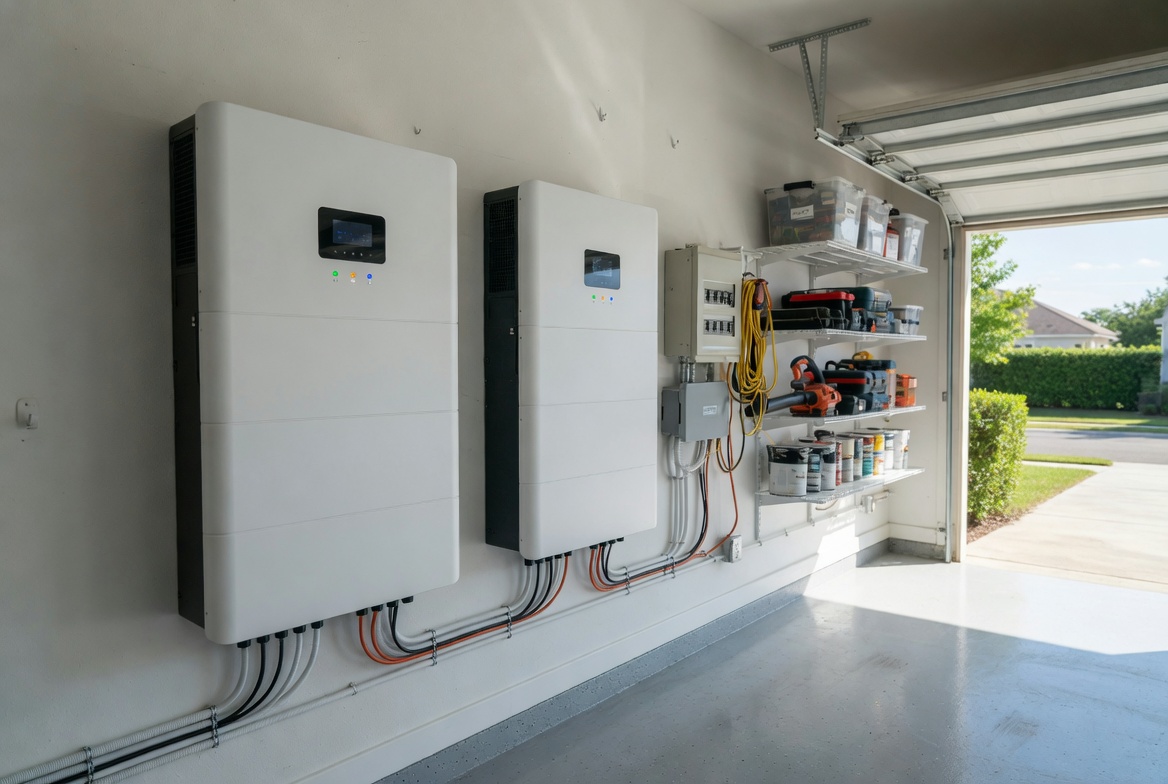
- Garages
- Outbuildings
- Utility rooms with fire separation
- External wall mounts
The change sits alongside the existing fire safety specification PAS 63100:2024. Together they require a minimum 1-metre outdoor clearance from doors and windows, and proper ventilation and smoke detection wherever the battery is sited, to address thermal runaway risk, the chain reaction that can occur if a lithium-ion cell is damaged or faulty.
What to ask your installer: Any MCS-certified installer should be able to confirm in writing that your design complies with both BS 7671:2018+A4:2026 and PAS 63100:2024, and explain which specific clause covers your chosen location. If a quote doesn't mention either standard, or proposes a loft installation, that's a red flag worth pushing back on.
How Much Can You Save?
Savings depend heavily on whether you have solar, which tariff you're on, and your usage patterns.
Smart tariffs make the biggest difference
The biggest factor in battery savings is your electricity tariff. On a flat-rate tariff, a battery saves you money by storing solar. But switch to a time-of-use tariff and you unlock a second income stream: charging the battery cheaply at night and using it during expensive peak periods. Compare them in our Octopus tariffs guide, and see battery storage without solar for the battery-only maths.
Which Battery Brands Do UK Installers Fit?
A quick guide to the names on your quotes. For our ranked picks and installed prices, see the best home batteries.
GivEnergy is no longer recommended
GivEnergy was the UK's most popular home battery brand and our previous top pick. On 9 April 2026, GivEnergy Ltd entered administration. The administrator confirmed the company has ceased trading, and that it will no longer honour hardware warranties or provide user support. As of June 2026, no buyer had been confirmed.
Already own one? Your battery should keep working. The app and portal are run by a separate company, GivEnergy Software Ltd, which is not in administration, although full app features now cost £4.99 a month. For faults or warranty questions, contact the installer who fitted your system first. Keep your receipts, serial numbers and warranty paperwork somewhere safe.
The batteries you are most likely to be quoted in 2026 are the Tesla Powerwall 3, Fox ESS, Myenergi Libbi, Sigenergy, Sunsynk, BYD and Enphase. Octopus Energy's own installs use Fox EVO, Enphase and Tesla, with battery-only prices from £3,947 for 5 kWh when we checked on 20 October 2026.
Which one suits you depends on whether you already have solar, an EV charger or plans for a heat pump. Our best home battery guide ranks five systems with installed prices and matches each to the kind of home it suits.
The lesson from GivEnergy: check who stands behind the warranty
A 10- or 12-year warranty is only as good as the company behind it. Before you buy, ask your installer three things: who honours the warranty if the manufacturer fails, whether they offer their own workmanship guarantee, and whether that workmanship guarantee is insurance-backed, so it survives even if the installer closes. MCS installers must also belong to a consumer code such as RECC or HIES, which gives you a route to complain if things go wrong.
Want a full product comparison with verified 2026 prices?
We've reviewed the top 5 home battery systems available through UK installers right now, including Tesla Powerwall 3, Fox ESS EP11, Myenergi Libbi, Sigenergy SigenStor and Sunsynk.
Read: Best Home Battery Storage UK 2026 →Use an MCS-certified installer. Most Smart Export Guarantee tariffs need an MCS-certified installation before they pay for exported power, and MCS installers must belong to a consumer code, which gives you a route to complain. Check certification at mcscertified.com before agreeing to any work.
Know which battery you want? Get a fitted price
An installer can size the battery to your usage, check your existing solar and find a spot that meets the new location rules. Get a fitted price from Blue Ape Renewables, the MCS-certified installer we work with, or compare prices from local installers.
No obligation. We earn a commission if you go ahead.
Home Battery Storage: Frequently Asked Questions
All Our Battery Storage Guides
Everything we've written on home and plug-in batteries.