
Best Solar Export Tariffs UK 2026: Every SEG Rate Compared
What each supplier pays for the solar electricity you send to the grid, and the eligibility conditions that decide which rate you can get.
Every SEG rate compared, with the conditions attached to each.
Quick answer: most suppliers run three tiers. There is a low rate open to anyone (3p to 6p per kWh), a better rate if they also supply your electricity (12p to 15p), and their best rate for people who bought their solar system through them (15p to 25p). The best rate with no strings is Fuse Energy at 13p, which you can take without switching your electricity. The best rate for switching supplier is EDF's Export 12m at 15p, fixed for a year. Good Energy (25p) and OVO and So Energy (20p) pay the most, but only on systems they installed.
The Smart Export Guarantee (SEG) pays you for every unit of surplus solar electricity you send to the grid. Ofgem requires any supplier with 150,000 or more customers to offer at least one export tariff. It doesn't set a minimum rate, so suppliers compete, and the headline numbers you see quoted are rarely the whole story.
The conditions attached to the best-sounding rates decide which one you can get, so the table below sets out all three tiers for each supplier.
The Pattern Every Supplier Follows
Almost every major supplier structures its export offer the same way:
Tier 1: open to anyone. You keep your current electricity supplier. Lowest rate, typically 3p to 6p per kWh. Fuse Energy is the exception at 13p.
Tier 2: their electricity customer. You buy your electricity from them too. Usually 12p per kWh, with E.ON Next at 13p and EDF at 15p.
Tier 3: they installed your solar. Their best rate, for customers who bought the system through them. 15p to 25p per kWh.
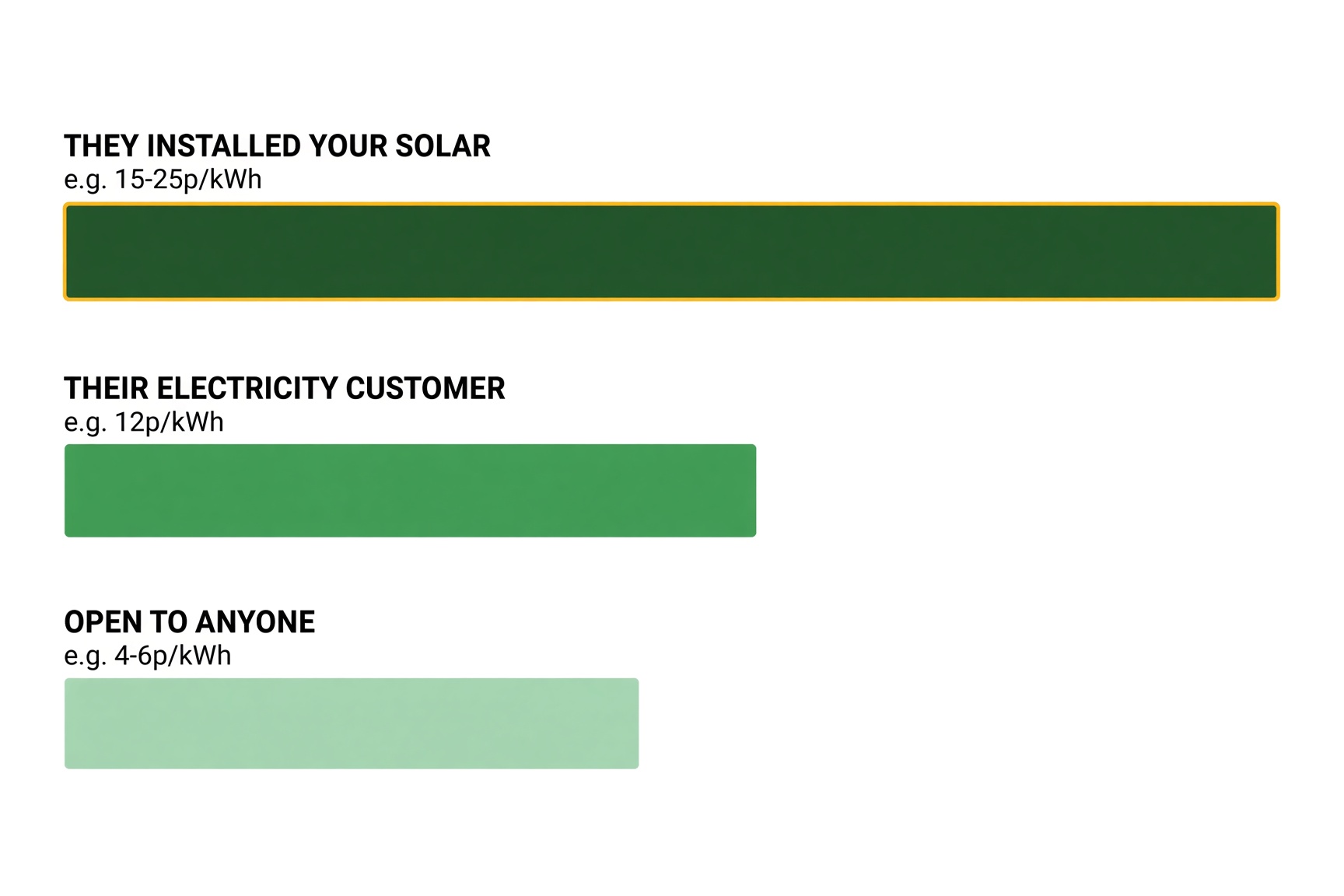
This matters because the "best rate" in an advert is very often a tier 3 rate. You can't have it unless you buy a new solar system from that company.
Every Rate Compared, October 2026
| Supplier | Open to anyone | If they supply your electricity | If they installed your system |
|---|---|---|---|
| Fuse Energy | 13p | 13p | — |
| EDF | 3p | 15p (fixed 12 months) | 18p |
| E.ON Next | 6p | 13p (fixed) | 17.5p |
| Octopus Energy | 4.1p | 12p (cut from 15p on 1 March 2026) | — |
| British Gas | 3p | 12p | — |
| ScottishPower | 6p | 12p | 15p |
| OVO Energy | 4p | 12p | 20p |
| Good Energy | 4p | 12p | 25p (fixed 12 months) |
| So Energy | 4.5p | — | 20p (fixed 12 months) |
Rates in pence per kWh, checked on 2 October 2026 against two independent rate trackers updated on 16 and 30 September. Suppliers can change variable rates with 30 days' notice, so confirm the rate on the supplier's own site before you apply. Ecotricity also pays its electricity customers a rate reported at between 12p and 16p. Octopus has time-of-use export tariffs as well, covered in our Octopus tariff comparison.
What changed since our August check: Fuse Energy now pays 13p with no requirement to be its customer, which is more than double the next-best open rate. EDF's customer rate is 15p on a 12-month fix. E.ON Next has a 13p rate for its electricity customers. E.ON announced in May that it is buying OVO. The competition regulator is reviewing the deal and nothing changes for customers of either company in the meantime.
What Each Rate Is Worth in a Year
A typical 4 kWp system generates about 3,800 kWh a year and exports around 60% of it, which is about 2,280 kWh. This is what that export earns at each rate:
| Export rate | Example | Yearly income |
|---|---|---|
| 4.1p | Octopus basic SEG, open to anyone | £93 |
| 6p | ScottishPower or E.ON Next open rate | £137 |
| 12p | Most suppliers, if you are their customer | £274 |
| 13p | Fuse Energy, open to anyone | £296 |
| 15p | EDF Export 12m | £342 |
| 20p | OVO or So Energy, on their installation | £456 |
| 25p | Good Energy, on their installation | £570 |
The gap between the basic 4.1p rate and 13p is about £203 a year for doing nothing more than filling in a form. If you have never switched from the export tariff your installer set up, this is the easiest money on the page. To see the numbers for your own roof, use the solar panel calculator, which lets you change the export rate.
Which Rate Suits You
You want to keep your electricity supplier
Fuse Energy pays 13p whoever supplies your electricity. If you would rather use a bigger name, ScottishPower and E.ON Next pay 6p with no switching.
You're happy to switch electricity supplier
EDF pays 15p fixed for 12 months, E.ON Next 13p and most others 12p. Check the import prices too. A dear electricity tariff can cost you more than the extra export earns.
You haven't chosen an installer yet
Good Energy's 25p and the 20p from OVO and So Energy are the highest rates, but only if you buy the system through them. Compare the install quote as well as the export rate. What to check on the panels →
You have a battery or an EV
A time-of-use setup can beat every flat rate here: charge overnight at about 8p and export solar in the day. That needs the right import tariff. Octopus tariffs compared →
How to Get Paid for Your Export
Use It or Export It?
Whichever rate you land on, keep the bigger picture in view. Even the best export rate on this page, 25p, is below the 26.32p you pay to buy electricity at the October 2026 price cap. On a flat tariff, using your own solar is nearly always worth more than exporting it.
The order of priority on a standard tariff: run appliances in daylight first, then look at a battery to shift more of your generation into the evening, and only then pick the export tariff that pays best for what's left. The exception is a cheap overnight tariff. If you can charge a car or battery at about 8p, exporting your solar at 12p or more and refilling overnight is the better deal. Our battery storage guide explains how that works.
Frequently Asked Questions
Related Guides
Rates last checked 2 October 2026 against independent rate trackers; our previous check, in August 2026, was made on each supplier's own website. Suppliers change export rates at short notice, so confirm the current rate with the supplier before applying. Yearly income figures assume 2,280 kWh of export from a 4 kWp system. Cool Power Co is an independent comparison site and does not set or influence these rates.
Thinking About Solar?
Compare free quotes from MCS-certified installers, then choose the export tariff that suits your setup.
Get Free Solar Quotes →Free · No obligation · MCS-certified installers only