
8 Things to Know Before Installing Solar Panels in the UK
The day-to-day details most buying guides skip, from squirrels chewing cables to why your panels switch off in a power cut, even at midday.
Affiliate disclosure: some links on this page are affiliate links. If you buy through them we earn a small commission at no extra cost to you. It doesn't affect what we recommend.
Quick answer: solar panels are low-maintenance, but a few things rarely make it into a sales quote. Birds and squirrels nest underneath. Panels switch off in a power cut, even in full sun. The inverter needs replacing once in the system's life, and nobody budgets for it. None of these is a reason not to install solar. They are the gaps between the sales pitch and owning a system.
Before you get to comparing brands and warranties, covered in our best solar panels guide, these are the practical points worth knowing. If you haven't worked out the numbers yet, start with the solar panel calculator.
1. Birds and Squirrels Love the Space Underneath
The gap between your roof and the underside of a panel is warm, dry and sheltered, which is what pigeons and starlings look for when nesting. It is common enough that pest control firms now sell solar bird-proofing as a standard service. Beyond the noise, nesting debris can block the ventilation gap under the panels, and droppings on the glass reduce output.
Squirrels are the more serious version of the problem. They are known to chew through the DC cabling that runs between panels, which is a fire and safety hazard and not just a nuisance.
Birdgo Solar Panel Bird Proofing Mesh Kit
30m black PVC-coated mesh and 60 fixing clips. No drilling
From an established UK bird control brand (Seahaven Limited, trading since 2002), rated 4.5 out of 5 from 278 reviews when we checked. It clips around the perimeter of the array, so there is no drilling and nothing that affects your panel warranty.
Several reviewers say the included clips run short on larger or T-shaped arrays. Order a spare pack of clips if your system has more than a handful of panels.
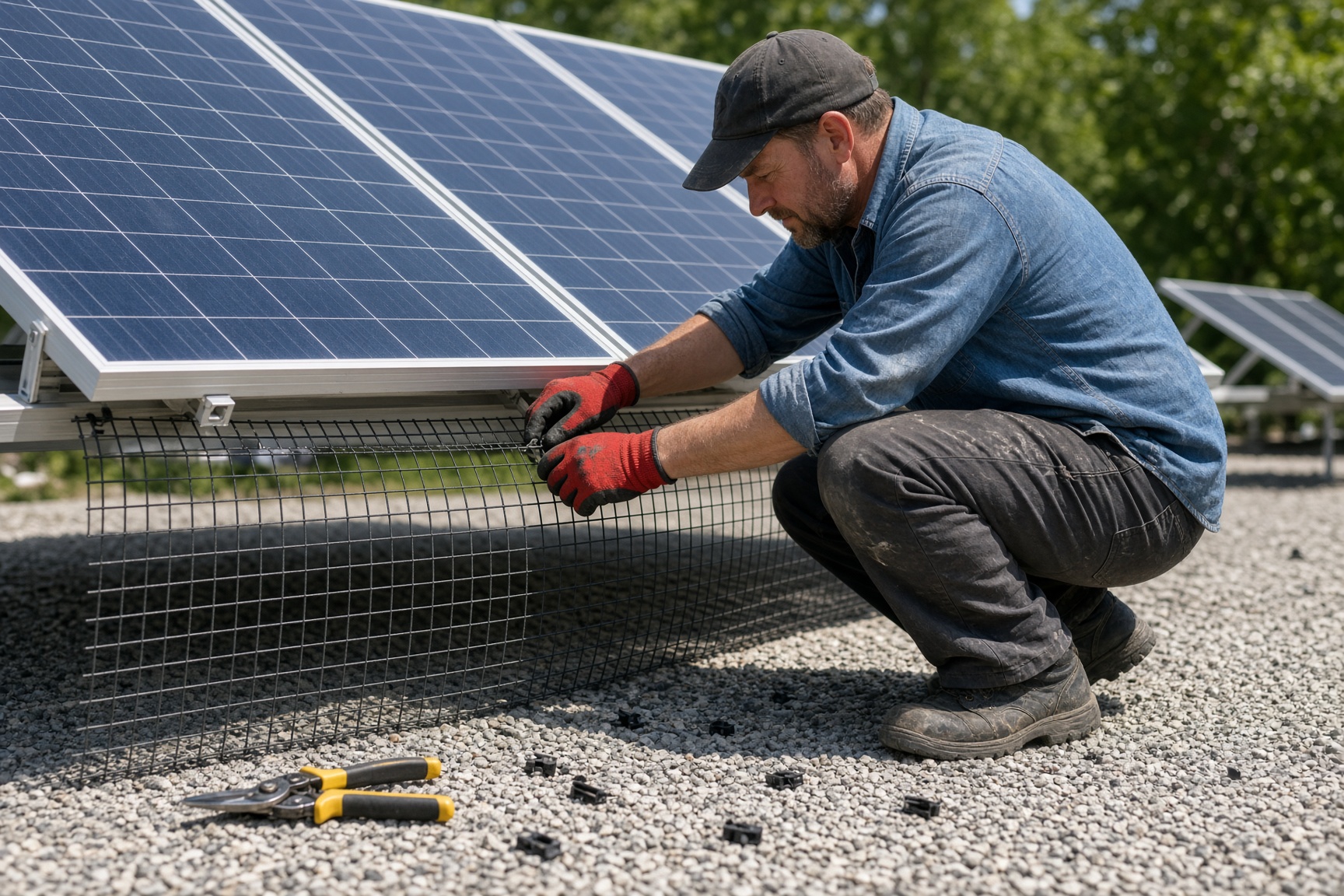
Mesh fitted around the edge of the array at installation solves this cheaply and for good. Ask your installer to quote it upfront, while the scaffolding is already there. Retrofitting it after birds have moved in means a second scaffold and a nest to clear, and you can't legally disturb an active nest during the breeding season.
2. You'll Clean Them Far Less Than You Think
Most people picture regular ladder trips with a squeegee. In practice UK rain does most of the cleaning, and a pitched roof-mounted system typically needs a proper clean only every few years. The routine that matters is a look once a year for obvious dirt, bird mess or debris.
Losses from dirt are small on a well-positioned system, usually a few per cent at most. That isn't the same for everyone. Homes near farmland, busy roads or trees, shallow-pitched roofs and roofs with regular bird activity need attention sooner. If that's you, check once a year instead of assuming the panels look after themselves.
BoomDing 23ft Telescopic Water-Fed Cleaning Pole
7m extendable pole with soap dispenser. 4.3 out of 5 from 3,520 reviews when we checked
A lightweight aluminium telescopic pole with a soft-bristle brush and built-in soap dispenser, extending to 7m. It suits panels on a single-storey roof, a garage or a low pitch, and doubles up for windows and conservatory roofs.
Reviewers say 7m isn't enough to clean roof-mounted panels from the ground on a typical two-storey house. Don't work from a ladder to make up the difference. For a high roof, pay a window cleaner with a longer water-fed pole. A few reviews also say the soap dispenser and hose connector are fragile.
3. Cloudy Days Aren't the Enemy. Short Days Are
Solar panels respond to light, not heat. Cold weather doesn't reduce output, and cooler cells are slightly more efficient. Panels still generate on an overcast day, just less than in direct sun.
Winter output is lower mainly because there is less daylight, about 8 hours around the December solstice against more than 16 in midsummer, and the sun is lower in the sky. A typical system produces five or six times as much in June as in December, which you can see month by month in our calculator. Heavy snow is the one thing that stops generation completely, until it slides off or melts. Leave it. It isn't worth climbing on a roof for. The Energy Saving Trust's guidance on solar panels is a good independent reference on seasonal output.
4. Solar Panels Don't Work in a Power Cut, Even in Full Sun
This is the most misunderstood fact about home solar. A standard grid-tied inverter has a required safety feature called anti-islanding. It shuts the system down the moment the grid loses power, so that it can't feed electricity into lines that engineers may be working on.
In plain terms, solar panels alone do not give you backup power in a blackout, however sunny it is. For that you need a battery system with a backup gateway or whole-home switchover, and not every battery has one. Our best home battery comparison shows which systems support it. If you only need the essentials kept on, such as the Wi-Fi, lights and fridge, a portable power station costs from about £199, and our guide to what to do in a power cut covers the rest.
Want backup power in a power cut?
Compare the battery systems that support outage backup in our best home battery guide.
5. The Inverter Won't Last as Long as the Panels
Panels can last 25 years or more, losing a little output each year. The inverter, which converts the panels' DC output into the AC your home uses, has a shorter life. Expect to replace it once, around year 10 to 15, at a cost of roughly £800 to £1,500 depending on the size of the system.
This is a normal part of owning a system and not a sign that anything has gone wrong. Budget for it as a mid-life cost. Our calculator's 25-year figure already includes one replacement. Check the inverter warranty on your quote too: 10 years is standard, and some brands sell extensions.
6. Keep Your MCS Certificate. You'll Need It to Sell Your House
When you sell, the buyer's solicitor will ask for your MCS (Microgeneration Certification Scheme) installation certificate, along with confirmation that the network operator was notified and any warranty documents. Losing them means chasing your installer years later, if they are still trading, and that can delay a sale.
File the paperwork with your other house documents on the day you receive it, not in an email you'll struggle to find in ten years. You also need the MCS certificate to be paid for your exports, which is covered in our export tariff comparison. On resale value itself, see do solar panels add value to your house?
7. A Hot Water Diverter Isn't the Easy Win It Used to Be
A diverter, such as myenergi's Eddi, sends surplus solar electricity to the immersion heater in your hot water cylinder instead of exporting it. When export paid 4p or 5p a unit, that was an obvious saving. With export rates of 12p or more now common, the sums have changed:
| How you heat water now | What a kWh of hot water costs you | Diverting instead of exporting at 12p |
|---|---|---|
| Gas boiler | About 9p | Loses about 3p a unit. Export it instead |
| Gas boiler, but you only get a basic 4p export rate | About 9p | Saves about 5p a unit |
| Electric immersion at the standard rate | 26.32p | Saves about 14p a unit |
| Oil or LPG boiler | About 10p to 13p | Roughly break-even, and it saves running the boiler in summer |
A diverter costs £450 to £900 fitted. It earns its keep in homes that heat water with electricity, or that can't get a decent export rate. If you have a gas boiler and a 12p export tariff, you are better off exporting. If a diverter does suit you, add it to the original installation. Having it fitted while the installer is already on site is cheaper than a separate visit later.
8. Shading Changes Over the Years
A roof with no shading on installation day can lose output a decade later. Trees on a neighbouring plot grow and extensions get built next door. Nothing about your own roof needs to change for your system's performance to drift down.
Take a few photos of the shadows on your roof at different times of day when the system is installed. If output drops years later, you'll have something to compare against. If shade is likely, ask the installer about optimisers or microinverters, which stop one shaded panel dragging down the rest of the string.
Before You Sign: A Checklist
Frequently Asked Questions
Related Guides
Published September 2026, updated 2 October 2026. Based on general UK solar maintenance guidance and manufacturer and installer documentation. Product prices and review counts were correct when checked and will change. Hot water costs use the October 2026 price cap. Experiences vary by property, system and installer, so confirm the specifics with your own installer.
Thinking About Solar?
Get matched with MCS-certified installers who'll walk you through all of this before you sign anything.
Get Free Solar Quotes →Free · No obligation · MCS-certified installers only