
Solar · Planning Rules · 2026
Do You Need Planning Permission for Solar Panels in the UK?
For most homes, no. Rooftop solar has been permitted development for years, and on 27 August 2026 the rules in England were widened to cover more positions on a house, garden arrays closer to the boundary, and plug-in solar. Here's who is covered, who isn't, and the limits to stay inside.
Last updated: 2 October 2026
Quick answer: you don't need planning permission for solar panels on most homes in the UK. They count as permitted development as long as they stay within set limits: on a pitched roof, no higher than the top of the roof and not sticking out far from the slope. The main exceptions are listed buildings, walls that face a road in a conservation area, and garden arrays bigger than 9 square metres. In England, new rules in force from 27 August 2026 loosened several limits for houses and brought plug-in solar into permitted development. If you do need to apply, the householder fee in England is £548.
On this page:
What changed in 2026
Permitted development rights are the standing rules that let you make certain changes to a property without applying for planning permission. Domestic solar has been covered in England since 2008, so most rooftop systems never needed an application. What the government did in 2026 was widen the rules, through a change to the General Permitted Development Order that took effect on 27 August 2026.
So the practical position for a normal rooftop array hasn't changed: no application form, no fee and no wait. Your installer still has to meet building regulations and notify the network operator, which are separate from planning and covered below.
The limits for panels on a roof or wall
These are the limits in England. Stay inside all of them and no application is needed:
| Where | Limit |
|---|---|
| Pitched roof | Panels must not sit higher than the highest part of the roof, not counting the chimney |
| Flat roof | The top of the equipment can be up to 0.6 metres above the highest part of the roof |
| Panels on a wall or balcony (houses) | Can project up to 0.4 metres, or 0.2 metres where the wall, balcony or roof enclosure sits directly on a highway |
| Blocks of flats | Panels can project up to 0.2 metres from the wall or roof slope |
| Conservation area or World Heritage Site | Not on a wall that faces a highway. Roofs are fine |
| Listed building | Not permitted development. You need listed building consent, and usually planning permission too |
| In every case | Sited to minimise the effect on the look of the building and the area, and removed when no longer needed |
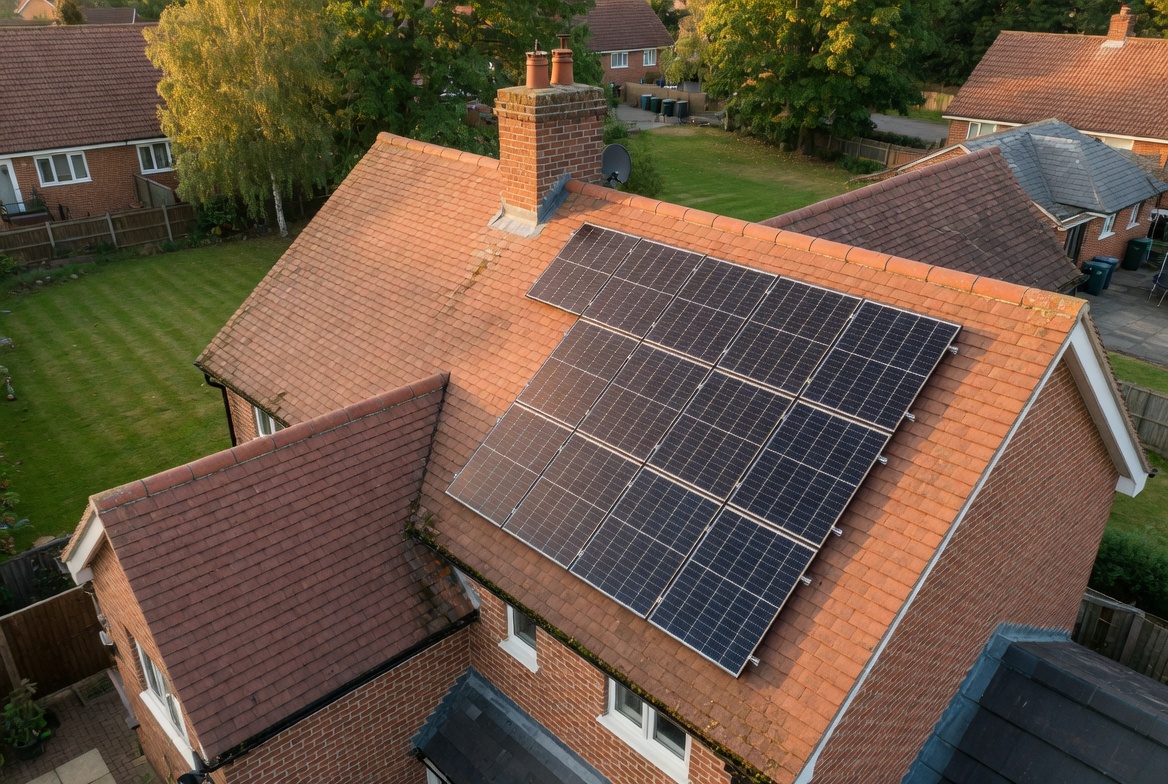
A standard array fitted on rails to a pitched roof sits about 15 centimetres off the tiles and well below the ridge, so it passes without any special design.
Panels in the garden
Ground-mounted or "stand-alone" arrays suit homes where the roof is shaded, faces the wrong way or can't take the weight. They have their own limits:
| Rule | Houses | Blocks of flats |
|---|---|---|
| How many | The first stand-alone array only | The first stand-alone array only |
| Size | Up to 9 square metres | Up to 9 square metres (3m by 3m) |
| Height | Up to 4 metres | Up to 4 metres |
| Near a boundary | Allowed within 5 metres if no taller than 2 metres, or 1 metre if it is in front of the house | Must be at least 5 metres from any boundary |
| Conservation areas | No taller than 2 metres if nearer the road than the house, and the council must approve it first | No taller than 2 metres if nearer the road than the building |
Nine square metres is about four or five panels, or roughly 2 kWp. Anything larger in a garden needs a planning application, which is why big ground-mounted systems are less common than rooftop ones.
Who still needs to apply
Listed buildings
You need listed building consent for panels on the building, and panels in its grounds are not permitted development either. Councils do grant consent, especially for hidden roof slopes, but apply before you sign a contract.
Conservation areas
Roof-mounted panels are usually fine. Panels on a wall facing the road are not. Some councils have removed permitted development rights locally with an Article 4 direction, so check.
Large or tall arrays
Garden arrays over 9 square metres, a second garden array, or equipment that rises above the roofline or more than 0.6 metres above a flat roof.
New-build estates
Some estates have a planning condition that removes permitted development rights. It will be in your purchase paperwork or on the council's planning register.
Needing permission doesn't rule solar out. It means a householder application, which costs £548 in England and usually takes about eight weeks. If you just want certainty that your plan is permitted development, a lawful development certificate costs £274.
Flats and leasehold homes
Permitted development for solar covers blocks of flats as well as houses, with slightly tighter limits. For a flat, planning is rarely the obstacle. The lease is. The roof and outside walls normally belong to the freeholder, so you need their written consent before anything is fixed to the building. The same goes for leasehold houses, where the lease may require consent for alterations.
For a balcony or plug-in kit, see is balcony solar legal in the UK?, which covers the landlord and freeholder side as well.
How to check your own property
Scotland, Wales and Northern Ireland
Planning is devolved, so the August 2026 changes apply to England only. Scotland, Wales and Northern Ireland each have their own permitted development rules for domestic solar. They follow the same pattern: rooftop panels within set limits don't need permission, and listed buildings and some conservation areas do. The detailed limits differ, particularly for flats and garden arrays, so check your council's guidance before you rely on the figures above.
What planning permission doesn't cover
Building regulations still apply. Planning and building regulations are different things. The roof has to be able to carry the panels and the electrical work has to be certified. An MCS-certified installer handles both as part of the job.
Your installer also has to notify the local network operator, under a process called G98 for small systems or G99 for larger ones. And keep the MCS certificate: you need it for export payments and when you sell. Our guide to things to know before installing solar panels covers the paperwork.
Plug-in solar now has permitted development status, but whether you can fit a kit yourself depends on separate product and wiring rules. Those are covered in our plug-in solar specification guide and the plug-in solar hub.
Frequently asked questions
Do I need planning permission for solar panels on my house?
Usually not. Solar panels on a house are permitted development as long as they stay within set limits, such as not rising above the highest part of the roof. You need permission if the building is listed, if the panels would go on a road-facing wall in a conservation area, or if the installation is outside the size limits.
What changed for solar planning rules in 2026?
In England, new permitted development rules took effect on 27 August 2026. Houses and flats now have separate rules, panels on house walls can project up to 0.4 metres, garden arrays can sit closer than 5 metres to a boundary if kept low, and plug-in solar is covered by name.
Do I need planning permission for solar panels in a conservation area?
Not for panels on a roof. In a conservation area you can't put panels on a wall that faces a highway under permitted development, and some councils remove the rights altogether with an Article 4 direction. Check with your council before you order.
Can I put solar panels on a listed building?
Not under permitted development. You need listed building consent, and usually planning permission as well. Councils do approve solar on listed buildings, particularly on roof slopes that can't be seen from the street, but you must apply first.
Do I need planning permission for solar panels in my garden?
Not for a first array of up to 9 square metres and no more than 4 metres high. For a house in England it can sit within 5 metres of the boundary if it is no taller than 2 metres. Larger or additional garden arrays need a planning application.
Does permitted development for solar apply to flats?
Yes. Blocks of flats are covered, with a 0.2 metre projection limit. The usual barrier is the lease, not planning: the roof and external walls belong to the freeholder, so you need their consent.
How much does a planning application for solar panels cost?
A householder planning application in England costs £548 from April 2026. A lawful development certificate, which confirms in writing that your plan doesn't need permission, costs £274. If your installation is permitted development there is no fee.
Do I still need to notify anyone about my installation?
Yes. Your installer notifies the local network operator under the G98 or G99 process and certifies that the work meets building regulations. Both apply whether or not you needed planning permission.
Which kind of quote suits you?
An MCS-certified installer checks your planning position as part of the survey and should confirm it in writing.
"I'd rather deal with one good installer" Get a quote from Blue Ape Renewables, the installer we work with. MCS-certified and NAPIT-accredited, fitting solar panels and batteries across England, Wales and Scotland. Get a quote →Tell us about your project and local installers will quote
Both are free and there's no obligation. We earn a commission if you go ahead with Blue Ape or with one of the installers you are matched with.
Related Guides
Published 26 July 2026, updated 2 October 2026. Based on the Planning Portal's guidance on the changes to permitted development rights for domestic solar in England, in force from 27 August 2026 (SI 2026/896), and the planning fee schedule from 1 April 2026. Rules depend on the property and on local designations, so confirm your own position with your council or installer before going ahead. This is general information, not planning advice.