
News · Solar · July 2026
Plug-In Solar UK: The Product Specification Is Here
The government has published the technical rulebook that defines a legal UK plug-in solar kit. Here are the confirmed rules straight from the document — and the one step that still has to happen before you can plug one into your socket.
Affiliate disclosure: Some links on this page may be affiliate links — if you buy through them we earn a small commission at no extra cost to you. This doesn't affect our recommendations.
The short version: The Department for Energy Security and Net Zero has published its Plug-in Solar Device Interim Product Specification (Version 2.0, July 2026) — the detailed technical rulebook defining exactly what a legal, self-installable UK plug-in solar kit must be. This is the piece everyone has been waiting for. It is not, on its own, the final green light: the enabling regulations must formally come into force and certified products must appear on the industry register before you can legally plug a kit into your socket. But it tells us precisely what those kits will look like — and confirms some rules that will surprise people.
What's actually been published
Plug-in solar — panels you mount on a balcony, wall or frame and connect to your home through a normal 13A plug socket, rather than having an electrician hardwire them — has been legal in principle in the UK since BS 7671 Amendment 4 came into force in April 2026. But "legal in principle" hasn't meant "plug one in yourself," because the UK had no product standard defining what a safe, compliant kit actually is. That gap is what this new specification fills.
The document is the technical and safety blueprint every UK plug-in solar product will have to meet. It's built on the German framework (DIN VDE V 0126-95) adapted for UK wiring, and it's detailed — covering everything from anti-islanding protection to fire performance to exactly how the plug must be built. For buyers, though, a handful of headline rules matter most.
What the consultation found
The plans drew 466 responses. 85% agreed with the product specification, 88% supported allowing a standard plug to be used, and 78% backed the government's fast timeline — driven partly by a desire to regularise the existing grey market of imported kits and let households benefit from the summer generation window. Support was broad across electricians, manufacturers, retailers and the public.
The rules that matter, confirmed
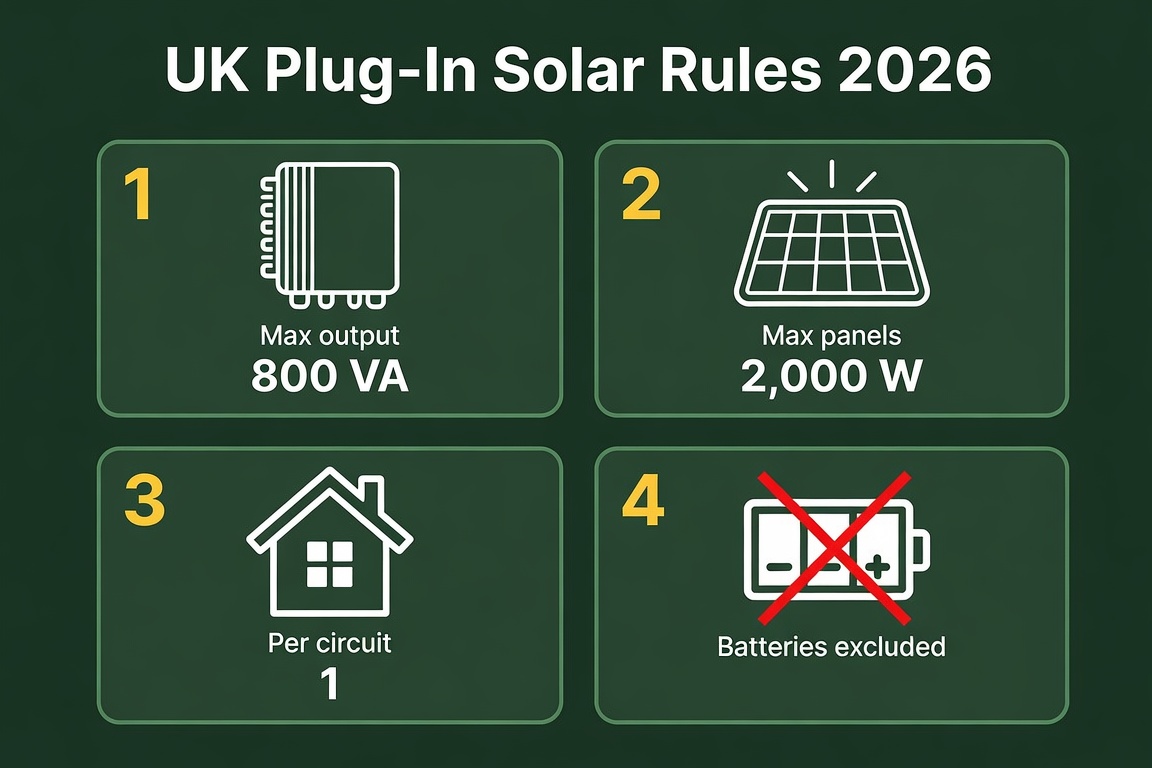
- Maximum 800 VA output.
The inverter can supply no more than 800 volt-amps to your home, with output current capped at 3.5 amps. This is the ceiling that keeps a plug-in kit safe on a normal ring circuit. - Up to 2,000W of panels — but with a caveat at 960W.
You can fit up to 2,000W of solar panels (the inverter simply caps output at 800VA). But above 960W of panels, manufacturers must advise you to get your electrical installation professionally assessed first. - One device per power circuit.
The government has confirmed the limit as one plug-in device per individual power circuit (each protected by its own breaker) — not one per whole household. Since most UK homes have at least two power circuits, you could eventually run more than one. Note: until a corresponding update to the G98 grid rules is made, an interim one-per-household limit still applies. - Straight into a wall socket — nothing in between.
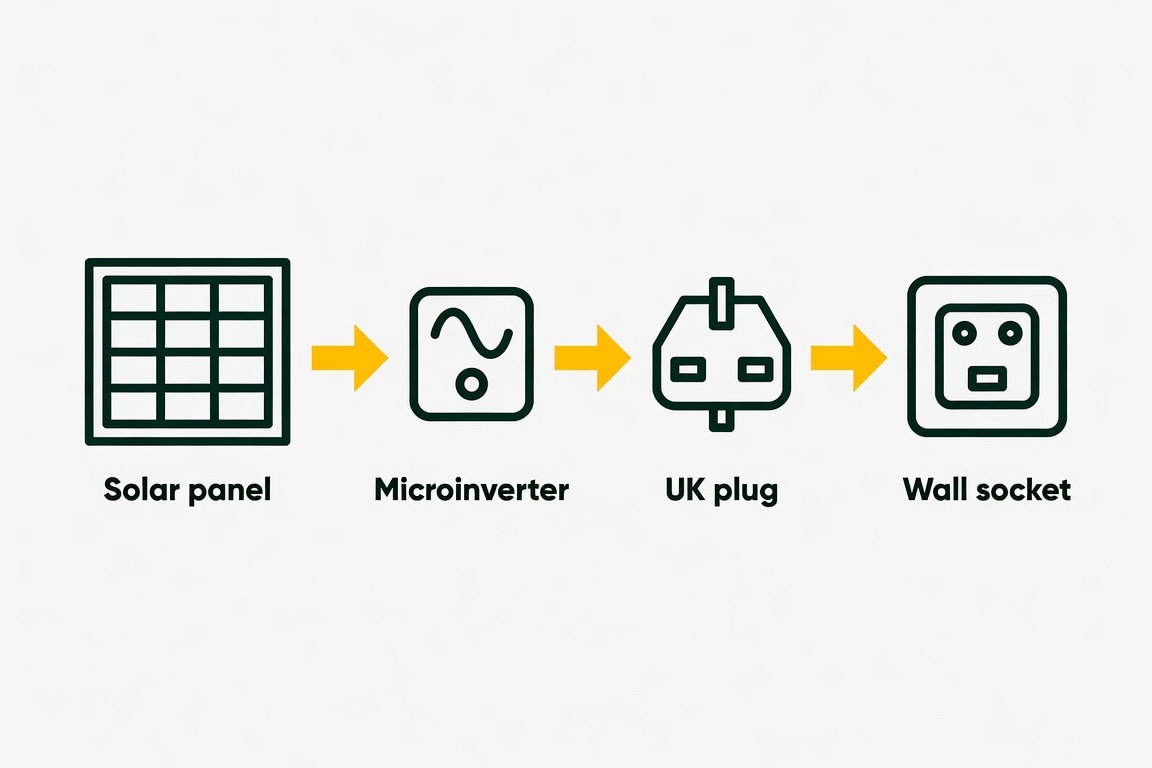
The kit must plug into a standard BS 1363 socket using the manufacturer's own fused plug. Extension leads, multi-way adaptors, travel adaptors and RCD adaptors are all explicitly banned. - Your fuse box has to be modern enough.
The rules assume a consumer unit with RCBO or RCD protection. If you've got an older fuse box, it must be checked and likely upgraded by an electrician before a kit can be used safely and compliantly. - You still have to tell your network operator.
Notifying your Distribution Network Operator via the G98 process remains mandatory for every device — even a single panel. It's a form, not an approval gate, but skipping it leaves you non-compliant.
The battery bombshell most coverage is missing
The specification explicitly and repeatedly excludes batteries. It does not apply to plug-in battery systems, or to plug-in solar devices integrated with battery storage. More than that: the rules require every compliant kit's instructions to carry a prominent warning that the device "is not intended to be connected to, operated with, or used in conjunction with a battery energy storage system." So when self-install does go fully live, it will be for solar panels and a microinverter only. A plug-in battery that feeds power into your home remains outside these rules and will still require professional installation.
The government's July 2026 consultation response makes clear this was a deliberate, contested decision. The exclusion of batteries was one of the most frequently raised objections from the 466 consultation respondents, many arguing it reduces the money-saving potential of plug-in solar. The government held firm for now, explaining that battery-integrated products "raise additional technical and regulatory issues that have not been assessed" yet — while confirming it will "continue to develop evidence" on them. So this is a "not yet," not a permanent "no." For today, though, any plug-in kit sold under the new rules is solar-only.
This matters because several retailers and guides have been telling people the opposite — that the plug-in rollout includes battery storage. The government's own document is unambiguous that it does not. If you're being sold a "plug-in solar battery" as part of this new framework, that's a claim worth questioning.
What still has to happen before you can plug one in
This is where accuracy matters, because it's easy to read "specification published" as "you can do it now." You can't quite, yet. Two things still need to fall into place:
1. The regulations must complete their passage through Parliament. In its July 2026 consultation response, the government confirmed it intends to lay a Statutory Instrument before Parliament very shortly, amending both the Plugs and Sockets (Safety) Regulations and the electricity safety regulations, with the final product specification published alongside it. This is the concrete legal step that makes socket connection lawful — it's now in motion rather than merely expected, but it isn't fully in force the moment you read this.
2. Actual products must be certified and registered. Under the specification, manufacturers must type-test each device and register it on the Energy Networks Association's Type Test Register before selling it. The document is explicit that submitting a product for registration is not the same as it being compliant. So even once the law is live, you'll need to buy a kit that's actually on the register — not just any imported balcony kit.
In practice: the direction is now completely clear, the technical rules are set, and genuine plug-and-play is close. But the fully compliant route today still runs through a qualified electrician, and the safest thing a buyer can do right now is choose a reputable system from a manufacturer positioned to certify quickly.
Getting ready to buy?
Our balcony solar guide covers the kits best positioned for the new UK rules, honest payback maths, and the connection options available right now — including the summer sale on the EcoFlow STREAM system.
Read the Balcony Solar Guide →See also: the complete balcony solar bundle · is balcony solar legal in the UK?
Published 16 July 2026. Based on the DESNZ Plug-in Solar Device Interim Product Specification (Version 2.0, July 2026) and the DESNZ Government Response to the plug-in solar consultation (July 2026), both Crown copyright under the Open Government Licence v3.0. Figures quoted directly from those documents. The enabling Statutory Instrument was in the process of being laid before Parliament at the time of writing; always check the current position on GOV.UK before installing.