
Buying Guide · Portable Air Conditioning
Unbranded Portable Air Conditioners on Amazon: How to Spot Fake Specs
Every heatwave, the named brands sell out and Amazon fills with "Generic" and no-name portable ACs claiming huge BTU numbers for small prices. Here is the 30-second sum that catches an impossible spec, and a checker that does it for you.
Last updated: 2 October 2026
Affiliate disclosure: some links on this page are affiliate links. If you buy through them we earn a small commission at no extra cost to you. We have no relationship with, and receive nothing from, the listings named below.
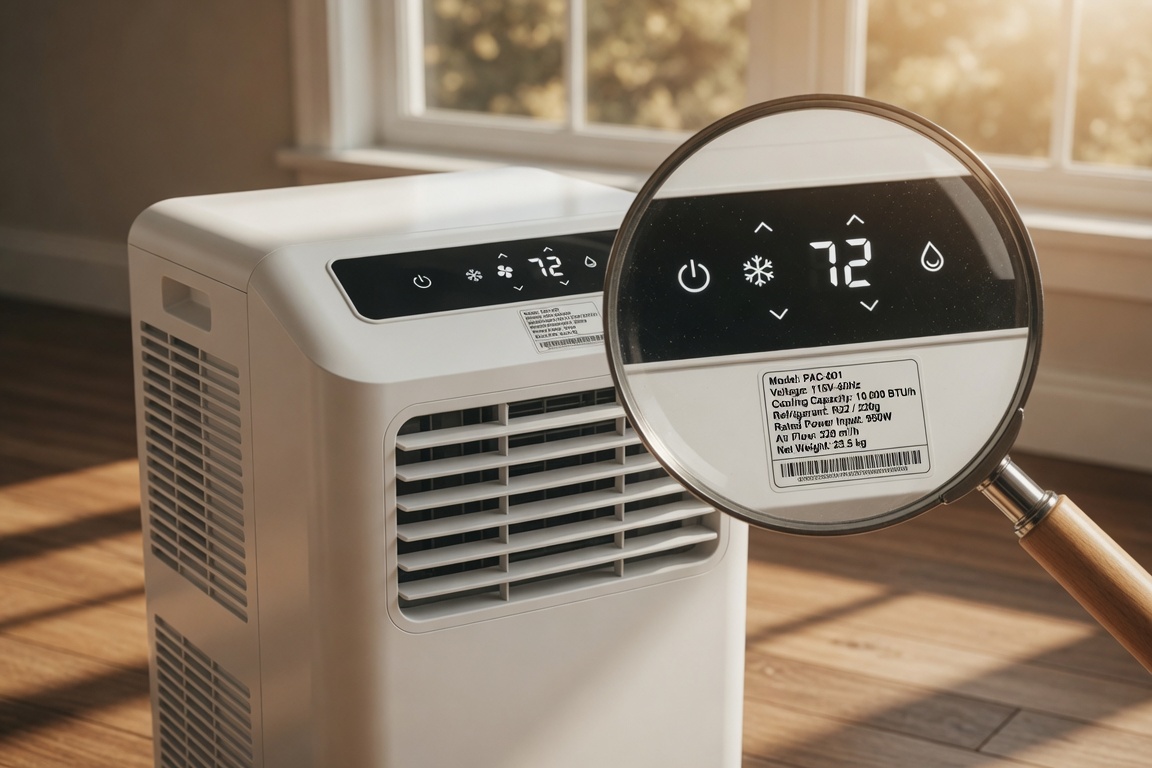
When Meaco, De'Longhi and the other named brands sell out in a heatwave, search results fill up with something else: the unbranded portable air conditioner, sold as "Generic" or under invented names nobody has heard of, promising big cooling power at bargain prices. Some are fine budget units. Some are physically incapable of doing what the listing claims. One sum tells them apart in under a minute.
Quick answer: real portable air conditioners produce roughly 8 to 10 BTU of cooling for every watt they draw. That ratio is called the EER. Divide the claimed BTU by the listed wattage. If the answer is well outside 8 to 10, one of the two numbers on the listing is wrong. We tested two real Amazon listings below and both failed, in opposite directions.
On this page:
Free Tool
Portable AC Spec Checker
Type in the two numbers from any listing. We'll tell you whether they can both be true.
Some listings give power in kW (1.2kW is 1,200 watts). If only a current is given, multiply the amps by 230. Running cost uses 26.32p per kWh.
The 30-second maths test
Every air conditioner has an Energy Efficiency Ratio, or EER: the cooling it produces, in BTU, for each watt of electricity it draws. It comes from how compressors and refrigerant work, so a seller can't invent a better one without the two headline numbers on the listing contradicting each other. Real UK portable air conditioners land at an EER of roughly 8 to 10. We checked six named-brand units from our portable AC guide, and every one fell inside that band:
| Unit | BTU | Power draw | EER | Cost per hour |
|---|---|---|---|---|
| SereneLife 7,000 | 7,000 | ~805W | 8.7 | 21p |
| NETTA 8,000 | 8,000 | ~920W | 8.7 | 24p |
| AuraHome 9,000 | 9,000 | ~1,000W | 9.0 | 26p |
| MeacoCool Pro 10,000 | 10,000 | ~1,150W | 8.7 | 30p |
| Meaco Cirro 12,000 | 12,000 | ~1,340W | 9.0 | 35p |
| DREO AC516S 12,000 | 12,000 | ~1,490W | 8.1 | 39p |
Power figures are approximate, from each unit's published power draw and running cost. Cost per hour at the October 2026 price cap of 26.32p per kWh.
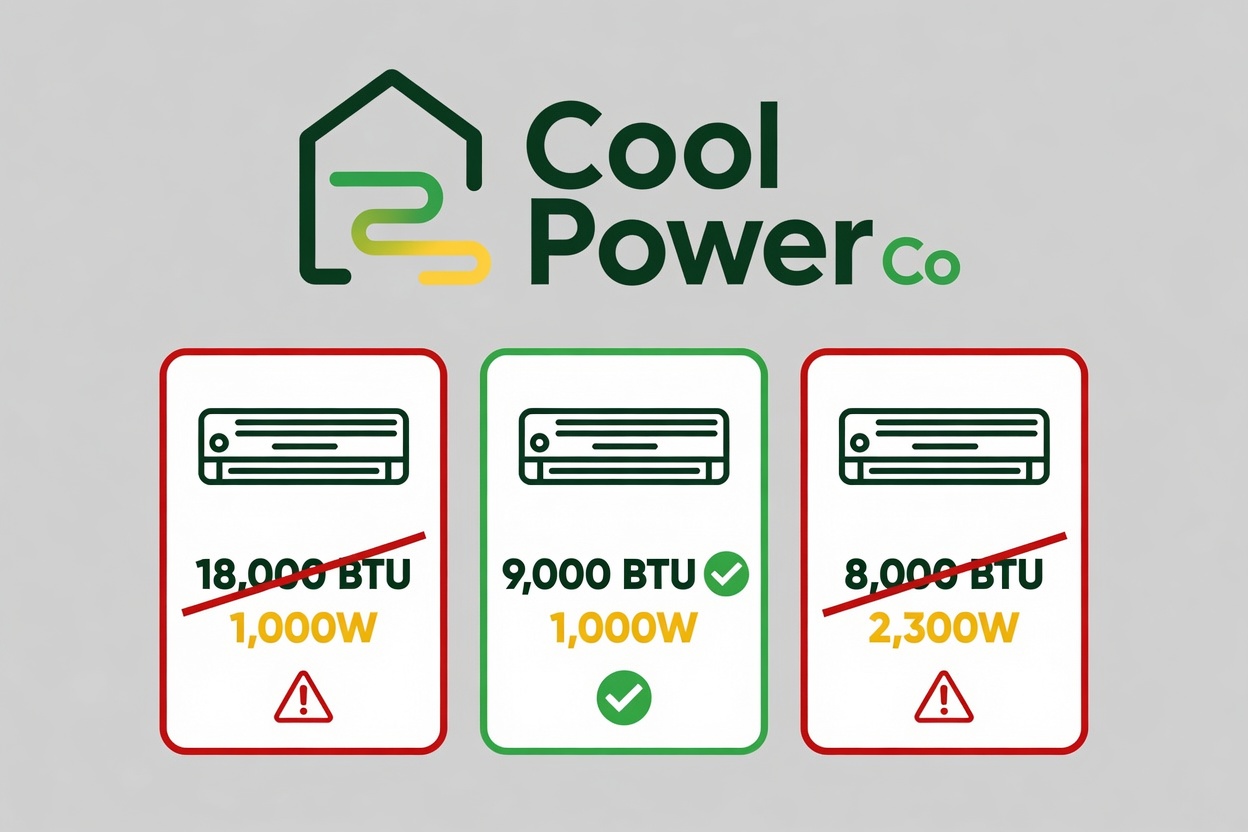
So the rule: take the claimed BTU and divide by 9, the middle of the real-world range, to get the wattage a real unit of that size should draw. If the listed wattage is far below that, the BTU claim is inflated. If it is far above, either the cooling is overstated or the wattage includes something else, usually a heating mode. Our guide to how air conditioning works explains BTU and EER in more detail.
Case study 1: "18,000 BTU" at 1,000W
A listing on Amazon UK for a brand called "UofZc" advertised an 18,000 BTU floor-standing unit, said to cool up to 550 sq ft (51m²), with a stated power of 1,000W and noise of 52dB.
The maths: 18,000 ÷ 9 = 2,000W expected. The listing claimed 1,000W, half of what a real 18,000 BTU unit draws.
That is an EER of 18, about double the best any portable air conditioner achieves, branded or not. It isn't physically plausible. At 1,000W this unit can produce around 8,000 to 10,000 BTU of real cooling. The 51m² coverage claim is inflated in the same proportion. A real 1,000W unit covers nearer 18 to 20m².
Case study 2: "8,000 BTU" at 2,300W
A second listing, with the brand field reading "Generic", advertised an 8,000 BTU unit for a bedroom or home office, covering 100 to 150 sq ft (about 9 to 14m²), priced at £600.99, with a stated power of 2,300W.
The maths: 8,000 ÷ 9 = about 890W expected. The listing claimed 2,300W, more than double.
That is an EER of 3.5, about a third of what real units achieve. A 2,300W draw at a normal EER would produce 18,000 to 23,000 BTU, not 8,000. Either the wattage includes a heating element the listing doesn't mention, or the real cooling is far below 8,000 BTU. At £600.99 it also cost more than twice as much as the branded, better-specified AuraHome 9,000 BTU in our portable AC guide.
The two listings fail in opposite directions. One understates the wattage to make the BTU sound bigger. The other gives a wattage that doesn't match any real compressor. Both are typical of specification pages assembled from a template, not from a tested product.
Other red flags worth checking
The brand is "Generic" or has no website
Search the brand name plus "reviews" outside Amazon. If nothing comes up beyond the listing itself, there is no company standing behind the warranty.
The bullet points describe a lifestyle
"Perfect for lounging, working or hosting gatherings" tells you nothing. Real listings state noise in dB, coverage in m², the refrigerant and the energy class, because they can back the claims up.
The reviews arrived in one cluster
Check the review dates. Dozens of 5-star reviews in the same week or two, with nothing before or since, is a classic paid-review pattern.
The seller has no UK trading history
Open the seller profile. A random alphanumeric name with no listings other than air conditioners in summer, and no years of trading, suggests a storefront that won't be there when you need a refund.
When an unbranded unit is fine
Not every no-name unit is a scam, and cheap doesn't mean fake. Several budget units we recommend, such as the AuraHome and the NETTA, are white-label products made by the same handful of factories that supply the big brands. The hardware is often the same. What differs is whether a real UK importer stands behind the listing and will answer a warranty claim, whether the specs pass the maths test, and whether the reviews are spread over months.
A £250 unbranded unit that passes all three checks is a reasonable budget buy. A £600 unit with impossible numbers on the spec sheet is not a bargain at any price. Prices also swing with the weather, which we tracked in our piece on portable AC resale markups. Autumn and winter are the cheap months to buy.
What to buy instead
A unit with specs that check out
Our portable AC guide lists real brands with verified specs and running costs. No maths test needed. Best portable air conditioners →
Improve the unit you already own
If you have a single-hose unit, a second hose made from ducting and tape gets 20% to 40% more effective cooling out of it for about £20. The dual-hose mod →
A ceiling fan
It costs about a penny an hour to run, is in stock all year, and makes a room feel cooler without lowering the temperature. Best ceiling fans →
Cool the room without a machine
Shading, night ventilation and a few cheap fixes do more than most people expect. Cooling without AC →
Frequently asked questions
Skip the guesswork
Our portable AC guide only features units with verified specs, real UK stock and running costs worked out at current prices.
See the Best Portable ACs →Related Guides
Published 13 July 2026, updated 2 October 2026. The EER range and power comparisons are based on the published power draw and running costs of named-brand units featured on this site. Running costs use the October 2026 price cap of 26.32p per kWh. The two listings were live on amazon.co.uk in July 2026. Listings, prices and sellers change often and may no longer match the details described. We have no commercial relationship with either listing or seller named in this article.