
Evaporative Cooler UK: Does It Actually Work?
After 15 years living in Thailand, Mexico, Brazil and Spain, I've used evaporative coolers in climates where they work brilliantly and climates where they do nothing. Here's the answer for the UK, with real weather data for your postcode.
Affiliate disclosure: some links on this page are affiliate links. If you buy through them we earn a small commission at no extra cost to you. It doesn't affect what we recommend.
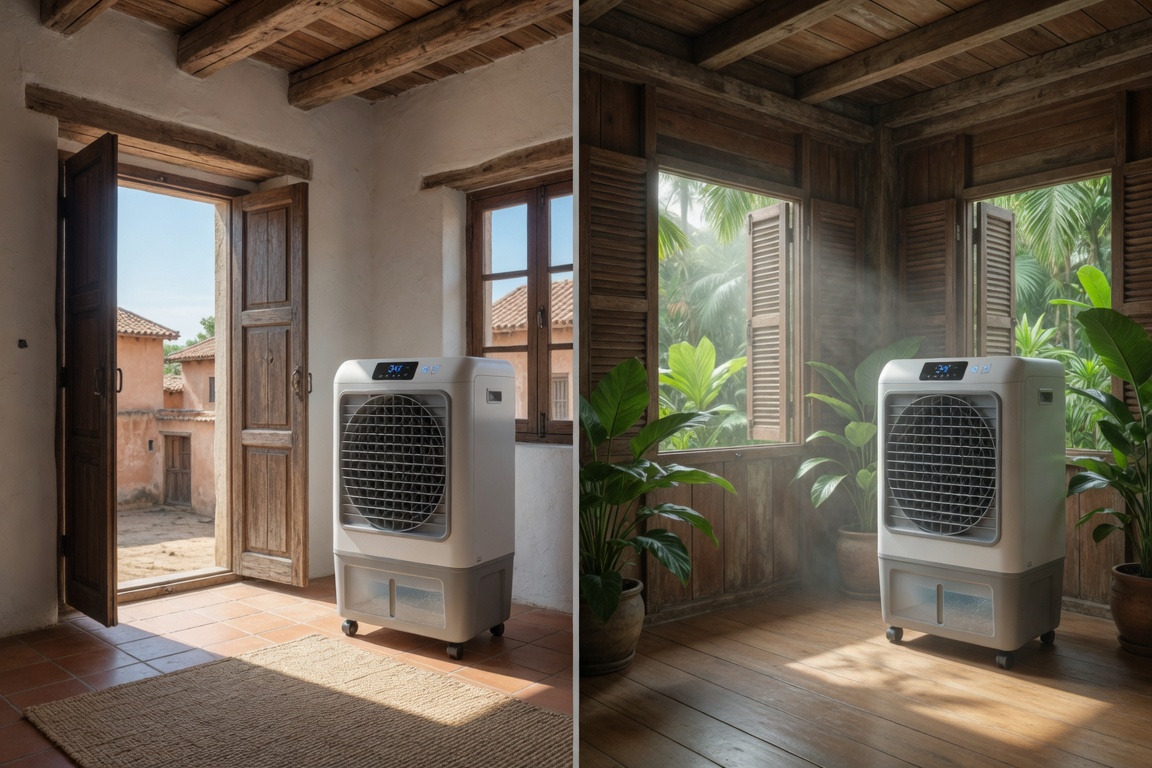
The same technology performs completely differently depending on humidity, which is why it is everywhere in Mexico and rare in Thailand.
I've spent the last 15 years living in Thailand, Mexico, Brazil and Spain, countries where many homes have no air conditioning but plenty have evaporative coolers, ceiling fans or both. In Mexico City, where the air is hot and bone dry for much of the year, an evaporative cooler can turn a stifling room into a comfortable one within minutes. In Bangkok, where humidity sits above 70% all year, I rarely saw anyone use one. They don't work there.
UK retailers sell evaporative coolers as a cheaper alternative to portable air conditioning, usually without explaining that limitation. The physics gives a clearer answer than the marketing does, and the UK result is better than the product's reputation and worse than the box suggests.
Quick answer: evaporative coolers do work in the UK on hot afternoons, because the air on a hot day in most of England is drier than people expect: about 35% to 45% relative humidity. In those conditions a cooler blows air 5°C to 7°C cooler than the room. They work poorly at night, when humidity climbs, in closed rooms, and in the wetter north and west. Treat one as a cheap way to take the edge off a hot afternoon, not as a replacement for air conditioning.
Free Tool
Would an Evaporative Cooler Work Where You Live?
Enter your postcode and we'll check recorded weather for your area: how many days were hot, and how dry the air was on those days.
How an Evaporative Cooler Works
An evaporative cooler, also called a swamp cooler, desert cooler or air cooler, works on a completely different principle from a portable air conditioner. There is no refrigerant, no compressor and no exhaust hose.
A fan draws warm air through a pad soaked with water. As the water evaporates it takes heat from the air, the same effect as feeling cold when you step out of a swimming pool on a hot day. The cooled, damper air is blown into the room.
The key difference from air conditioning
A portable AC removes moisture from the air and needs a closed room with a window for the exhaust hose. An evaporative cooler adds moisture and needs an open window or door. Run it in a closed room and the air turns swampy, which is where the nickname comes from.
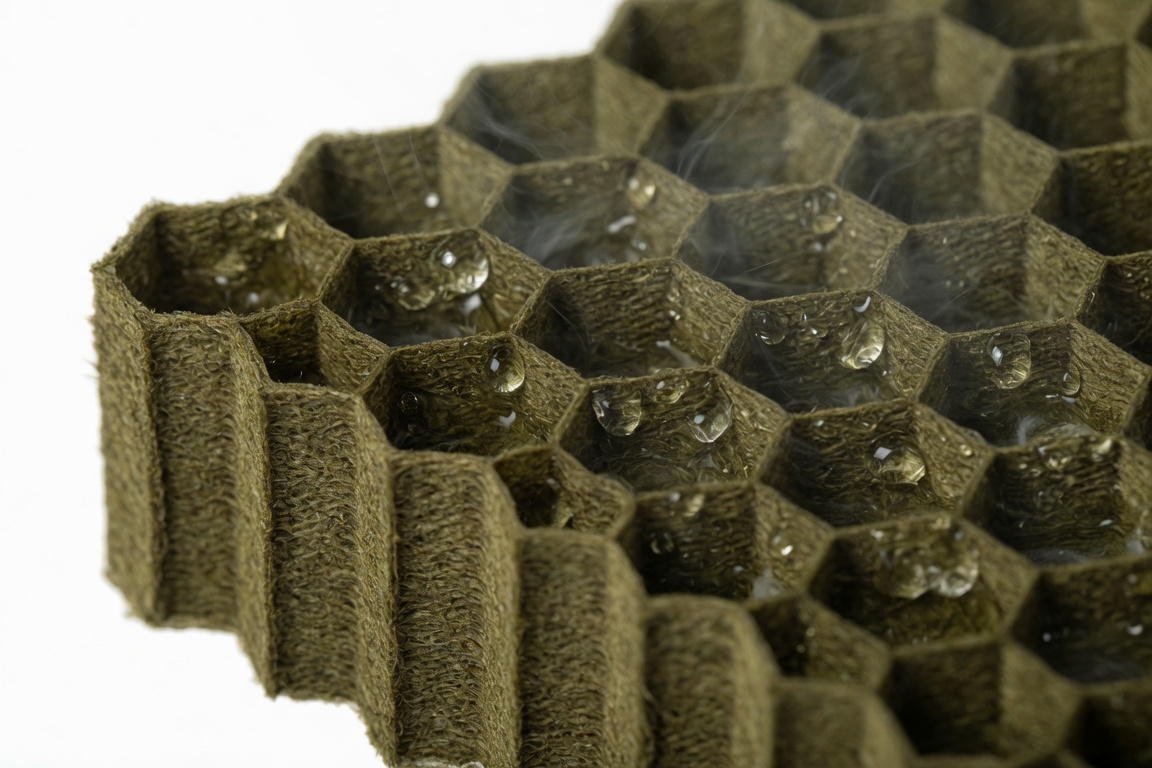
Warm air passes through a water-soaked pad, evaporation takes heat from the air, and cooler air is blown out.
Why Humidity Is Everything
Evaporation only happens when the air has room to take up more moisture. If the air is already humid, evaporation slows and so does the cooling. This is what a typical domestic cooler delivers in a 30°C room:
| Relative humidity | Air leaves the cooler about | Where you find this |
|---|---|---|
| 20% | 10°C cooler | Inland Mexico, Arizona, the Spanish interior in summer |
| 35% | 7°C cooler | A hot, dry afternoon in England |
| 50% | 5°C cooler | A warm, ordinary UK summer day |
| 65% | 4°C cooler | A UK summer night, or the west coast |
| 80% | 2°C cooler | Thailand, the Brazilian coast, a muggy UK evening |
Calculated for 30°C air and a pad that closes 70% of the gap to the wet-bulb temperature, which is typical for a domestic unit. Hotter, drier air gives a bigger drop: at 40°C and 15% humidity the same cooler manages about 13°C.
In Bangkok, where I lived for several years, humidity rarely drops below 70% even in the hottest months. A cooler there does almost nothing except make the air stickier. In Mexico City and inland Spain, where summer humidity sits at 20% to 35%, the same unit drops the air temperature by 8°C to 10°C.
The UK is usually described as too humid for these machines, and on average it is. But the average hides the hours that matter. Humidity falls as the day warms up, so the hottest afternoons are also the driest. We ran summer 2026 through the tool above for three cities:
| City, summer 2026 | Days that reached 25°C | Afternoon humidity on those days | Hot days dry enough |
|---|---|---|---|
| London | 59 of 92 | 38% | 54 of 59 |
| Manchester | 24 of 92 | 43% | 19 of 24 |
| Glasgow | 5 of 92 | 63% | 0 of 5 |
Summer 2026 was a hot one, so there were more hot days than usual, but the pattern holds for 2025 as well. In London and most of England the afternoon air on a hot day is dry enough for a cooler to work. In Glasgow there were hardly any hot days, and the few there were came with damp air. Where you live changes the answer, which is why the postcode tool is worth 20 seconds.
The Catch: Nights and Closed Rooms
Two things stop that from being the whole story.
Nights are humid
As the air cools after sunset, relative humidity climbs. On London's hot days in 2026 it averaged 38% in the afternoon and 66% overnight. That cuts the cooling from about 7°C to about 3°C, at the time most people in the UK want cooling: in the bedroom.
The room has to breathe
A cooler puts its whole tank of water into the air. With the windows shut, the humidity in the room rises within the hour and the cooling fades. You need a window or door open, which is no help if the reason you want cooling is that it is 32°C outside and you have closed up the house.
A cooler also only cools the air it blows at you. A 60 watt tower unit doesn't lower the temperature of a whole living room the way a 1,000 watt air conditioner does. Think of it as a fan that blows cooler air, not as a machine that cools a room.
What About the Ones With Ice Packs?
Many coolers sold in the UK, usually the smaller tower and desktop units, come with freezable ice packs or a compartment for ice cubes. They are still evaporative coolers working on the same wet pad and fan. The ice chills the water in the tank, so the air comes out slightly colder for the first 20 to 30 minutes.
It is a small effect. A couple of ice packs hold very little cooling compared with the heat in a room, and once they melt the unit performs like any other. Use them for a quick burst when you first sit down, and don't choose a model for its ice packs.
Practical tip: keep spare ice packs in the freezer and swap them every 30 to 45 minutes if you want the boost to last. Cold tap water in the tank does part of the same job with no effort.
Best Air Coolers Available in the UK
If an evaporative cooler suits your situation, for hot afternoons, occasional use or low-cost personal cooling, these are three well-reviewed options at different sizes and budgets. October to March is the cheap season for anything that cools, and stock is easy to find.
PELONIS 5L 3-in-1 Evaporative Air Cooler
2 ice packs included · Remote control · 28dB sleep mode · 2-year warranty
Fan, evaporative cooler and humidifier in one, with a slot for the two included ice packs. Its quiet sleep mode makes it one of the few air coolers you can run overnight, and the 2-year warranty is double what most rivals offer. Rated 4.3 stars from about 438 Amazon ratings when we checked.
SereneLife Portable Air Cooler 5L
Compact size · Easy-fill water tank · Low running cost
The lowest price on this list from a known brand. Good for a desk or bedside on a hot day. Don't expect it to cool a whole room, but for personal cooling at close range it does the job and costs about a penny an hour to run.
Midea 5L 3-in-1 Air Cooler
1,600m³/h airflow · 75° oscillation · Remote · 2 ice packs included
Airflow is what matters for covering a living room or open-plan space, and Midea's stated 1,600m³ an hour is far more than small desktop units move. Wide 75° oscillation and a remote control. Midea is one of the world's largest appliance makers, so support and spares are a known quantity.
When an Evaporative Cooler Works Well in the UK
When to skip it and buy a portable AC instead
Evaporative Cooler vs Portable AC
| Evaporative cooler | Portable AC | |
|---|---|---|
| Typical price | £50–£150 | £280–£550 |
| Power | 40–110 watts | 900–1,500 watts |
| Running cost per hour | 1p–3p | 24p–39p |
| Works whatever the humidity | No | Yes |
| Windows | Needs one open | Needs the room closed, with the hose out of a window |
| Moisture | Adds it | Removes it |
| Cools a whole room | No. Cools the air it blows at you | Yes |
| Best UK use | Hot, dry afternoons and occasional use | Any weather, regular use, bedrooms |
Running costs at the October 2026 price cap of 26.32p per kWh.
A Lesson From Mexico City
When I lived in Mexico City, plenty of people had no air conditioning. They could afford it. The dry climate made it unnecessary. A ceiling fan and an open window handled most days, and on the hot, dry afternoons of April and May an evaporative cooler did the rest: cheap, low-maintenance and very effective in that climate.
The lesson for the UK isn't "buy an evaporative cooler". It is to match the cooling method to the weather and not just to the temperature. A 30°C day at 70% humidity needs a different solution from a 30°C day at 35%, even though the thermometer reads the same.
Need cooling that works whatever the humidity?
We've reviewed and ranked the best portable air conditioners available in the UK. If you'd rather spend nothing, start with how to cool your home without AC.
See the Best Portable AC Units →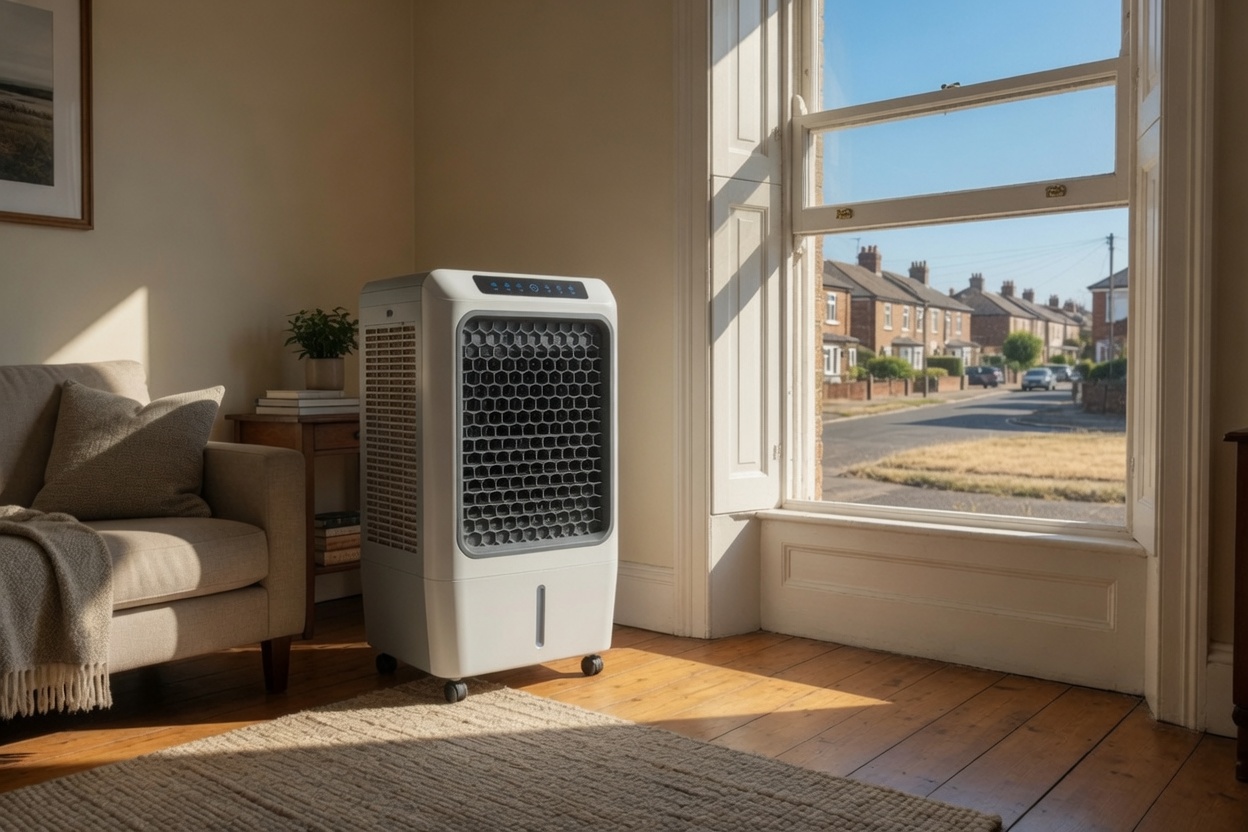
Placed next to an open window on a dry day, an evaporative cooler takes the edge off a hot UK room.
Frequently Asked Questions
Related Guides
For technical guidance, see the US Department of Energy guide to evaporative coolers.
Published June 2026, updated 2 October 2026. Temperature drops are calculated from wet-bulb temperature at 70% pad efficiency and vary by unit, airflow and ventilation. City figures are recorded weather for June to August 2026 from Open-Meteo's historical archive. Product prices and ratings were correct when checked and will change. Personal experience reflects the author's time living in Thailand, Mexico, Brazil and Spain. Cool Power Co is an independent comparison site.
Need Reliable Cooling Whatever the Weather?
A portable AC works regardless of humidity. See our comparison of the best units available in the UK.
See the Best Portable AC Units →