
Buying Guide
🆕 June 2026
How Does Air Conditioning Work in the UK? BTU, EER and Cooling Explained
Most UK buyers pick the wrong AC unit because they don’t understand BTU. Here’s the plain English guide — no jargon, no filler.
⏱️ 7 min read
✍️ Cool Power Co Editorial
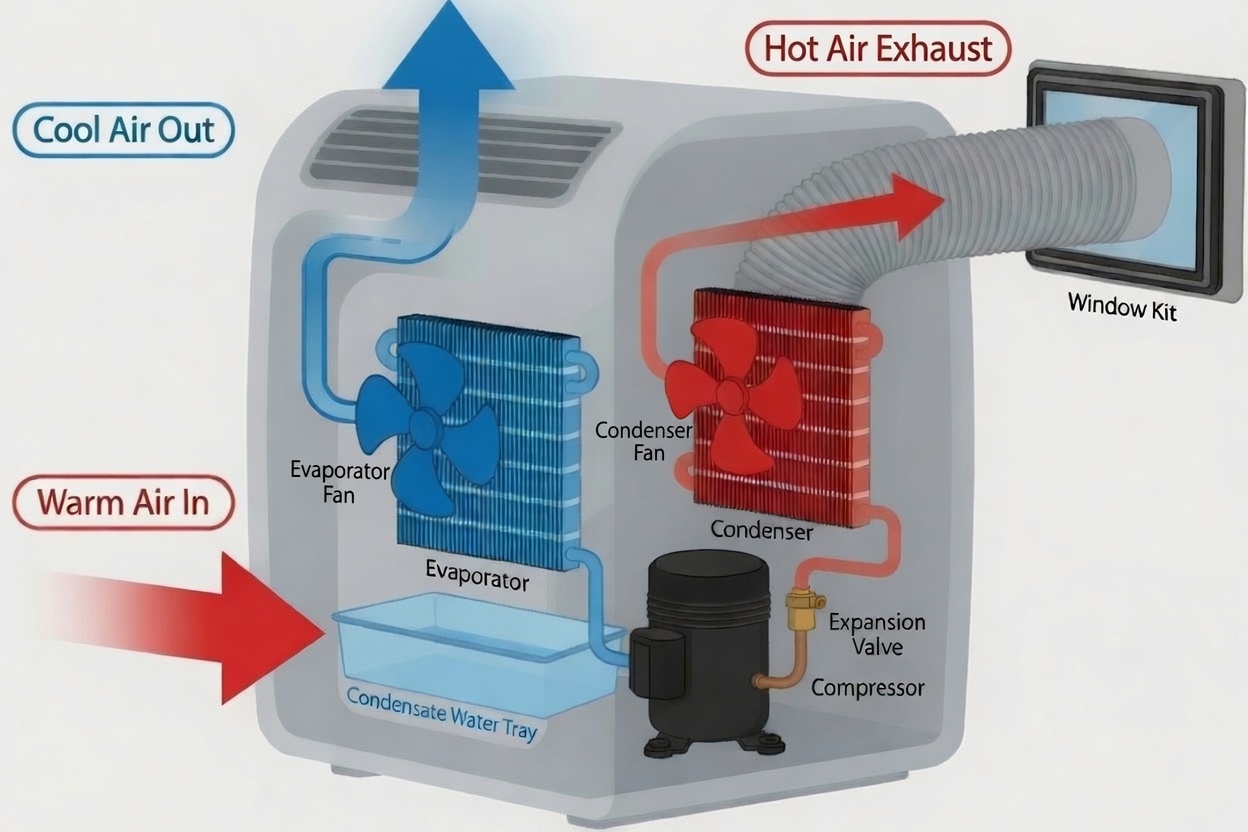
Understanding how air conditioning works makes it much easier to choose the right unit and avoid expensive mistakes.
Every summer UK homeowners buy air conditioners that are too small, too loud, too expensive to run — or completely wrong for their room. Almost all of these mistakes come down to one thing: buying based on price and looks without understanding the basics.
How Does Air Conditioning Work UK. This guide covers exactly how air conditioning works, what BTU actually means, how to read energy ratings, and how to avoid the most common mistakes UK buyers make. Read this before you spend a penny.
How Does Air Conditioning Work UK
Air conditioning doesn’t create cold air. It moves heat. That’s the fundamental thing most people don’t realise — an AC unit is essentially a heat pump that takes heat from inside your room and transfers it outside.
Here’s how it works in plain English, step by step:
-
1
Warm air is pulled in
A fan draws warm air from your room over cold refrigerant coils inside the unit. The refrigerant absorbs the heat from the air — cooling the air down. -
2
Cool air is blown back into the room
The now-cooled air is circulated back into your room. The temperature drops. This is the bit you feel. -
3
The refrigerant carries the heat to the compressor
The refrigerant — now warm and carrying all that absorbed heat — travels to the compressor. The compressor pressurises it, which raises its temperature further. -
4
The heat is expelled outside
Hot refrigerant passes through condenser coils — either outside the building (split system) or through a hose to a window (portable unit). The heat is released outside. The refrigerant cools back down and the cycle repeats.
The key insight: Air conditioning doesn’t destroy heat — it relocates it. Your room gets cooler because the heat has been moved outside. This is why every AC unit produces hot air from its exhaust — that’s where the heat went.
The refrigerant cycle is the heart of every air conditioning system — from a portable unit to a large commercial installation.
What Is BTU — and Why Does It Matter?
BTU stands for British Thermal Unit. It’s a measure of energy — specifically, the amount of heat needed to raise one pound of water by one degree Fahrenheit. In air conditioning, BTU per hour measures how much heat the unit can remove from a room per hour.
The higher the BTU, the more powerful the unit. But bigger is not always better — and this is where most UK buyers go wrong.
❌ Too few BTU
The unit runs constantly at full power and never cools the room to your target temperature. Your electricity bill goes up but you’re still hot. Very common mistake.
❌ Too many BTU
The unit cools the room too fast, switches off, then the temperature rises, then it switches on again — cycling constantly. You get cold and clammy rather than comfortably cool.
How to Calculate the BTU You Need
The standard rule for UK homes is 350 BTU per square metre. Measure your room’s length and width in metres, multiply together to get m², then multiply by 350.
Example calculation
Bedroom: 4m × 3.5m = 14m² × 350 = 4,900 BTU needed → choose an 8,000 BTU unit as the closest standard size above.
Then adjust upward for these factors which are very common in UK homes:
- +10%South or west facing room — gets afternoon sun, heats up more
- +10%Room is a kitchen — cooking generates significant heat
- +10%More than 2 people regularly in the room — bodies generate heat
- +15%Top floor flat or room directly under roof — radiant heat from roof is significant
- +25%Conservatory — essentially a greenhouse, needs significantly more cooling capacity
Quick BTU Reference Table for UK Rooms
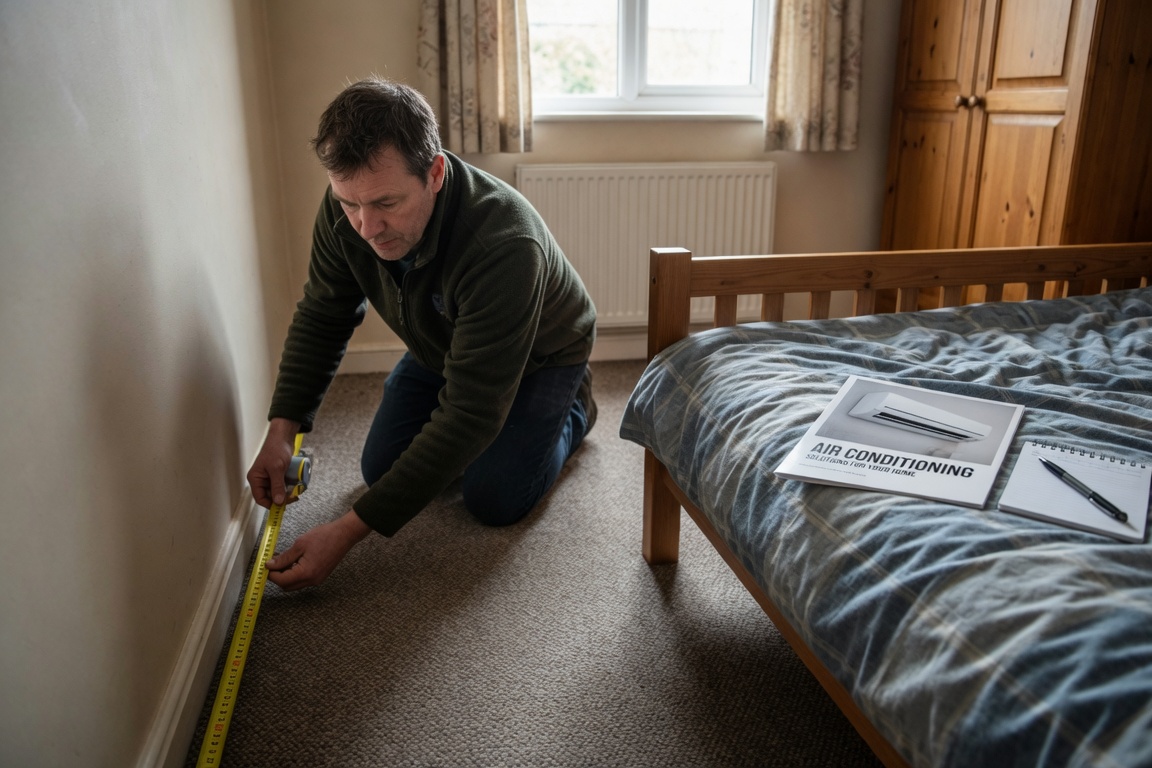
Measuring your room before buying is the single most important step — and the one most UK buyers skip.
What Is EER — Energy Efficiency Rating?
EER stands for Energy Efficiency Ratio. It measures how much cooling you get per watt of electricity consumed. The formula is simple: EER = BTU output ÷ watts input.
A higher EER means the unit is more efficient — it delivers more cooling per penny of electricity. On UK energy bills at 26p/kWh, EER makes a real difference to running costs over a summer.
⚠️ Warning on BTU claims: Some cheaper portable AC units advertise inflated BTU figures using the old ASHRAE standard rather than the newer SACC (Seasonally Adjusted Cooling Capacity) standard. A unit claiming 12,000 BTU under the old standard may only deliver 8,000 BTU effective cooling under real conditions. Always check whether the BTU figure stated is SACC-rated — reputable brands like Meaco and De’Longhi are transparent about this.
Types of Air Conditioning — Which Is Right for You?
Portable AC units
Freestanding units that connect to a window via an exhaust hose. No installation required — plug in and go. Best for renters and occasional use. Less efficient than split systems and noisier. The hot exhaust hose means a small amount of outside air is drawn back in through gaps, reducing efficiency.
Portable
Less efficient
Noisier
Split system (wall-mounted)
An indoor unit on the wall connected to an outdoor compressor unit via refrigerant pipes through a small hole in the wall. Requires professional F-Gas certified installation. Significantly more efficient and quieter than portable units. The right long-term choice for homeowners who use AC more than a few weeks per year.
Quietest
7–12p/hr running cost
Needs installation
Multi-split system
One outdoor unit connected to multiple indoor units — cooling several rooms simultaneously. Ideal for cooling an entire floor or house without multiple outdoor units. Higher upfront cost but the most efficient solution for whole-home cooling.
One outdoor unit
Higher upfront cost
Why UK Homes Are Different
Air conditioning was designed for climates that are hot for months at a time. The UK is different — we get heatwaves of 5–14 days rather than sustained heat. This changes the economics significantly.
- →UK homes have poor heat rejection — solid brick walls retain heat overnight, meaning bedrooms stay hot even when outside temperature drops. This is why so many people in the UK struggle to sleep during heatwaves even when it’s cooler outside.
- →UK summers are unpredictable — buying a large expensive split system for a country that might have two hot weeks in a year is a different calculation from Spain or Southern France.
- →UK electricity is expensive — at 26p/kWh (rising to the same in July 2026 cap), running an inefficient AC unit costs significantly more here than in countries with cheaper electricity.
- →UK planning rules — outdoor split system units in conservation areas or some flats may require permitted development permission. Check with your local council before installing.
5 Common Mistakes UK Buyers Make
❌ Mistake 1 — Buying based on price alone
A cheaper unit with a lower EER rating will cost more to run within a single summer than the price difference between it and a more efficient model. Always calculate running cost alongside purchase price.
❌ Mistake 2 — Not measuring the room
The single most common cause of disappointment. An 8,000 BTU unit will not cool a 30m² living room on a hot day — it will run constantly and barely make a dent.
❌ Mistake 3 — Ignoring noise levels
A 65dB portable AC in a bedroom is the equivalent of a loud conversation running all night. Always check the dB rating before buying for bedroom use — anything above 55dB will disrupt sleep for most people.
❌ Mistake 4 — Not accounting for solar gain
A south-facing room with large windows can receive enormous amounts of solar heat on a summer afternoon. Buying by m² alone without accounting for window size and orientation leads to an underpowered unit.
❌ Mistake 5 — Leaving doors and windows open
An AC unit is cooling a defined space. Open a door and you’ve doubled or tripled the volume it needs to cool. Keep the room sealed while the AC is running — close curtains on sun-facing windows too to reduce solar gain.
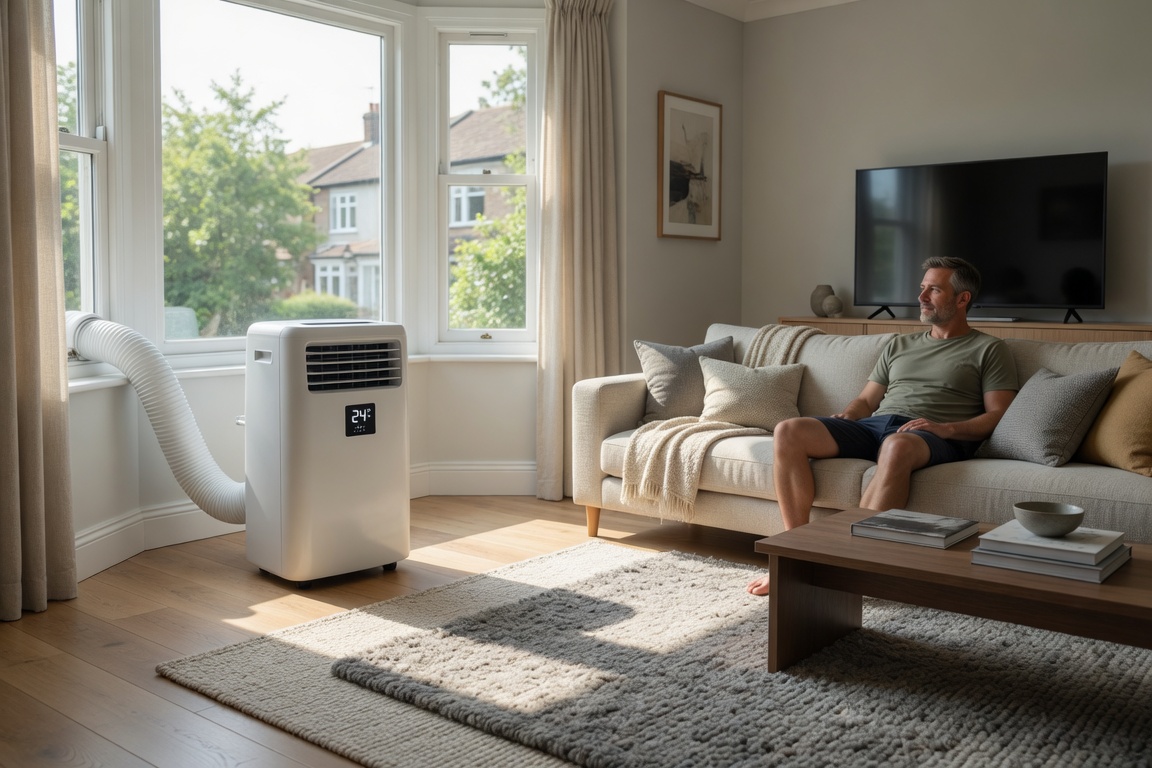
A portable AC unit works best in a sealed room — close doors, windows and curtains on sun-facing walls for maximum effectiveness.
Quick Summary — What to Remember
- ✅AC moves heat — it doesn’t create cold air
- ✅BTU measures cooling power — use 350 BTU per m² as your baseline
- ✅EER measures efficiency — higher is better, look for 3.0+ minimum
- ✅Measure your room before buying — always
- ✅Add 10–25% for south-facing rooms, top floors and kitchens
- ✅Portable units — easy but less efficient. Split systems — more efficient but need installation
- ✅Keep the room sealed when running — doors, windows and sun-facing curtains closed
Ready to choose your AC unit?
We’ve reviewed and ranked the best portable air conditioners available in the UK right now — with honest BTU ratings, noise levels, running costs and links to check current prices.
Related Guides
For technical standards on energy efficiency ratings, see the UK Government guidance on energy-related product regulations.
Published June 2026. BTU and EER guidance based on UK industry standards and manufacturer specifications. Running cost figures based on Ofgem July 2026 price cap electricity rate of 26.1p/kWh. Room size guidance is illustrative — actual requirements vary by insulation, ceiling height, window size and solar exposure. Always consult product specifications before purchasing. Cool Power Co is an independent comparison site.
Need a Permanent Cooling Solution?
A split system AC is quieter, more efficient and cheaper to run than any portable unit. Get free quotes from F-Gas certified local installers.
✅ Free · ✅ No obligation · ✅ F-Gas certified installers only