
Updated 18 October 2026: prices checked with each manufacturer or retailer on 18 October.
Damp · Mould · Condensation · Drying Clothes
Best Dehumidifiers UK 2026: 5 Picks for Damp, Mould and Drying Clothes
The five best dehumidifiers in the UK for damp, mould, condensation and drying clothes indoors, compared on what actually matters in a cold UK home: real extraction, noise, and what they cost to run at October 2026 prices.
See Our PicksAffiliate disclosure: Some product links on this page may be affiliate links. If you buy through them we earn a small commission at no extra cost to you. This doesn't affect our recommendations.
Quick answer: The best dehumidifier in the UK for most homes is the Pro Breeze 20L (£179.99): big capacity, a laundry mode and about 8p an hour to run. If you want the quietest and cheapest to run, get the MeacoDry Arete One 10L (£159.99) at 35dB and about 4p an hour, or its bigger sibling the Arete One 20L (£259.99) for a larger, damper home. The DREO 512S is the smart, app-controlled pick, and the De'Longhi Tasciugo AriaDry Multi is best for allergies.
Jump to the best dehumidifier for: drying clothes · bedrooms · damp walls and mould · a whole home · garages and cold rooms
The Best Dehumidifiers in the UK Right Now
All five are compressor dehumidifiers, the right type for a heated UK home. We've compared them on the manufacturers' own published specs and checked prices with each brand on 18 October 2026.
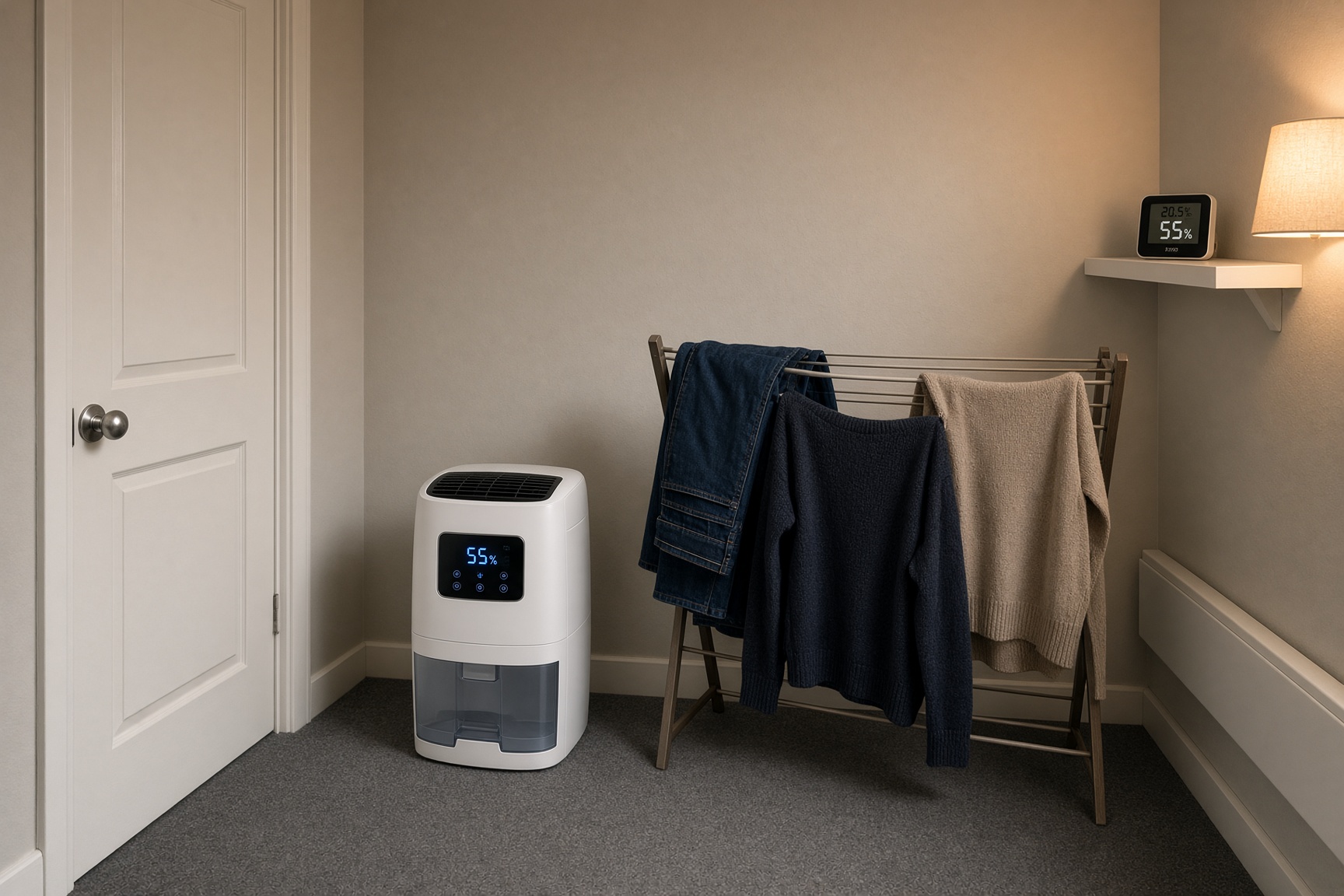
| Model | Best for | Extraction | Noise | Running cost | Price |
|---|---|---|---|---|---|
| Pro Breeze 20L | Best overall / laundry | 20L/day | ≤48dB | ~8p/hr | £179.99 |
| MeacoDry Arete One 10L | Quietest / cheapest to run | 10L/day | 35dB | ~4p/hr | £159.99 |
| MeacoDry Arete One 20L | Larger homes | 20L/day | 38dB | ~6p/hr | £259.99 |
| DREO 512S | Smart & quiet | 20L/day | 38dB | ~9p/hr | £189.99 |
| De'Longhi AriaDry Multi | Allergies | 14L/day | 40dB | ~8p/hr | £299.99 |
Pro Breeze 20L Dehumidifier with Laundry Mode
20L/day · Laundry mode · 5.5L tank · Continuous drainage · Up to 30m²
A big-capacity 20-litre dehumidifier with a dedicated laundry mode, at £179.99 when we checked on 18 October. It has the biggest tank here (5.5L), so you empty it less often, plus a hose for continuous drainage if you want to leave it running in a damp room for days. A strong airflow of 195m³/h and a one-touch laundry mode make it quick at drying washing, and auto mode holds the room at 40–60% humidity. It suits bigger rooms, whole-house condensation or a family doing several loads a week.
Buying direct from Pro Breeze: free UK delivery, a 1-year warranty with postage covered on claims, and an optional 3-Year Protection Plan at checkout.
It's the loudest here: Pro Breeze rates it at up to 48dB, and some owners say it's noticeable in a bedroom at night. Use the sleep mode or run it while you're out.
MeacoDry Arete One 10L Dehumidifier & Air Purifier
10L/day · 35dB · HEPA air purifier · Laundry mode · 5-year warranty
The quietest and cheapest dehumidifier to run on this page. It uses about half the electricity of the 20L units (151W in a heated room, around 4p an hour), runs at just 35dB, and doubles as an air purifier with a HEPA filter. Meaco is also the most open brand about performance: it publishes extraction figures for real UK conditions, not just the warm lab test. In a heated room it removes about 4.3 litres a day, enough to deal with a load of washing overnight. It has a laundry mode, a 2.5L tank and a continuous drainage option. Best for bedrooms, flats and smaller homes up to 42m².
Buying direct from Meaco: a 5-year parts and labour warranty, the longest here, and support from Meaco's UK team.
If you want a little more capacity without going up to 20 litres, Meaco also sells an Arete One 12L.
MeacoDry Arete One 20L Dehumidifier & Air Purifier
20L/day · 38dB · HEPA air purifier · Laundry mode · 4.8L tank · 5-year warranty
The one to choose for a bigger, damper home. In a heated room it removes about 8.5 litres a day, roughly twice the 10L model, while still using less power than the other 20L units here: 216W, about 6p an hour. It's as quiet as the DREO at 38dB, has the same HEPA air purifier and laundry mode as the smaller Meaco, and a 4.8L tank with a continuous drainage option. It costs £80 more than the Pro Breeze, but you get a much longer warranty and lower running costs.
Buying direct from Meaco: a 5-year parts and labour warranty and support from Meaco's UK team.
DREO Smart Dehumidifier 512S
20L/day · 38dB · WiFi app control · Auto mode · Dual drainage
The same 20L size as the Pro Breeze but much quieter at 38dB, and the only unit here with full WiFi app control. You can check humidity and switch it on from your phone, and its intelligent auto mode adjusts to the room. It drains into its bucket or through a continuous-drain hose. At 355W it's the most power-hungry of the four, costing about 9p an hour. At £189.99 when we checked on 18 October it was £10 more than the Pro Breeze, so it is worth the extra if you want a quieter machine with app control, at a slightly higher running cost.
De'Longhi Tasciugo AriaDry Multi 14L
14L/day · 3-stage filtration · Asthma & Allergy certified · Laundry mode · R290
The pick if anyone at home has asthma or allergies. It's the only unit here with independent Asthma & Allergy Friendly certification, and its three filters (dust, allergen and active carbon) clean the air as it dries it, which also helps with musty smells. It has a dedicated laundry mode, a built-in hygrometer and thermometer, continuous drainage and eco-friendly R290 refrigerant, and it's reasonably quiet at 40dB.
Buying direct from De'Longhi: 30-day returns for a refund, the full manufacturer warranty, and free delivery in 1–3 working days.
It's full price at £299.99 at the moment. It sold for £189.99 in August, so if you're not in a hurry, it's worth waiting for another sale.
Drying washing indoors this winter?
Our step-by-step guide shows how to set up a room so your clothes dry fast and the moisture ends up in the tank, not on your walls.
Read the Drying Guide →Best Dehumidifier for Every Room and Job
The right dehumidifier depends on what you need it for. Here's our pick for each of the most common jobs.
Best dehumidifier for drying clothes (laundry mode)
Our pick: Pro Breeze 20L
If you are looking for a laundry dehumidifier, this is the one. Its one-touch laundry mode, strong 195m³/h airflow and 5.5L tank make it the quickest here at drying a load indoors, usually in 4–6 hours with the door closed. For a small room overnight, the Meaco Arete One 10L also has a laundry mode and costs about 24p a load. Four of the five picks have a dedicated laundry mode (the DREO uses its auto mode instead), and all of them dry washing for less than a tumble dryer (about 66p a load). See our full guide to drying clothes indoors without damp.
Best dehumidifier for a bedroom: small and quiet
Our pick: MeacoDry Arete One 10L
At 35dB it's quiet enough to leave running while you sleep, it's compact, and it costs about 4p an hour. It suits bedrooms, box rooms and flats up to 42m². For a large or very damp bedroom, the DREO 512S removes more water at a still-quiet 38dB.
Best dehumidifier and air purifier (2-in-1)
Our pick: MeacoDry Arete One 10L or 20L
Both Meaco Arete One models combine a dehumidifier with a HEPA air purifier, so one machine removes moisture and filters dust, pollen and mould spores. That makes them a good choice for allergy sufferers, homes with pets, or anyone who'd rather not run two appliances. The De'Longhi Tasciugo AriaDry Multi is the alternative: it uses three-stage filtration (dust, allergen and active carbon) rather than HEPA, and it's independently certified as asthma and allergy friendly.
Best dehumidifier for damp walls and mould
Our pick: Pro Breeze 20L or Meaco Arete One 20L
For a room with damp walls or recurring black mould from condensation, you want capacity and continuous drainage so it can run for days without stopping. Both 20L units have a drainage hose option; the Meaco uses about a third less electricity, and the Pro Breeze is £80 cheaper. Clean off existing mould first (see our black mould guide), and check it's condensation rather than rising or penetrating damp, which a dehumidifier can't fix.
Best dehumidifier for bathrooms
Our pick: An extractor fan first, then a compact unit outside the door
An extractor fan is the proper fix for a steamy bathroom, because it removes moisture at the source. Plug-in dehumidifiers aren't designed for wet areas, and you shouldn't run an extension lead into a bathroom. If condensation spreads to the landing or a neighbouring bedroom, a compact unit like the Meaco Arete One 10L, run just outside the bathroom with the door open for an hour after showering, deals with it quietly and cheaply.
Best dehumidifier for a whole home or large house
Our pick: MeacoDry Arete One 20L
It removes about 8.5 litres a day in a heated room, twice the 10L model, for around 6p an hour, and has a 4.8L tank plus a 5-year warranty. On a tighter budget, the Pro Breeze 20L covers rooms up to 30m² for £179.99.
Best dehumidifier for garages, conservatories and cold rooms
Our pick: A desiccant dehumidifier
Compressor dehumidifiers, including all five above, lose most of their extraction below about 15°C. For an unheated garage, conservatory, caravan or holiday home, choose a desiccant model instead. They cost more to run, but keep working in the cold. Our desiccant dehumidifier guide compares three, including the Pro Breeze 10L, which was in stock at £199.99 when we checked, and the Meaco DD8L Pro.
Dehumidifier Buying Guide UK
What actually matters when choosing a dehumidifier for damp, condensation and laundry in a UK home.
How a dehumidifier works
A dehumidifier draws damp air from the room, pulls the moisture out and collects it as water in a tank, then blows drier air back out. Keeping humidity between 40% and 60% stops condensation forming on cold windows and walls, which is what leads to black mould, musty smells and peeling paint. It won't fix leaks or rising damp, but for the condensation that causes most damp in UK homes, it's the most direct fix you can buy. Our guide to what a dehumidifier does explains how the two types work, where to put one and how long it takes.
1. Compressor or desiccant?
There are two types. Compressor dehumidifiers work like a small fridge: they cool the air so the moisture condenses into the tank. They're the most efficient choice in a normally heated home at 15°C and above, and they're what all five of our picks use. Desiccant dehumidifiers absorb moisture with a heated material instead. They keep working well in the cold, so they suit unheated garages, conservatories and holiday homes, but they typically draw 300–650W, so they cost more to run. Choose one only if the room stays below about 15°C through winter. Our desiccant dehumidifier guide has three picks and their running costs.
| Compressor | Desiccant | |
|---|---|---|
| Best for | Heated homes (15°C+) | Cold rooms (below ~15°C) |
| Typical power | 130–360W | 300–650W |
| Running cost | ~3–9p/hr | ~8–17p/hr |
| Noise | Quieter at low speed; compressor hum | No compressor; fan noise only |
| Side effect | Adds a little warmth to the room | Adds noticeable warmth |
2. What size do you need?
Dehumidifiers are sized by how many litres of water they can remove per day. Bigger isn't always better: a larger unit removes water faster, but costs more and is usually louder.
| Your home | Size | Our pick |
|---|---|---|
| Flat, bedroom or 1–2 bed home, mild condensation | 10L/day | MeacoDry Arete One 10L |
| 2–3 bed home, allergies or musty smells | 12–14L/day | De'Longhi AriaDry Multi |
| 3–4 bed house, visible mould, daily laundry | 20L/day | Pro Breeze 20L, Meaco Arete One 20L or DREO 512S |
| Very damp property or suspected rising damp | Find the cause first | Diagnose the damp → |
3. Why "20 litres a day" isn't 20 litres in your home
The headline extraction figure on every dehumidifier is measured at 30°C and 80% humidity, a warm, sticky lab condition you'll almost never have in a UK home in winter. In a cooler room, every compressor dehumidifier removes much less. Meaco is one of the few brands that publishes figures for realistic conditions, and the drop-off is steep:
| Room conditions | Arete One 10L | Arete One 20L |
|---|---|---|
| 30°C, 80% humidity (the lab test) | 10.4L/day (100%) | 20L/day (100%) |
| 20°C, 60% humidity (a heated living room) | 4.3L/day (42%) | 8.5L/day (43%) |
| 10°C, 60% humidity (a cold spare room) | 1.4L/day (14%) | 3.4L/day (17%) |
So don't compare units on the headline figure alone. As a rule of thumb, expect a third to a half of the rated extraction in a heated UK home, and choose one size up if your rooms are cold. One load of washing releases about 2 litres of water, which even the 10L unit can deal with overnight in a heated room.
4. Running costs: what you'll actually pay
Based on the October 2026 Ofgem price cap of 26.32p/kWh and each unit's rated power. In practice the humidistat switches the compressor off once the room reaches its target, so real costs are usually lower.
| Model | Per hour | Per load of washing (6 hrs) | Per month (8 hrs a day) |
|---|---|---|---|
| MeacoDry Arete One 10L (151W) | ~4p | ~24p | ~£10 |
| MeacoDry Arete One 20L (216W) | ~6p | ~34p | ~£14 |
| De'Longhi AriaDry Multi (300W) | ~8p | ~47p | ~£19 |
| Pro Breeze 20L (~310W) | ~8p | ~49p | ~£20 |
| DREO 512S (355W) | ~9p | ~56p | ~£22 |
| For comparison: tumble dryer (~2.5kWh a load) | n/a | ~66p | n/a |
The hidden bonus: almost all the electricity a compressor dehumidifier uses ends up as gentle warmth in the room. It isn't cheap heating, but in winter you're not paying for it twice. See our dehumidifier vs tumble dryer cost comparison for the full breakdown.
5. How to get the most from a dehumidifier
- Set it to 50–55% humidity and let the humidistat do the work. Below 40% just wastes electricity.
- Close the door of the room you're drying, otherwise it tries to dry the whole house.
- Leave 20–30cm of space around it so air can circulate.
- For laundry, put it right next to the airer and use laundry mode. A load is usually dry in 4–6 hours.
- Clean the filter monthly through winter. A clogged filter cuts extraction and raises running costs.
- Use continuous drainage in a very damp room so it doesn't stop when the tank fills.
6. When a dehumidifier isn't the answer
A dehumidifier treats condensation: moisture in the air settling on cold surfaces. It won't fix rising damp or penetrating damp from leaks, broken gutters or failed pointing. Tide marks low on a wall, or damp patches that appear after rain, need the cause fixing. Our guide to damp patches on walls helps you tell them apart.
If you keep getting condensation on the same cold walls, better insulation keeps those surfaces warmer so moisture doesn't settle there in the first place. The government's damp and mould guidance is a useful reference, especially if you rent.
Best Dehumidifier UK: Frequently Asked Questions
Related Damp & Condensation Guides
Fix the Cause, Not Just the Symptom
Cold Walls Keep Causing Condensation?
Warmer walls mean less condensation and less for your dehumidifier to do. See what insulation could save you, and whether you qualify for a grant.
Try the Insulation Calculator →