
Energy Saving · Autumn 2026
Dehumidifier vs Tumble Dryer: What Drying Your Washing Actually Costs
Radiators, a tumble dryer or a dehumidifier: the real cost of drying a load of washing indoors this winter, worked out in actual pence at October 2026 prices, plus the cheapest alternatives to a tumble dryer.
Affiliate disclosure: Some links on this page may be affiliate links. If you buy through them we earn a small commission at no extra cost to you. This doesn't affect our recommendations.
Updated 12 October 2026
Millions of UK households dry a load of washing on the radiators every week without ever asking what it costs. It isn't free. It just doesn't show up as its own line on the bill. Here's what each of the three real options actually costs, worked out in pence.
Is a dehumidifier cheaper than a tumble dryer? Yes, in most homes. Drying a load on an airer with a dehumidifier costs about 16p to 55p at the October 2026 price cap of 26.32p per kWh, against about 66p in a vented or condenser tumble dryer. A heat pump tumble dryer is closer, at about 26p to 39p a load, and faster. Over a year of four loads a week, a dehumidifier costs about £33 to £115 and a condenser dryer about £137. If the January 2027 price cap forecast of 30.28p is right, a tumble dryer load rises to about 76p and a dehumidifier load to about 18p to 64p.
The 30-second version
- Radiators aren't free: they trap moisture indoors, feeding condensation and mould
- A standard tumble dryer costs around 66p a load at October 2026 prices; a heat pump dryer about 26–39p
- A dehumidifier is usually cheaper per load, and dries the room, not just the clothes
- The bit nobody explains: almost all the electricity a dehumidifier uses ends up as heat in your room
- That's not cheaper heating than your boiler. It's a bonus, not a replacement
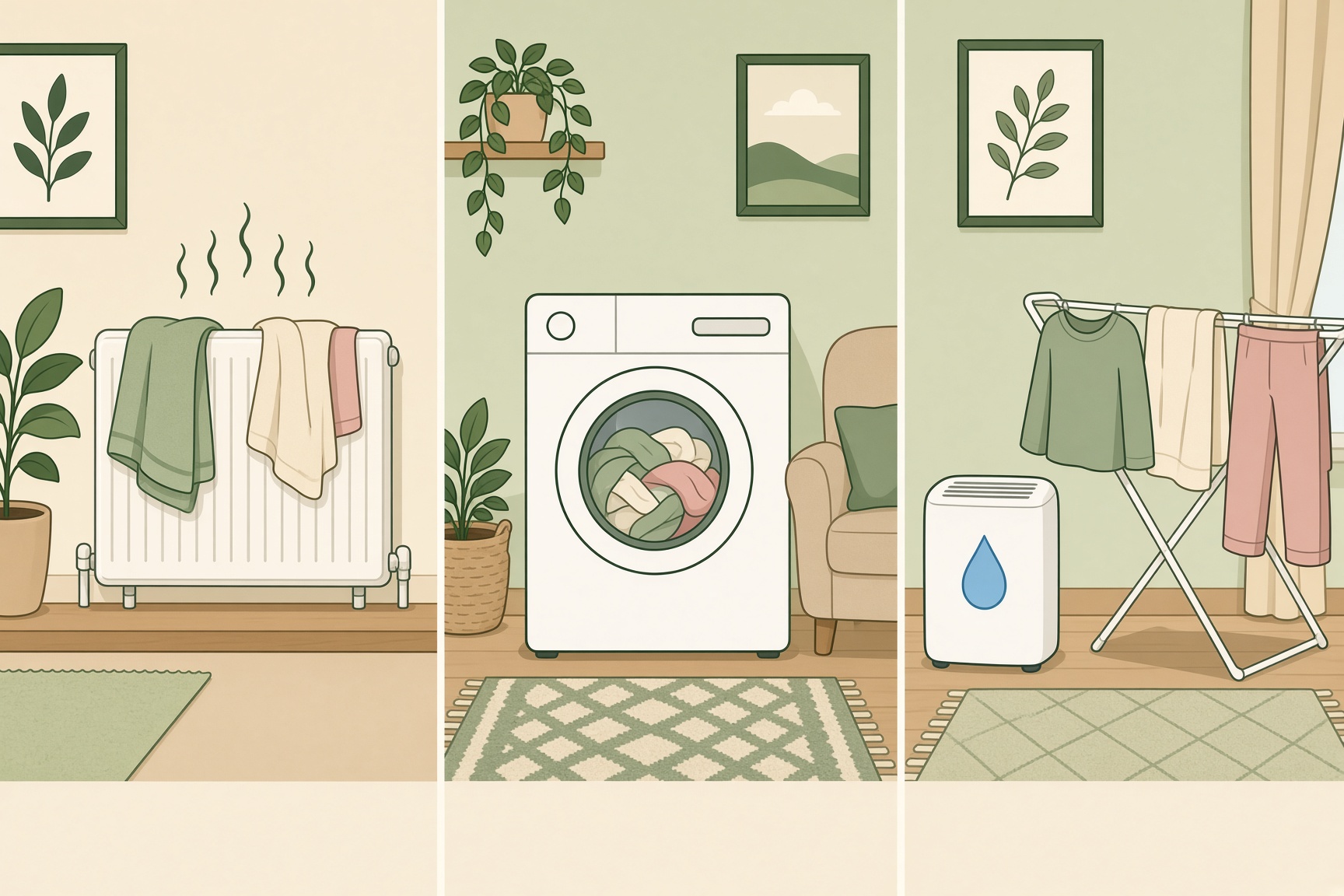
Option 1: Drying on the radiators
This is the default for most UK homes, and it feels free because nothing new switches on. But it isn't free. The cost just hides inside your existing heating bill and your home's condition rather than showing up as its own number.
A wet load of washing holds roughly 1.5–2 litres of water; one 2025 study measured about 2 litres evaporating from a single cotton load (more in our guide to drying clothes indoors without damp). All of that evaporates into your room air rather than outside. That extra moisture has to go somewhere: it raises indoor humidity, it condenses on your coldest surfaces (windows, external walls, behind furniture) and over time it's one of the biggest contributors to condensation damp and black mould in UK homes. It can also make your heating work slightly harder, since damp air feels cooler than dry air at the same temperature, so people with wet washing draped around the house often nudge the thermostat up without realising why.
The Energy Saving Trust's guidance on condensation specifically names drying clothes indoors on radiators as one of the main everyday causes of excess moisture in UK homes.
We can't give this option a pence-per-load figure the way we can the other two, because the cost isn't metered electricity. It's a slower-building cost in mould treatment, redecoration, and marginally higher heating use. That's precisely why it's worth naming rather than ignoring. There's a health cost too: the UK Health Security Agency links damp and mould in English homes to around 5,000 new asthma cases a year, and government guidance recommends drying laundry outdoors where possible.
Option 2: The tumble dryer
The easiest to cost, because it's a single appliance with a rated power draw. A typical vented or condenser tumble dryer draws around 2,000–2,500W and runs for roughly an hour to an hour and a half per load.
The maths: roughly 2.5kWh per load × 26.32p/kWh = ~66p a load. A household doing four loads a week spends roughly £2.63 a week, or around £137 a year, just on drying.
A heat pump tumble dryer is considerably cheaper to run, using roughly 1–1.5kWh a load, or about 26–39p (around £55–£82 a year at four loads a week). It costs significantly more to buy and takes longer per load, so the true comparison depends on how long you'll own it.
Option 3: A dehumidifier, and what it costs to run
A compressor dehumidifier typically draws 130–350W depending on the model and room conditions, considerably less than a tumble dryer. Left running near an airer of wet washing, it usually takes 4–6 hours to dry a full load, depending on room size and how efficiently the air circulates around the clothes. New to them? Our guide to what a dehumidifier does explains how they work.
The maths: 130–350W for 4–6 hours = roughly 0.6–2.1kWh × 26.32p/kWh = ~16–55p a load, depending on the model, or roughly £33–£115 a year at four loads a week. Usually cheaper than the tumble dryer, and it dries the surrounding room at the same time rather than just the clothes in the drum.
The trade-off is time and space: a dehumidifier dries slower and needs the washing on an airer taking up floor space, whereas a tumble dryer is quicker and self-contained. For many households the answer is both: a dehumidifier for everyday loads, a tumble dryer kept for when you need something dry fast.
Is a dehumidifier cheaper than a tumble dryer? Cost per load compared
At the October 2026 price cap of 26.32p/kWh, for a household drying four loads a week:
| Method | Per load | Per year (4 loads/week) | Per load from January* | Removes the moisture? |
|---|---|---|---|---|
| Radiators | £0 in electricity | Hidden: damp, mould, slightly higher heating | n/a | No, it goes into your walls |
| Dehumidifier + airer | ~16–55p | ~£33–£115 | ~18–64p | Yes, into the tank |
| Heat pump tumble dryer | ~26–39p | ~£55–£82 | ~30–45p | Yes |
| Vented or condenser tumble dryer | ~66p | ~£137 | ~76p | Yes, if vented outside |
*At Cornwall Insight's forecast of 30.28p per kWh for January to March 2027. Ofgem confirms the real figure by 25 November. Our January price cap guide has the details.
The cheapest alternatives to a tumble dryer
If you're looking to dry clothes without a tumble dryer, here are the options in order of running cost:
- The washing line: free, and still effective on dry, breezy winter days. Start outside and finish indoors if you need to.
- An airer with ventilation: free, but you lose heat through the open window in cold weather, and it's slow.
- An airer with a dehumidifier: about 16–55p a load, dries in 4–6 hours and removes the moisture. The best all-round alternative for most homes in winter.
- A heat pump tumble dryer: about 26–39p a load and self-contained, but expensive to buy.
- A heated airer: about 46–63p a load. It dries faster than a normal airer but removes no moisture, so pair it with a dehumidifier or ventilation. See the best heated clothes airers.
Our guide to drying clothes fast indoors covers how to get the best from each.
Buying a heated airer?
The best heated clothes airers, compared on cost per load
Six airers from about £50 to £200, what a load really costs on each, and when a dehumidifier or tumble dryer works out cheaper.
The bit nobody explains: dehumidifiers make free heat
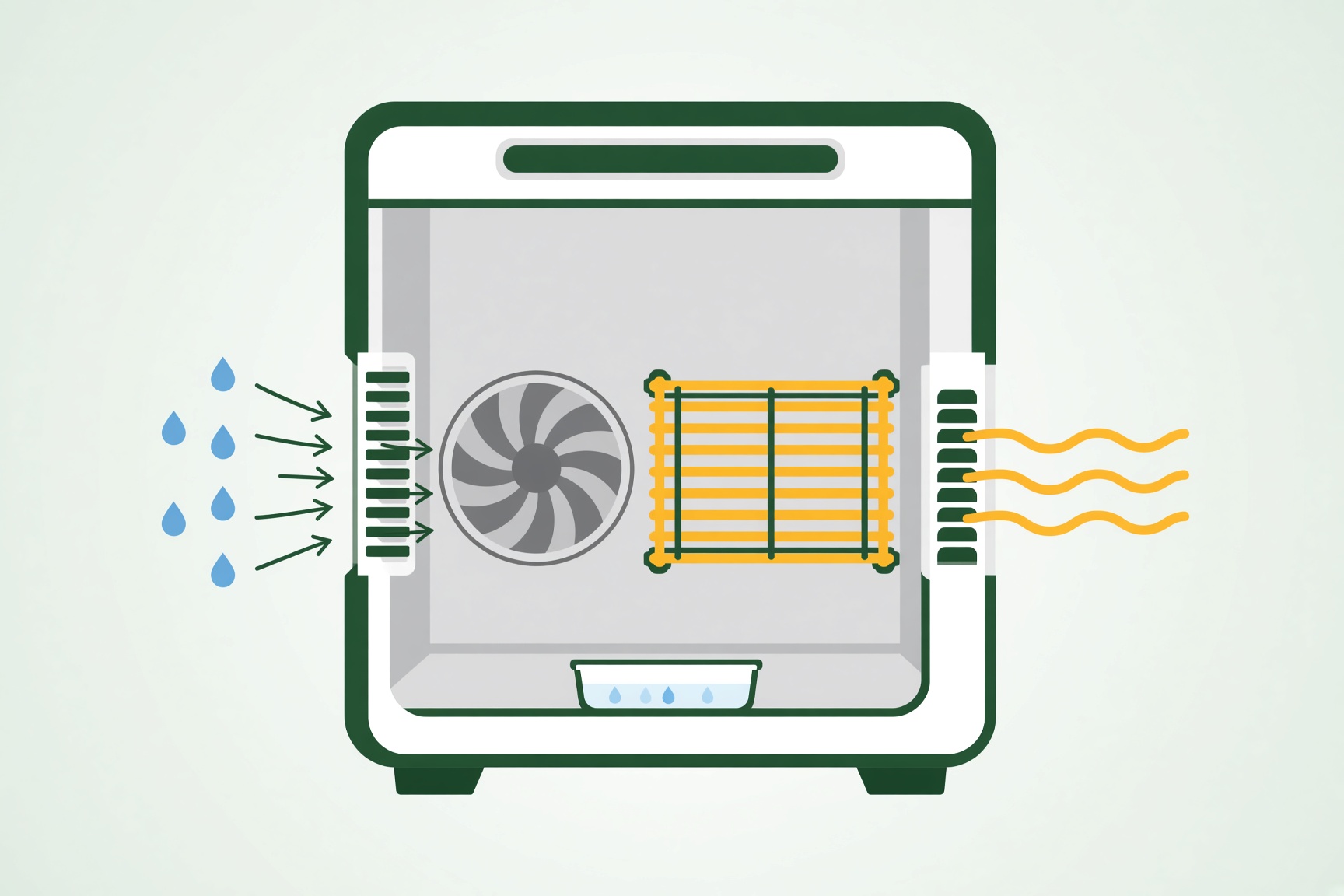
A compressor dehumidifier works by condensing water vapour back into liquid water, and condensing water releases real heat, the same physics that makes a fridge warm the room behind it. Combined with the compressor's own waste heat, essentially all the electricity a dehumidifier uses ends up as warmth in your room. In practical terms, running one in winter is a bit like running a small electric heater that also happens to dry your washing and your walls.
Worth being clear: this doesn't mean a dehumidifier is cheap heating. It converts electricity to heat at roughly the same rate as a plain electric heater, useful as a side effect, but not remotely as efficient as a heat pump, and certainly not cheaper than gas central heating per unit of warmth. The real win is that you're getting that heat anyway, as a byproduct of drying the air, rather than paying for it twice.
Which is actually worth it?
Choose a dehumidifier if...
- You already have condensation or damp problems
- You dry washing indoors regularly
- You have space for an airer and don't need clothes dry in an hour
Keep the tumble dryer if...
- You need clothes dry quickly, not overnight
- You have limited space for an airer
- You already own one. A dehumidifier is an addition, not always a replacement
Which dehumidifier for drying washing?
These are the five picks from our best dehumidifier for drying clothes guide, with the cost of drying one load (about 6 hours) at October 2026 prices. All are compressor dehumidifiers, the right type for a heated home; prices checked 12 October 2026.
| Model | Best for | Power | Per load | Price | |
|---|---|---|---|---|---|
| Pro Breeze 20L | Biggest tank, laundry mode | ~310W | ~49p | £179.99 | Check price → |
| MeacoDry Arete One 10L | Cheapest to run, quietest | 151W | ~24p | £159.99 | Check price → |
| MeacoDry Arete One 20L | Larger homes, low running cost | 216W | ~34p | £259.99 | Check price → |
| DREO 512S | Smart app control, 38dB | 355W | ~56p | £161 | Check price → |
| De'Longhi AriaDry Multi 14L | Allergies, laundry mode | 300W | ~47p | £299.99 | Check price → |
Want the full comparison?
Real extraction in UK conditions, noise, warranties and the best pick for every room in our full guide.
See Best Dehumidifiers UK →Dehumidifier vs tumble dryer: frequently asked questions
See also: Best Dehumidifiers UK · Best Heated Clothes Airers · Drying Clothes Indoors Without Damp · Condensation on Windows · Black Mould · Energy Efficiency Bundle · Insulation guide
Published 7 August 2026, updated 12 October 2026. Costs based on the October 2026 Ofgem price cap of 26.32p/kWh; product prices checked 12 October 2026. January figures use Cornwall Insight's forecast of 30.28p per kWh. Appliance run times and power draws are typical figures. Actual costs vary by model, room size and load. This is general guidance, not a substitute for checking your specific appliance's rated power draw.