
Plug-In Solar for Renters & Flat Owners
Plug-In Solar UK: Balcony Panels, Costs & Legal Rules
Self-install plug-in solar became legal in the UK on 27 August 2026. Six weeks on, 120 kits from 26 suppliers are on the official compliant list. Here is what you can actually buy, what it costs, and which new names are still only on paper.
Last reviewed: 8 October 2026
Updated 8 October: the register now lists 120 Compliant Plug-in Solar kits from 26 suppliers, up from 84 on 30 September. New this week: Solarfy kits from £449, Zendure's SolarFlow 800 on the register, Perlight kits with a balcony mount at Plug In Solar and four more Thunder Bolt registrations. Readers still get £20 off Thunder Bolt kits with code COOLPOWER20.
Six weeks on: what changed this week (updated 8 October 2026)
The register listed 120 Compliant Plug-in Solar kits from 26 suppliers on 8 October, up from 84 when we counted on 30 September. Much of the jump is Worldwide Solar, which now has 31 Compliant configurations. The new names are Zendure, Solarfy, The Solar Centre, Fusion Renewables, Clean My Carbon, Smith Bros and VDS. Being on the register is not the same as being on sale: of those, only Solarfy was selling to the public when we checked. Status still moves both ways. Voltacon's HF-800-WB kit has turned Compliant, while InstaGen's newer INS-PPG2-800 kit was listed Non-compliant on 7 October (its two earlier kits are still Compliant). Anker and Fox ESS are still absent from the Plug-in Solar category. See the new names.
Quick answer: yes. Self-install plug-in solar became legal in Great Britain on 27 August 2026, and on 8 October the ENA register listed 120 Compliant kits from 26 suppliers. For ground or wall space, City Plumbing's DMEGC kits are the cheapest compliant options we have found, from £336 for one panel or £444 for two. Octopus Energy's own kits start at £450. If a balcony is all you have, Perlight's PowerPlug MAX kits at Plug In Solar (from £588) are the first compliant kits we have found sold with a mount the retailer says suits a balcony. EcoFlow's STREAM kits are Compliant from £449. EcoFlow also sells an 800W kit with two 500W panels and STREAM batteries. A typical 800W system saves £95–£140 a year, with payback of about 4–9 years depending on the kit.
What Is Plug-In Solar, and How Does It Work?
Balcony solar panels UK — also called plug-in solar, balcony power stations, or micro-inverter systems — are compact solar setups designed for people who can't install traditional rooftop solar. You mount one or two panels on a balcony railing, south-facing wall, flat roof edge, or garden fence, and the system feeds electricity directly into your home's circuits.
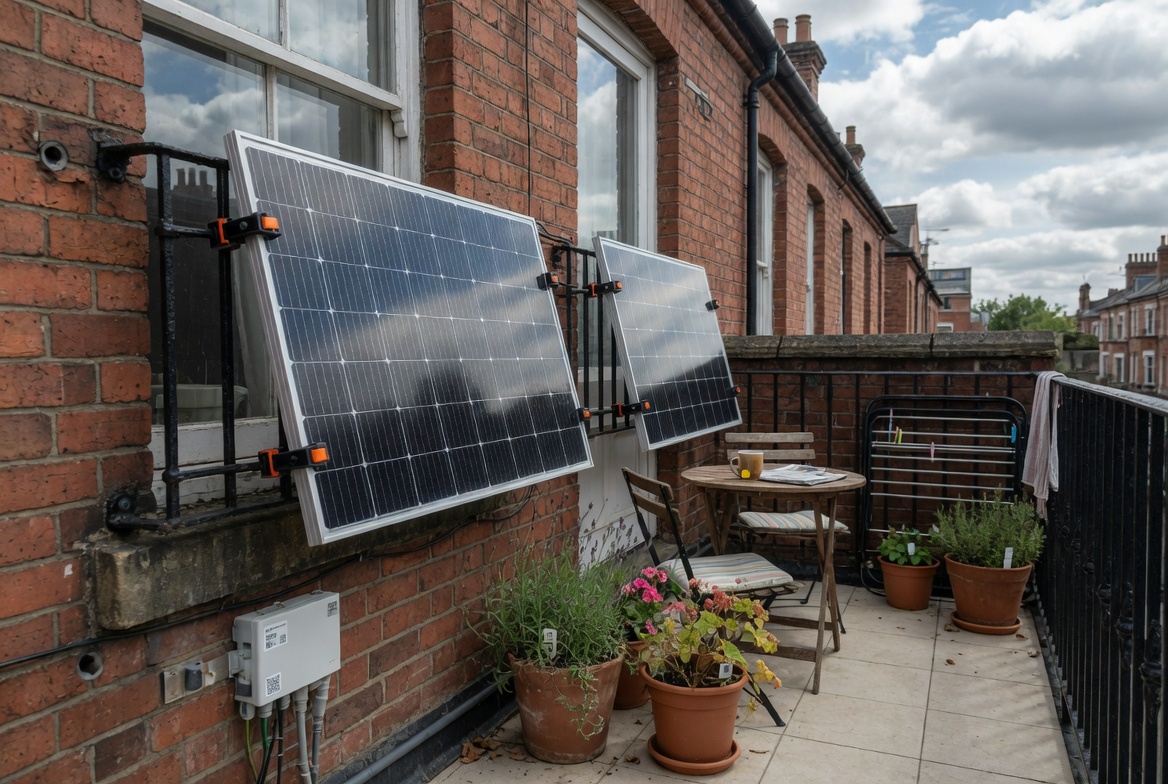
They've been hugely popular in Germany for years — over 1.2 million installations and counting — and the UK is now catching up following the government's 2026 legalisation of self-install. Four weeks after launch, the compliant kit list has expanded — see our launch-day roundup for the full picture of how fast this has moved.
We've covered the full legal picture in detail — including what SI 2026/848 actually changed and what's still coming — in our dedicated guide: Is balcony solar legal in the UK?
How it works
- 1️⃣Solar panels capture sunlight and produce DC electricity
- 2️⃣A micro-inverter converts DC to 230V AC
- 3️⃣Power feeds into your home's circuits via a socket
- 4️⃣Your meter runs slower — you buy less from the grid
Who it's best for
- Renters who can't modify the property
- Flat owners with a south-facing balcony
- Homeowners with unsuitable roofs
- People testing solar before committing to rooftop
Caveat: Balcony solar won't replace your electricity bill. Even a full 800W system saves under £150 a year for most locations. If you own your home and have a suitable roof, rooftop solar will deliver far better returns.
Is Plug-In Solar Legal in the UK? 2026 Status Update
The UK lagged behind Europe on this for years. That's now changing, and fast — the compliant kit list has moved on since launch.
Before 27 August 2026 — standard installation rules applied
SupersededThere was no dedicated "plug-in solar" legal category. Any grid-connected system, however small, needed a qualified electrician to install it and notify your DNO — typically £150–£300 on top of the hardware.
27 August 2026 — Self-install becomes legal (SI 2026/848)
Confirmed, live, expanding fastMade 16 July 2026, in force 27 August 2026. A "plug-in microgenerator" kit can now be plugged straight into a standard socket — no electrician required for the connection. Confirmed rules: maximum 800VA AC inverter output, up to 2,000W of panel capacity, one device per power circuit, no extension leads or adaptors, and battery storage is explicitly excluded from this framework. Only kits listed Compliant (not "submitted") under the "Plug-in Solar" type on the ENA Connect Direct Type Test Register are lawful to self-install — and that list has grown from 7 kits on launch day to 83 four weeks later. Read our full breakdown →
Right now — Portable power stations are fully legal
No install neededPortable power stations like the Anker SOLIX C1000 don't connect to the grid — they charge from solar panels and power appliances directly. Fully legal today, no electrician, no paperwork, no register to check. Great for garden offices, outbuildings and power backup — and still the only zero-ambiguity option on this page for anyone who doesn't want to think about compliance status at all. Compare the best portable power stations →
Don't confuse this with BS 7671 Amendment 4. That's a separate regulation (published 15 April 2026, in force for new installs from 15 October 2026) covering where home battery storage can physically be wired — lofts, bedrooms and small internal cupboards are excluded as battery locations. It has nothing to do with the 800W plug-in solar cap above, and isn't retrospective. It matters here only because, as below, batteries are excluded from the plug-in framework and still need a professional connection.
A note on checking compliance yourself: the ENA register lists many device categories beyond plug-in solar, including older, general-purpose "PV" inverter test entries that predate this framework entirely (some go back to 2024). A "Compliant" result isn't proof of self-install legality unless the entry's Type column specifically reads "Plug-in Solar" — always check that field, not just the compliance status. We found and corrected exactly this mix-up on this page; see the Voltacon listing below.
What about the G98/G99 form?
Grid-connected systems still require notification to your Distribution Network Operator (DNO) — for compliant plug-in kits, this is now handled through the new myplugin.solar portal, a genuine 2-minute online registration rather than the old G98/G99 paperwork route. It sits alongside G98/G99, which still handles larger or hard-wired installs. It's a simple, free notification, not an approval you have to wait for.
Do I need landlord permission?
The Renters' Rights Act 2025 introduced a right for tenants to request energy improvements. Landlords cannot unreasonably refuse a reasonable request — and a plug-in solar system that requires no structural modification has a low bar for "reasonable". That said, it's always worth asking your landlord first and getting permission in writing.
How Much Can Balcony Solar Panels Save You?
Savings are modest compared to rooftop solar, and — without a battery — depend heavily on how much of your generation you're actually home to use.
*Based on the confirmed October–December 2026 electricity rate of 26.32p/kWh and roughly 60% self-consumption without a battery (plug-in systems currently receive no SEG export payment — see FAQ — so unused generation is exported for free). East or west-facing installations will generate roughly 20–30% less than the figures above; add a battery and self-consumption typically rises to 70–90%.
Adding battery storage — improves savings, but isn't the plug-in route
Without storage, electricity you generate but don't use in the moment is exported to the grid — and you currently won't get paid for it as a plug-in system, since plug-in kits aren't MCS-certified. A battery raises self-consumption from around 50–60% to 70–90%, which meaningfully improves the numbers above. The important caveat: battery storage is explicitly excluded from the plug-in self-install framework, so a battery-equipped system still needs a qualified electrician for the connection today, whatever the marketing around a given battery product implies.
Why plug-in batteries are excluded from the new rules →Affiliate disclosure: Some product links on this page may be affiliate links — if you buy through them we earn a small commission at no extra cost to you. This doesn't affect our recommendations. We only feature products we'd recommend, and we flag clearly below where a product still requires professional installation.
What's Actually Available Right Now
Sorted by what you can buy and use today. The compliant list has grown fast, so always check the exact model number, and that the register's Type column reads "Plug-in Solar" specifically, before buying, since status can move in both directions week to week.
EcoFlow STREAM Plug-In Solar
Wall and roof kits from £449, an 800W kit and STREAM batteries
EcoFlow is the biggest brand with compliant UK kits. Its Facade, Flat Roof and Pitched Roof kits are covered by register entry ECOFL/21128/V1/A3, and a second entry, ECOFL/21606/V1/A1, is also Compliant. Prices on EcoFlow's UK store on 8 October. Stock changes often, so check EcoFlow's site for what is available today:
EcoFlow's own FAQ still says an electrician must wire the STREAM cable in, so ask EcoFlow to confirm your kit ships with a UK plug before you buy. Batteries are outside the self-install rules whatever the brand. Prices for all 13 kit configurations and a savings calculator are in our full EcoFlow STREAM guide.
Octopus Energy Plug-In Solar
The first big energy supplier selling its own kits: one or two 460W JA Solar panels, wall or ground mount
Octopus's bundles pair JA Solar 460W bifacial panels with an 800W Fox ESS-made microinverter (listed on the register as the M1-800-E), and come with wall or ground mounting rather than a balcony-rail bracket. The single-panel kit is £450 and the two-panel 920W kit is £650. Octopus customers can also track generation in the Octopus app. They cost a little more than City Plumbing's DMEGC kits, but you're buying from the UK's biggest supplier, which counts for something after GivEnergy's collapse. As with every kit, check the reference on the box matches the register entry, and notify your DNO once it's plugged in.
Thunder Energy Bolt 460W & 920W
Launch-day compliant kits with Hoymiles microinverters, for gardens, walls and flat roofs
Enter at checkout on thunderenergy.co.uk for £20 off each Bolt 460W or 920W kit. Thunder pays Cool Power Co a commission on orders using this code, at no extra cost to you.
Thunder's Bolt kits use 460W N-type TOPCon panels and a Hoymiles HMS-800-2WB microinverter (the 920W kit runs both panels through one 800W inverter, as the rules allow). Both have been on the register as Compliant since 27 August. They're sold for gardens, walls, sheds and flat roofs (flat-roof versions cost more) rather than balcony rails. They're dearer than City Plumbing's kits, but you get a longer inverter warranty and a UK brand with direct support. On 5 October Thunder added four more Compliant entries: separate registrations for the flat-roof versions of the Bolt 460W and 920W, and a new single-panel Bolt Max 530W for the ground or a flat roof. We had not seen the Bolt Max on sale when we checked on 7 October.
Voltacon Plug-In Kits
The HF-800-WB kit turned Compliant on the register, but the kits on Voltacon's own site use other inverters
What the register says on 8 October: VOLTD/21572/V1/A2, Voltacon's kit built on the Hoymiles HF-800-WB, is now Compliant. Two other Voltacon entries are Non-compliant: the BYM500 kit (VOLTD/21533/V1/A3) and a JA Solar 930W kit with an HMS-800-2WB (VOLTD/21738/V1/A3). The plug-in kits we found on Voltacon's website use BYM and VMI inverters, not the HF-800-WB, so the Compliant entry does not cover them. Earlier versions of this page wrongly cited a 2024 inverter test record (ZHEJI/15702/V1/A1) as proof Voltacon had a compliant balcony kit. It was not a plug-in solar entry, and we corrected it on 25 September.
Voltacon is an established UK solar retailer, and a Compliant HF-800-WB kit should follow on its shop. Until it does, buy only a kit whose model and inverter match the Compliant entry, and check the register on the day you order.
PowerXpress 800W Bifacial Plug-In Kit
2×460W panels + 800W micro-inverter, explicitly listed for wall, floor and balcony installation
Still the first compliant-category kit we've found on a mainstream UK high-street retailer's own site (937 stores nationwide), rather than a specialist solar retailer. Delivered via Screwfix's approved supplier network rather than Screwfix's own stock. Manufacturer guarantee is 1 year, meaningfully shorter than other kits on this page.
InstaGen 870W Plug-In Solar Kit
2 × 435W bifacial N-type panels, an 800VA Hoymiles HiFlow microinverter (HF-800-WB) and an adjustable mount
InstaGen (listed on the register as InstaGroup) has two Compliant plug-in configurations. The Currys listing appears to match INSTA/21105/V1/A1, the 435W-panel kit. Currys lists the kit as a "435W, pack of 2", so it's 870W of panels feeding one 800VA inverter, the same idea as the Thunder Bolt 920W.
On balconies: Currys markets it for balconies, railings, fences, walls and gardens. Each panel weighs 25.1kg and is 1.72m tall, though, so check that your railing can carry it, and get permission from your landlord or freeholder first. A garden or wall mount is the easy option. As with every kit here, check that the model number on your order matches the register entry.
City Plumbing Plug-In Solar Kits
Now 11 kits — DMEGC and UKSOL — all with Hoymiles microinverters
Balcony check: City Plumbing's listing for the DMEGC 1030W kit now says its Fastensol mount fits "walls, balcony rails, or ground mounts", but the other DMEGC listings don't say so, and the UKSOL kits are explicitly "Ground Mount". If a balcony rail is your only option, confirm the bracket with City Plumbing before you buy.
| Kit | Output | Price (inc. VAT) |
|---|---|---|
| DMEGC 465W Hoymiles HiFlow | 465W (1 panel) | £336.00 |
| DMEGC 475W Hoymiles HiFlow | 475W (1 panel) | £336.00 |
| DMEGC 515W Hoymiles HiFlow | 515W (1 panel) | £348.00 |
| DMEGC 525W Hoymiles HiFlow | 525W (1 panel) | £360.00 |
| DMEGC 930W Hoymiles HiFlow | 930W (2 panels) | £444.00 |
| DMEGC 930W Hoymiles HiFlow (Black) | 930W (2 panels) | £456.00 |
| DMEGC 950W Hoymiles HiFlow | 950W (2 panels) | £456.00 |
| DMEGC 1030W Hoymiles HiFlow | 1030W (2 panels) | £468.00 |
| DMEGC 1050W Hoymiles HiFlow | 1050W (2 panels) | £480.00 |
| UKSOL Pro Compact 460W | 460W (1 panel) | £670.80 |
| UKSOL Pro Duo 890W | 890W (2 panels) | £951.60 |
City Plumbing now lists 11 plug-in kits and is the second-biggest name on the register after Perlight. The new single-panel DMEGC kits from £336 are the cheapest way in, though with one panel you'll generate roughly half what a two-panel 800W kit does, so the two-panel DMEGC 930W at £444 is the better value per watt. The Jinko 940W kit we previously listed at £432 is no longer on City Plumbing's plug-in page. Every kit includes the panels, a pre-matched 800W Hoymiles HiFlow microinverter, a 5m cable with a standard 13A plug and mounting frames. The single-panel kits share register entries with their two-panel versions, so check the reference on the box matches the register.
Perlight Solar PowerPlug Range
18 Compliant entries, including five new PowerPlug+ kits added on 3 October. The MAX range is on sale at Plug In Solar.
Plug In Solar lists four PowerPlug MAX kits: MAX 465W £588, MAX 500W £594, MAX 930W £798 and MAX 1kW £810. Each comes with an APsystems EZ1-M 800W microinverter, a 4m cable with a moulded UK plug and an adjustable mount the listing describes as "suitable for wall, floor or balcony mounting". Check the delivery time on the listing before you order.
These are the first compliant kits we have found sold with a mount the retailer says suits a balcony. Each panel is about 1.76m by 1.13m, so check your railing can take the size and weight, and ask your landlord or freeholder first. Fixings are not supplied. Match the model on the box to the register: the MAX 465W listing links to PERLI/21158/V1. The five new PowerPlug+ kits (codes PLM-PPM-M2 and PLM-PPM-SPE2) are separate registrations and were not on sale when we checked. Westech Solar is Perlight's UK customer centre.
PatioSun Lite
A UK brand selling its own compliant kits direct, from £449
PatioSun has moved fast since launch and now offers a full six-kit range (Lite, Lite+, Duo, Duo+, Max, Max+), all confirmed Compliant. Newer brand than City Plumbing or UKSOL, so worth checking real customer reviews before buying, but the compliance status itself is verified.
UKSOL Compliant Ground-Mount Kits
The first brand to achieve Compliant status, still going strong
Not for balconies: UKSOL's own datasheet states these kits are ground-mount and not suitable for balcony use. If you have garden or ground space this is lawful to self-install today; if you only have a balcony, check the EcoFlow guide above — but always confirm mounting suitability with the seller directly.
Still a solid, compliant option for anyone with garden or ground space. Argos now stocks six UKSOL bundles from £599, with delivery estimated late October — a real, mainstream retail channel that didn't exist on launch day.
Anker SOLIX Solarbank 4 Pro (E5000 Pro)
A 5kWh battery being sold and demonstrated as plug-and-play — but its ENA submissions remain Non-compliant
A recent hands-on UK review describes the 800W mode exactly as its marketing promises: "a box you carry into the room and plug into a socket," with simple app setup. That much checks out in practice.
Checked again on 25 September: Anker's current ENA submissions (ANKER/21630/V1, ANKER/21631/V1, both dated 24 September) sit under the "Energy Storage Device" category and are listed Non-compliant — not under "Plug-in Solar" at all. SI 2026/848 explicitly excludes battery storage from the self-install framework, so a battery-equipped system still needs a qualified electrician for the connection regardless of panel-side wattage. We're not able to confirm whether Anker has a compliant self-install route in progress or is running ahead of the register with its marketing — we'll update this section once that changes.
Anker SOLIX C1000 Gen 2
Portable power station — no grid connection needed
The C1000 Gen 2 (1,024Wh, 2,000W output, under 10ms UPS switchover) charges from solar panels and powers appliances directly — no grid connection, no electrician, no ENA register to check, because it never touches your house wiring. Fully legal today. Ideal for garden offices, outbuildings, camping, and backup power. Pairs with any compatible solar panels. Not directly comparable to the grid-tied systems above — it won't reduce your meter reading, but it will run appliances off-grid. Our best portable power station guide compares it with seven others for power cut backup.
New on the Register Since Late September
These suppliers have Compliant entries but are new to this page. Most are not on sale yet. We checked each one on 8 October and will move them up the page as they launch.
| Supplier | Kit | Compliant entries | Can you buy it? |
|---|---|---|---|
| Solarfy | Solo 455 (1 panel) and Duo 910 (2 panels) | 2 | On sale direct: £449 and £599 inc. VAT. Free-standing 20° ground or flat-roof frame; you supply 100–160kg of ballast per panel. |
| Zendure | SolarFlow 800 with 2 panels and floor, wall or balcony brackets | 6 | Not on sale in the UK yet. The UK kits have no battery. SolarFlow can take Zendure batteries, but adding one takes it outside the self-install rules. |
| Worldwide Solar | Kits with Hoymiles or VaySunic 800W inverters and JA Solar or AIKO panels, with or without mounts | 31 | Sold from its own website. We have not confirmed prices. |
| The Solar Centre | Plug-In Solar 1 Panel and 2 Panel kits | 2 | Coming soon page with a register-interest form; nothing on sale yet. |
| Fusion Renewables | Two 475W panels, Hoymiles HMS-800-2WB, two balcony mounts | 1 | A Dumfries installer. Not found on sale. |
| Clean My Carbon | Clean 800W: Hoymiles HMS-800-2WB with two JA Solar panels | 1 | Not found on sale. |
| Smith Bros (Caer Conan) | SolarGo-One 435: one Anglo Solar 435W panel | 1 | A wholesaler. Not found on sale. |
| Jiangsu VDS | VDS power 800W balcony, wall or ground kit | 1 | Not found on sale in the UK. |
Newly Non-compliant entries in the same period: InstaGen INS-PPG2-800, HEPA Premium 880, Voltanic VPS-800, TSAI TM-L800Mi, The Solar Home LS-800Mi and two Fusion Renewables kits. Non-compliant kits need an electrician to connect them.
Other names worth watching
Other suppliers with Compliant kits: TSUNESS (3), Segen (2, trade only), HDM Solar (2), InstaGroup (InstaGen, 2), Modular Solar Technologies (4), APsystems (2), Skyworth (2), VALE (2, see below), PowerXpress (1, on Screwfix) and The Impact Crowd (1). Status moves in both directions, so check the exact model number on the register on the day you buy, and that the Type column reads "Plug-in Solar". Fox ESS and Anker are still absent from the Plug-in Solar category. Our launch-day roundup has the history.
Lidl kits look close (added 1 October): VALE GmbH, the company behind Lidl's balcony solar kits in Germany, now has two UK ENA approvals for what look like two versions of a 900W kit. They closely match two kits Lidl sells in Germany: a 900Wp kit with four flexible panels (€449) and an 880W two-panel kit with an EcoFlow inverter (€299). Germany charges no VAT on solar kits, so expect UK prices to be higher. We'll track it on our Lidl plug-in solar page.
Want the complete renter setup?
Solar panels, portable power station, AC unit, smart thermostat and energy monitor — all in one guide with real prices.
See the Complete Renter Bundle →Balcony Solar for Renters
Renting doesn't have to mean being stuck with high energy bills. Here's what you need to know.
Do I need landlord permission?
Under the Renters' Rights Act 2025, landlords cannot unreasonably refuse a request for energy improvements. For a plug-in system that requires no structural work or drilling, the bar for "reasonable" is low. Always get permission in writing before installing anything.
What if I don't have a balcony?
Panels can also be mounted on a south-facing window ledge, garden fence, or flat roof edge. A portable power station like the Anker SOLIX C1000 remains the most flexible option if you don't have any mounting space at all — no mounting, no register question, just charge from panels through a window and power appliances directly.
Can I take it with me when I move?
Yes — that's one of the biggest advantages of balcony solar over rooftop. The whole system comes with you when you move. No abandoned investment, no negotiation with landlords about fixtures.
Will it actually make a difference to my bills?
A south-facing 800W system in the UK saves roughly £95–£140 per year without a battery. With City Plumbing's two-panel kits from £444 and PatioSun's from £449, payback is meaningfully faster than the £848+ UKSOL-only picture from launch — closer to 4–6 years on the cheapest compliant kits, rather than 7–9.
Frequently Asked Questions
All Our Plug-In Solar Guides
Everything we've written since plug-in solar became legal, in one place.
Ready for More Than a Balcony Kit?
Prefer to Talk to a Professional?
Get Free, No-Obligation Quotes
Not sure whether balcony solar or a full rooftop system makes more sense for your home? Get matched with up to four MCS-certified local installers who can talk you through your options.
Free · No obligation · MCS-certified installers only