
Battery Storage · Rule Change · 2026
New Battery Storage Rules from 15 October 2026
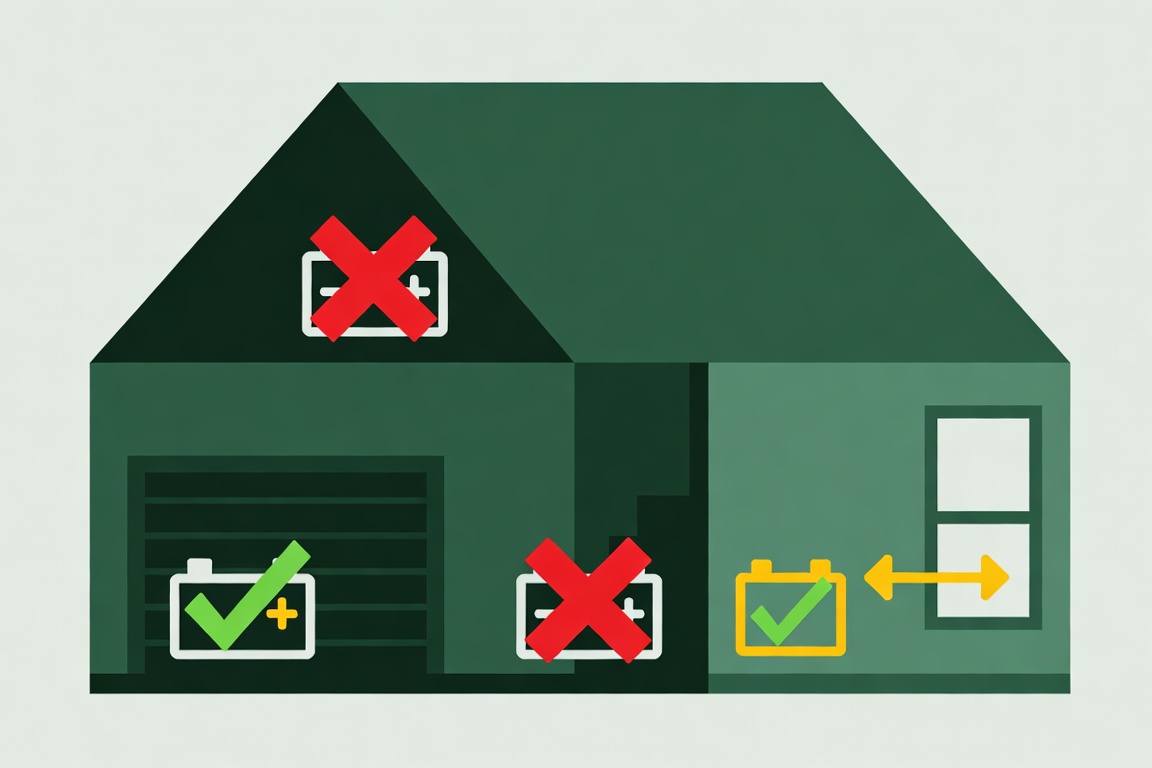
No batteries in lofts or bedrooms. One metre of clearance from windows and doors outdoors. Since 15 October 2026, where a home battery goes matters far more than it did, and it affects anyone planning to add to a system they already have.
Last updated: 15 October 2026
The 30-second version
On this page:
What's changing
Until this year the UK wiring regulations had no dedicated rules for home battery storage. Electricians worked to manufacturer instructions, MCS standards and a safety specification called PAS 63100. That was good practice, but it didn't carry the weight of the wiring regulations themselves.
That changed when the IET and BSI published BS 7671:2018+A4:2026, known in the trade as Amendment 4, on 15 April 2026. It introduced Chapter 57, the first dedicated rules for fixed battery installations, covering location, ventilation, fire protection, isolation and testing. For homes, regulation 570.6.7.203 requires compliance with PAS 63100.
There was a six-month changeover after publication, during which an installer could design to either version. It ended on 15 October 2026, when the previous version was withdrawn. New domestic battery installations now have to comply.
Where you can't put a battery
Most of these locations were already considered bad practice. What's new is that they are now written into the wiring regulations, and one of them affects a lot of homes.
Lofts, roof spaces and voids
The big one. Lofts were a popular choice because they are out of sight and use no wall space. They also get very hot in summer and very cold in winter, are poorly ventilated, and are the hardest place in the house to reach in a fire.
Escape routes
Hallways, stairwells and landings that you would use to get out of the building. A battery fire here blocks the way out.
Bedrooms
Rooms people sleep in are excluded, because a sleeping person has the least time to react.
Basements without their own way out
A cellar or basement is only acceptable if it has direct access to the outside.
Outdoors: the one metre rule
A battery mounted outside must be at least 1 metre from doors, windows, ventilation openings and escape routes, and 2 metres from stored flammable materials such as fuel cans or gas cylinders. Plenty of older installations sit neatly beside the back door or under a kitchen window. The reasoning is simple: if a lithium battery overheats and vents, you don't want the fumes going into the house or blocking the way out.
Manufacturers also specify clear space around the battery and inverter, often 30 centimetres on every side. That is separate from the one metre rule and worth checking at the same time.
Where a battery can go
If a loft was your only option, find out before you pay a deposit. Ask the installer to confirm the proposed location in writing before you commit, not after the survey.
Not sure where a battery could go in your home?
An installer works out the location at the survey. Get a quote from Blue Ape Renewables, the MCS-certified installer we work with, or compare prices from local installers, and ask for the proposed location in writing.
No obligation. We earn a commission if you go ahead.
Does this affect a battery you already have?
No. The rules are not retrospective. An installation that complied with the regulations in force when it was fitted stays compliant. You don't need to move it, modify it or have it re-certified.
There is one caveat, and it is the part that gets missed:
Alterations and additions after 15 October 2026 must comply with the new rules. If you have a battery in a loft and later want to add a second module or change the installation, that work falls under Chapter 57. In practice the system may have to move. If you plan to expand your storage, talk to an installer now. Our guide to adding batteries to an existing solar system covers the options.
One other practical point: some home insurers have started asking where a battery is sited. Check your policy schedule, particularly if yours is in a loft. A future electrical inspection may also note an older location as a departure from the current standard, which is a record and not a requirement to move it.
Planning to add to a battery you already have?
Extra capacity added from 15 October has to meet the new rules, so get the location checked before you buy a module. Blue Ape fits and extends home batteries, or you can compare local installers.
No obligation. We earn a commission if you go ahead.
If you're buying a battery now
The changeover window closed on 15 October 2026, so a battery installed now has to be designed to the new rules. If you were quoted before then, ask the installer to confirm the design and the location still comply before the work goes ahead.
Four things to ask your installer
A good MCS-certified installer does all of this as a matter of course. Asking makes it explicit and gives you something in writing if it is ever queried.
The rules change where a battery can go, not whether it pays. For the sums, see our battery storage calculator and the best home batteries comparison.
What about plug-in batteries?
Different rules, and worth keeping apart. The plug-in solar framework that took effect on 27 August 2026 covers solar panels and a microinverter only. Battery storage is excluded from it. A plug-in battery is not something you can plug in yourself under those rules, and connecting one to your home's circuits is still work for a qualified electrician.
So a battery wired into your home falls under the rules on this page, whatever the box says. Our guide to plug-in solar batteries explains what you can and can't do.
Portable power stations are different again. A unit you charge from a socket and plug appliances into never becomes part of your electrical installation, so these location rules don't apply to it. If you want backup for a power cut without an installer, our best portable power station guide compares eight models.
Frequently asked questions
Which kind of quote suits you?
Whichever you choose, ask the installer to confirm in writing that the design meets BS 7671 Amendment 4 before you commit.
"I'd rather deal with one good installer" Get a quote from Blue Ape Renewables, the installer we work with. MCS-certified and NAPIT-accredited, fitting batteries and solar panels across England, Wales and Scotland. Get a quote →Tell us about your project and local installers will quote
Both are free and there's no obligation. We earn a commission if you go ahead with Blue Ape or with one of the installers you are matched with.
Related Guides
Published 24 July 2026, updated 15 October 2026. Based on BS 7671:2018+A4:2026, published by the IET and BSI on 15 April 2026, with the previous version withdrawn on 15 October 2026. Chapter 57 covers fixed battery installations, and regulation 570.6.7.203 requires domestic installations to comply with PAS 63100:2024. This is general guidance for homeowners and not a substitute for advice from a qualified electrician. Have your own installation assessed by an MCS-certified installer.