What to Do in a Power Cut (UK): Checklist, Who to Call and What You Can Claim
The checks to make in the first five minutes, the free number to report it, how to keep food safe and the house warm, and the payments you're owed if it goes on.
Last updated: 17 October 2026
105
Free power cut number in GB
12 hours
Before compensation is due
£100
First payment, normal conditions
48 hours
A full freezer stays frozen
The 30-second version
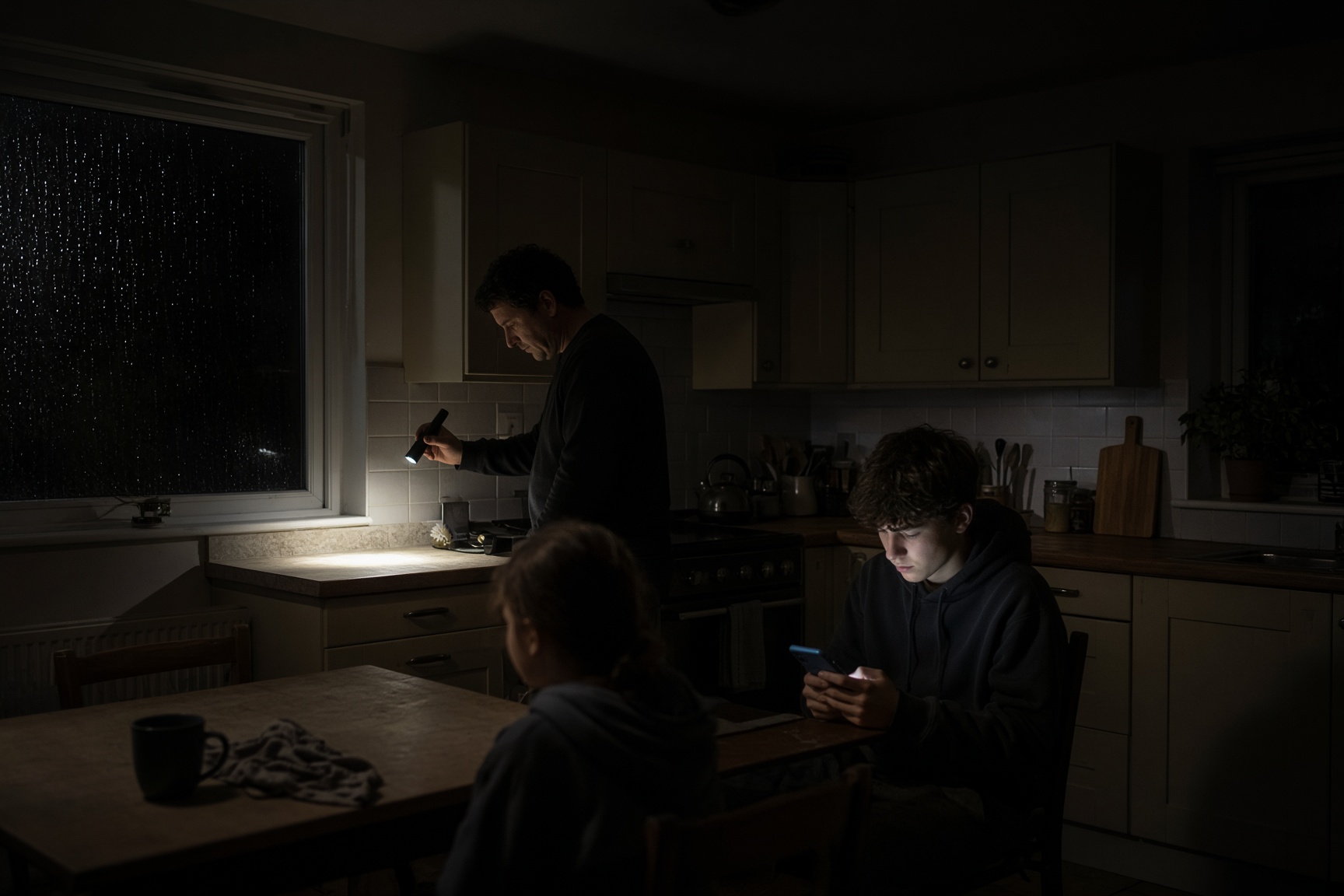
Is it just you? Look out of the window. If the street lights and your neighbours are on, check your consumer unit for a tripped switch.
Report it: call 105 free in England, Scotland and Wales, or 03457 643 643 in Northern Ireland.
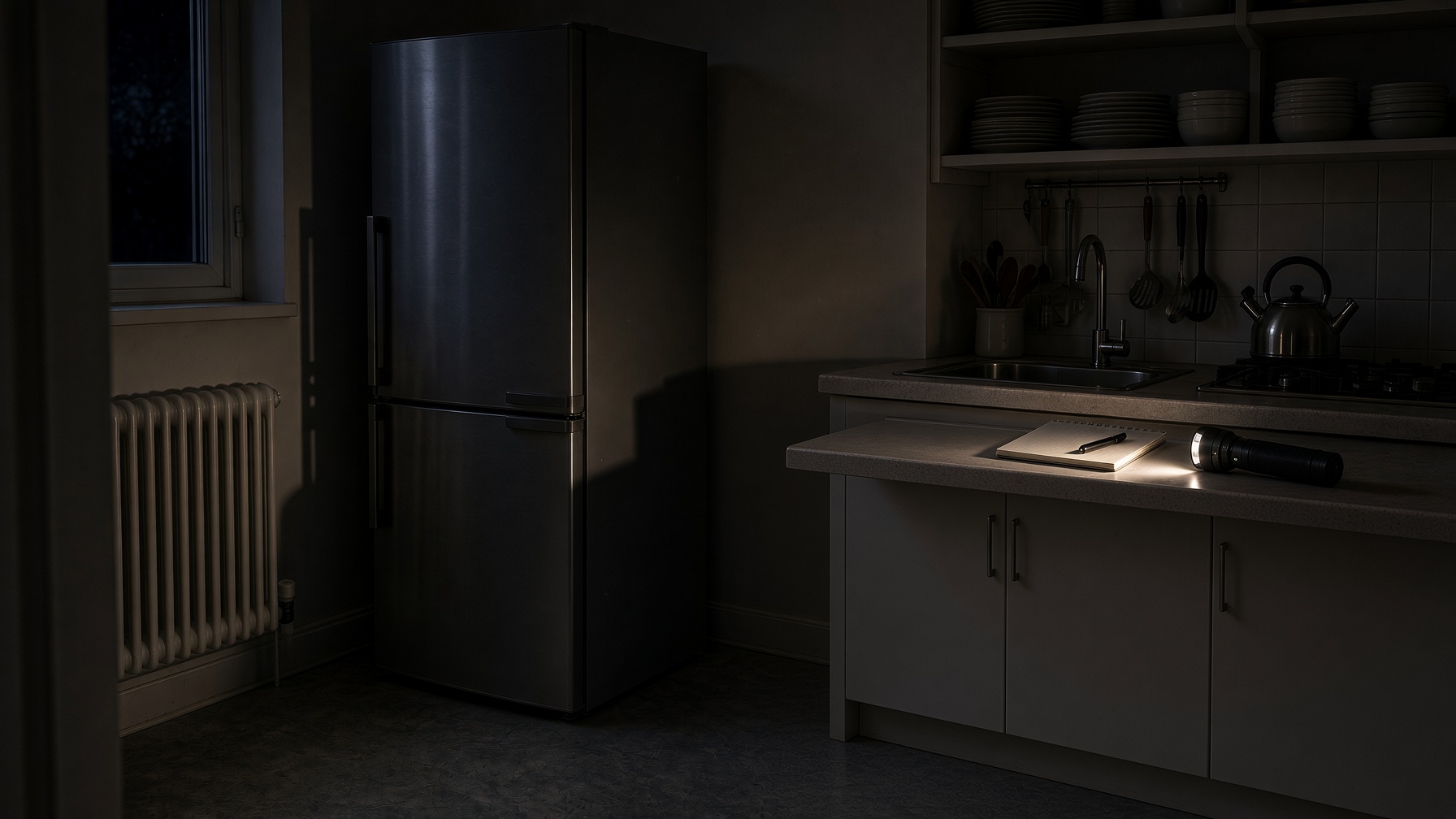
Keep the fridge and freezer shut. Fridge food stays safe for about 4 hours, a full freezer for about 48.
Never use a barbecue, camping stove or petrol generator indoors. Carbon monoxide kills.
Off for more than 12 hours? You're usually owed £100, paid automatically by your network operator.
Most power cuts are local and short, but a few minutes of checks tells you whether it is your house or the whole street.
The first five minutes
1
Check whether it's just your home
Look out of the window at street lights and your neighbours' houses, or ask on a local group. If everyone is dark, it's a network fault and there is nothing to fix inside your home.
2
If only you are off, check the consumer unit
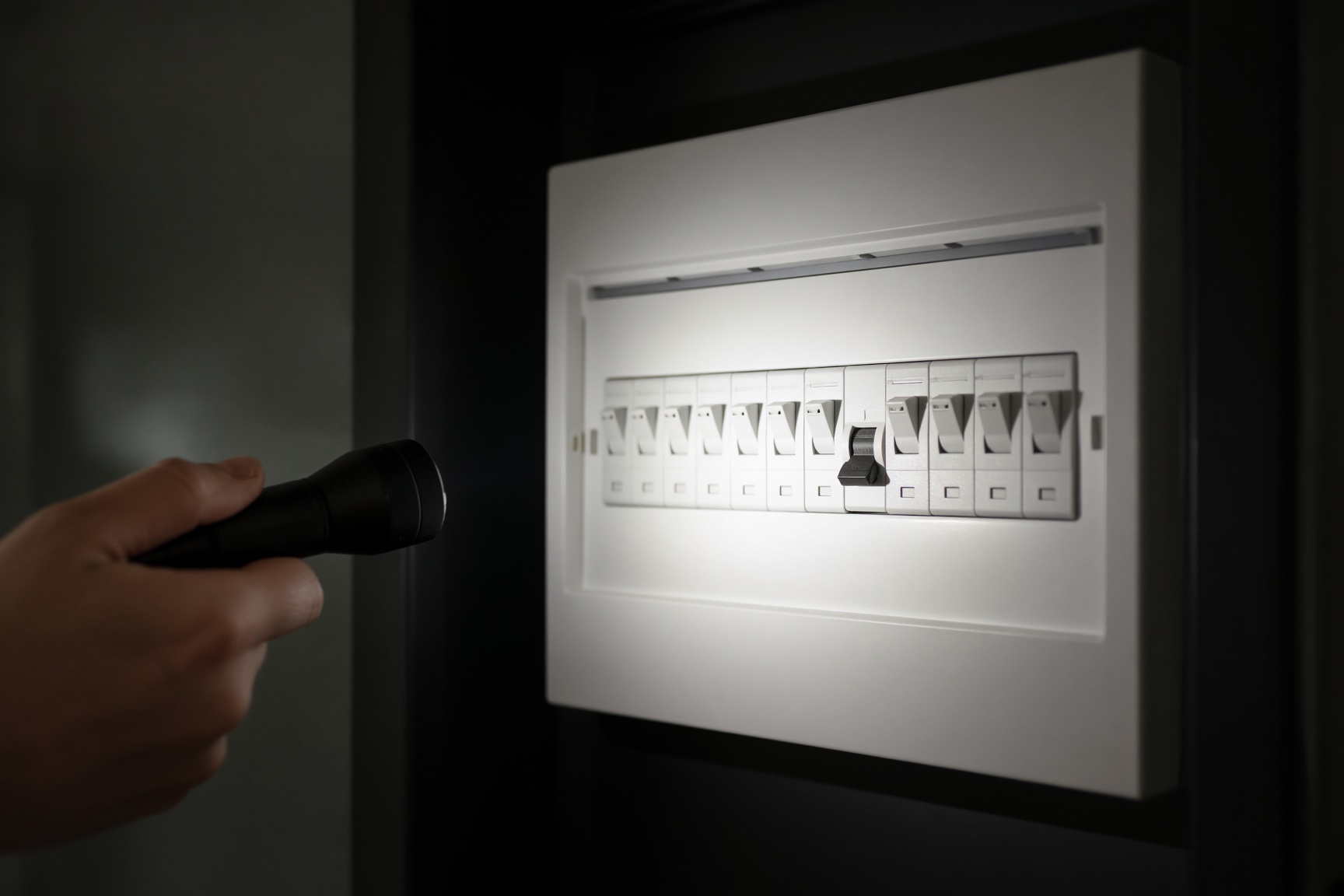
Open your fuse box. If a switch has flipped down, turn off everything on that circuit, push the switch back up, then plug things back in one at a time. The one that trips it again is your faulty appliance.
3
On a prepayment meter, check your credit
An empty or faulty meter looks exactly like a power cut. Top up, or call your supplier if the meter itself is the problem.
4
Report it
Call 105, or use your network operator's website or power cut map. Reporting it, even if the neighbours already have, helps them find the fault.
5
Switch off and unplug
Turn off cookers, heaters and irons so nothing comes back on unattended, and unplug TVs and computers. Leave one light switched on so you know when the power returns.
If only your home is dark, a tripped switch in the consumer unit is the most likely cause.
Your home, your meter or the network?
What you see
Likely cause
Who to contact
Only your home is dark, and a switch in the consumer unit is down
A faulty appliance or circuit in your home
Reset it yourself. If it keeps tripping, an electrician
Only your home is dark, consumer unit looks normal, prepayment meter
No credit, or a meter fault
Top up, or your energy supplier
Only your home is dark, everything looks normal
A fault on the cable to your home
Your network operator: call 105
The whole street or area is dark
A fault on the local network
Your network operator: call 105
Who to call in a power cut
Power cuts are fixed by your network operator, the company that owns the cables and substations in your area. That's not your energy supplier, the company that sends your bills. Calling your supplier about a power cut usually just gets you redirected.
Number
What it is for
105
Power cuts in England, Scotland and Wales. Free from landlines and mobiles, and it puts you through to your local network operator
03457 643 643
Power cuts in Northern Ireland (NIE Networks)
0800 111 999
Gas emergencies in Great Britain, including a smell of gas
999
Fallen power lines, sparking or anyone in danger. Stay well away from a fallen line and assume it is live
Most network operators also run a live power cut map on their website, showing the cause where they know it and an estimated time to restore. Find yours by searching your postcode on the Energy Networks Association's "who is my network operator" tool.
How long will the power cut last?
There's no single answer, but the rules do set a deadline: network operators have to restore supply within 12 hours in normal conditions, or pay you compensation. In severe storms the deadline is extended to 24 or 48 hours, depending on how many faults the storm causes.
Long cuts are almost always storm damage, and rural homes on overhead lines are usually the last to be reconnected. In Storm Arwen in November 2021, nearly a million homes lost power. More than 59,000 were off for over 48 hours, and a small number for almost two weeks.
If you're told a cut will last more than a few hours, think about food, heating and anyone in the home who relies on powered medical equipment. That's when a portable power station earns its keep, keeping the fridge, router, lights and phones going.
Keeping food safe
Keep the doors shut. Every time you open the fridge or freezer, you let the cold out.
Fridge: food should stay safe for about 4 hours. Normally it should be at 5°C or below. If it rises to 8°C or above, eat chilled food within four hours or throw it away.
Freezer: food stays frozen for about 48 hours if the freezer is full, or about 24 hours if it's half full. It depends on the model and how warm the room is.
Eat in this order: chilled food first, then defrosted food that doesn't need cooking, then bread and fruit, and tinned and dried food last.
Don't refreeze food that has fully defrosted unless you cook it first.
A full freezer keeps food frozen for about 48 hours if you keep the door shut.
Staying warm and safe
A power cut usually takes your heating with it. A gas boiler needs electricity for its pump, fan and controls, so it stops even though the gas is still on. Storage heaters keep giving out what they have stored, but won't recharge.
Keep everyone in one room, close the doors and curtains, and put on layers, hats and blankets.
Fill flasks with hot drinks while you can, and use hot water bottles if you have hot water left in the tank.
Use torches rather than candles. If you do use candles, keep them in proper holders and never leave them unattended.
Never use a barbecue, camping stove, patio heater or petrol generator indoors or in a garage. They give off carbon monoxide, which you can't see or smell.
Don't use a gas oven or hob to heat the room.
If someone in the home is elderly, very young or unwell, and the cut is likely to be long, tell your network operator. They may be able to offer extra help.
Your landline may not work. Landlines are moving to digital lines that run through your broadband router, and most homes are expected to have switched by the end of January 2027. A digital landline stops working in a power cut unless it has a battery backup. Providers have to offer a free solution that gives at least one hour of emergency calls to customers who rely on their landline, such as people with no mobile signal or a telecare alarm. Ask yours if that applies to you.
Keep your mobile charged, and a power bank topped up, through the winter.
Your Wi-Fi router stops in a power cut too, so mobile data is what you'll have. A small power station or a UPS keeps the router running.
If you rely on powered medical equipment, such as a home oxygen concentrator, a CPAP machine or a stairlift, join the Priority Services Register (below) and ask your equipment provider about backup.
The Priority Services Register
The Priority Services Register is a free list kept by network operators and energy suppliers of homes that need extra help. If you're on it, you can get advance warning of planned cuts, priority updates during unplanned ones, and in some cases practical help such as a portable generator, battery packs or bottled water during a long outage.
You may qualify if anyone in your home:
has reached State Pension age
is disabled, or has a long-term medical condition
is recovering from an injury, or is pregnant
has a child under five
has hearing or sight loss
uses medical equipment that needs electricity
It's free and you don't need proof. Register with your network operator (search your postcode at thepsr.co.uk) and tell your energy supplier too. Being on the register doesn't increase compensation, but it does mean you're contacted first.
Compensation: what you can claim
If your power is off for longer than the deadlines below, your network operator owes you a payment under Ofgem's Guaranteed Standards. Most payments are made automatically once the power is back, by cheque, bank transfer or a credit to your energy account.
Situation
Payment for a home
Normal conditions, off for more than 12 hours (fewer than 5,000 homes affected)
£100, then £45 for each further 12 hours
Normal conditions, 5,000 or more homes affected, off for more than 24 hours
£100, then £45 for each further 12 hours, capped at £400
Severe weather, category 1, off for more than 24 hours
£90, then £45 for each further 6 hours
Severe weather, category 2, off for more than 48 hours
£90, then £45 for each further 6 hours
More than four cuts of 3 hours or more in a year (1 April to 31 March)
£100 extra. You have to claim this one
If a payment hasn't arrived a few months after a qualifying cut, contact your network operator. These amounts are reviewed each year for inflation.
Be ready for the next one
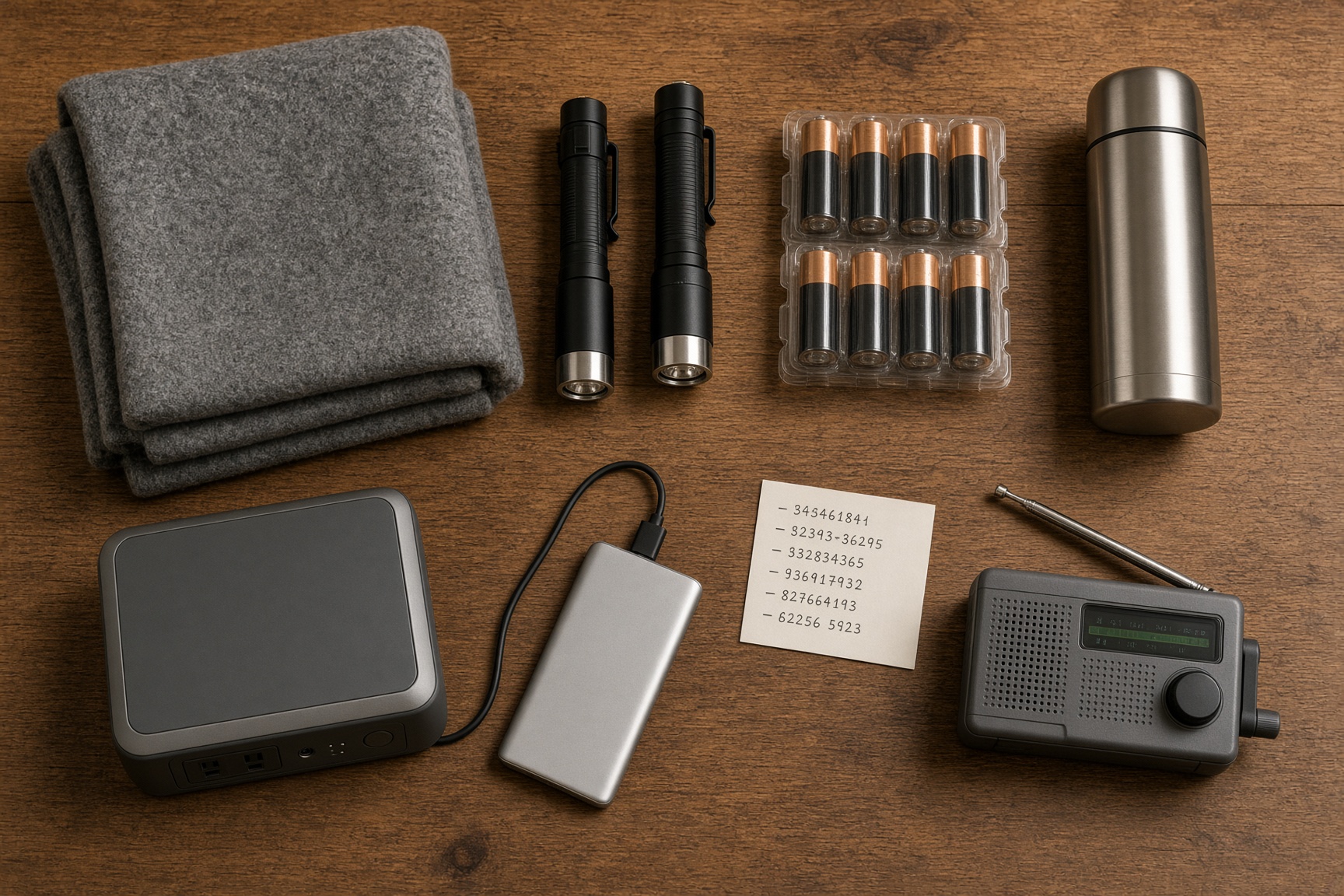
Torches, a charged power bank, warm layers and a list of numbers cover most power cuts. A power station keeps the essentials running.
Torches in places you can find in the dark, with spare batteries.
A charged power bank for each phone, plus a car charger.
Warm layers and blankets, and a flask.
A written list of numbers: 105, your network operator, family, and your GP if needed. Your phone may be flat.
A battery or wind-up radio for local news in a storm.
Know where your consumer unit and stopcock are, and how to reset a trip switch.
Join the Priority Services Register if anyone in your home qualifies.
If cuts are common where you live, or someone at home depends on electricity, a portable power station is the step up. A 1kWh model keeps a router, lights, phone charging and a fridge-freezer going for about 8 hours, and can work as a UPS so the Wi-Fi doesn't even drop. It's silent and makes no fumes, so it's safe indoors, unlike a petrol generator.
Keep the essentials running in the next power cut
Eight portable power stations compared, from £199, with a calculator showing what each will run and for how long.
Switch appliances back on gradually, not all at once.
Check the fridge and freezer, and follow the food advice above.
Your boiler should restart by itself. If it doesn't, check its display for a fault code and follow the reset steps in the manual.
Reset clocks, timers and your heating schedule.
Frequently asked questions
What should I do first in a power cut?
Check whether your neighbours and the street lights are off too. If they are, it's a network fault, so report it on 105. If only your home is off, check your consumer unit for a tripped switch, and your meter if you're on prepayment.
How do I report a power cut?
Call 105 free from any phone in England, Scotland and Wales, and you'll be put through to your local network operator. In Northern Ireland call NIE Networks on 03457 643 643. You can also report it on your network operator's website.
How long do power cuts last in the UK?
It varies. Network operators have to restore power within 12 hours in normal conditions, or 24 to 48 hours in severe storms, or pay compensation. Storm damage can take longer: in Storm Arwen more than 59,000 homes were off for over 48 hours.
How long will food last in the fridge during a power cut?
About 4 hours if you keep the door shut. A full freezer keeps food frozen for about 48 hours, or about 24 hours if it's half full. If the fridge rises above 8°C, eat chilled food within four hours or throw it away.
Does my gas central heating work in a power cut?
Usually not. The boiler needs electricity for its pump, fan and controls, so it stops even though the gas supply is still on. Keep warm with layers and blankets, and never use a gas oven, hob or barbecue to heat the room.
Can I get compensation for a power cut?
Yes, if it lasts longer than the standards allow. In normal conditions that's £100 after 12 hours, plus £45 for each further 12 hours. Different rules apply in severe storms. Payments are usually made automatically by your network operator.
What is the Priority Services Register?
A free register of households that need extra help, kept by network operators and suppliers. It covers people over State Pension age, disabled people, those with medical conditions or medical equipment, pregnant people and families with children under five. You get advance warning of planned cuts and priority support.
Will my landline work in a power cut?
An old analogue corded phone usually will. A digital landline, which runs through your broadband router, won't unless it has a battery backup. Keep your mobile charged, and ask your provider about a free backup if you rely on your landline.
Last updated 17 October 2026. Compensation figures are from Ofgem's guidance on payments for power cuts (Guaranteed Standards of Performance), which are reviewed yearly. Food safety timings are from Food Standards Scotland. Priority Services Register criteria are from Energy Systems Catapult's summary of the scheme. Storm Arwen figures are from the government's Storm Arwen review interim report. Digital landline guidance is from GOV.UK's guide to the switch to digital landlines. 105 covers England, Scotland and Wales.
To provide the best experiences, we use technologies like cookies to store and/or access device information. Consenting to these technologies will allow us to process data such as browsing behaviour or unique IDs on this site. Not consenting or withdrawing consent, may adversely affect certain features and functions.
Functional
Always active
The technical storage or access is strictly necessary for the legitimate purpose of enabling the use of a specific service explicitly requested by the subscriber or user, or for the sole purpose of carrying out the transmission of a communication over an electronic communications network.
Preferences
The technical storage or access is necessary for the legitimate purpose of storing preferences that are not requested by the subscriber or user.
Statistics
The technical storage or access that is used exclusively for statistical purposes.The technical storage or access that is used exclusively for anonymous statistical purposes. Without a subpoena, voluntary compliance on the part of your Internet Service Provider, or additional records from a third party, information stored or retrieved for this purpose alone cannot usually be used to identify you.
Marketing
The technical storage or access is required to create user profiles to send advertising, or to track the user on a website or across several websites for similar marketing purposes.