
Winter Heating · Running Costs

Electric Heater vs Central Heating: Which Is Cheaper to Run?

What an hour of gas central heating costs against an electric heater at today's price cap and January's forecast, the cheapest way to heat a room, where heat pumps and air conditioning fit in, and a calculator for your own home.

Published 13 October 2026

9.4p
Per kWh of heat from a gas boiler
26.32p
Per kWh of heat from an electric heater
53p
An hour for a 2kW heater on full
3p
An hour for a heated throw

Affiliate disclosure: some links on this page are affiliate links. If you buy through them we earn a small commission at no extra cost to you. It doesn't affect what we recommend.

The short answer

Per unit of heat, gas central heating is about 2.8 times cheaper than an electric heater: 9.4p per kWh against 26.32p.
An electric heater only saves money when it lets you heat much less of the house, for example one person in one room for the evening.
For a typical home, one 2kW heater on its thermostat costs about the same per hour as the whole central heating (37p against about 40p). Two heaters cost more.
The cheapest option of all is to warm yourself, not the room: a heated throw costs about 3p an hour.
A heat pump, including an air conditioner with a heat pump heating mode, gets two to four units of heat from each unit of electricity. That is the one kind of electric heating that matches or beats gas.
Woman reading on a sofa next to a white oil-filled electric heater while the radiator under the window is turned off, in a UK living room on a winter evening
Heating one room with a plug-in heater only saves money if the central heating stays off.

Calculator: is a heater cheaper in your home?

Enter your yearly gas use from a bill or your supplier's app, and how long your heating usually runs on a winter day. If you have done the one-hour meter test below, put that figure in instead, as it is more accurate than our estimate.

From the one-hour meter test. Leave blank to use our estimate.

Central heating
n/a
Electric heater
n/a
Heated throw
n/a
One person, about 120W

Our estimate assumes about 80% of your gas goes on heating (the rest on hot water and cooking) over about 33 weeks a year. It is an average: a cold house warming up from scratch burns more in the first hour.

Per unit of heat, gas central heating wins

Under Ofgem's price cap for October to December 2026, gas costs 7.97p per kWh and electricity 26.32p. A modern condensing boiler turns about 85% of the gas it burns into heat, so a kWh of heat from gas costs about 9.4p. A plug-in electric heater turns almost all the electricity it uses into heat, so a kWh of heat from it costs 26.32p, about 2.8 times as much.

That is true of every type of plug-in heater: fan, ceramic, oil-filled, convector or halogen. None of them is more efficient than another, whatever the advert says. Our electric heater guide explains why.

Gas central heatingElectric heater
Price per kWh of fuel7.97p26.32p
Share turned into heatAbout 85%About 100%
Price per kWh of heat9.4p26.32p
Standing chargeYou pay it whether the boiler runs or notYou pay it either way

Is it cheaper to heat one room with an electric heater?

A heater can still cost less because central heating warms the whole house, and a heater warms one room. If you are the only one home and spend the evening in one room, heating every radiator in the house is the expensive part, not the gas price.

Usually cheaper with a heater: one person at home, one room, a large or poorly insulated house, or an hour or two in a room the radiators struggle to reach.
Usually cheaper with a heater: a room you use at a different time from everyone else, such as a home office during the day when the heating would otherwise be off.
Usually cheaper with central heating: the whole household at home, a small flat, or any time you would need two or three heaters running at once.
Never cheaper: running a heater while the central heating is on as well. Turn the radiator in that room down or off if you add a heater.
The middle option: keep the central heating, but turn the radiator valves down in rooms you are not using and close their doors. You still pay gas prices, for less of the house.

What is the cheapest way to heat a room?

From cheapest to most expensive to run, for one person spending an evening in one room of a gas-heated home:

1
Warm yourself, not the room
A heated throw or electric blanket uses about 100W to 150W, roughly 3p an hour. Warm layers cost nothing to run. You can then set the room a couple of degrees cooler.
2
Central heating in fewer rooms
Turn the radiator valves down in the rooms you are not using and close their doors. You keep the cheaper gas price but heat less of the house.
3
One electric heater with a thermostat, door closed
The cheapest way to heat a room with electricity is the smallest heater that keeps you warm, on its thermostat, in a closed room. A 2kW heater cycling on its thermostat averages about 37p an hour, and a 1kW one about half that.
4
Whole-house central heating
About 40p an hour in a typical home, more in a large or draughty one. Cheaper per unit of heat than any plug-in heater, but you pay to warm every room.
5
Two or more electric heaters
Two 2kW heaters on their thermostats cost about 74p an hour, more than central heating in most homes.
Man working at a laptop at a kitchen table wrapped in a grey electric heated throw on a cold day in the UK
A heated throw uses about 120W, around 3p an hour, so you can set the room a couple of degrees cooler.

What about a heat pump, or using air conditioning as a heater?

Every plug-in heater turns one unit of electricity into one unit of heat. A heat pump moves heat in from the outside air instead of making it, so it gets two to four units of heat out of each unit of electricity. That is the only way electric heating matches or beats gas on the price per unit of heat. An air conditioner with a heating mode is a heat pump too: it runs the same refrigerant cycle in reverse.

Heating typeHeat per unit of electricityPrice per kWh of heat nowFrom January*
Gas central heatingn/a (85% boiler)9.4p11.5p
Plug-in electric heater (any type)126.32p30.28p
Portable air conditioner, heat pump modeAbout 2.510.4p12.0p
Air source heat pump (radiators)About 2.8 to 3.57.5p to 9.4p8.7p to 10.8p
Air-to-air heat pump (fixed split unit)3.8 or more6.9p or less8.0p or less

*January uses Cornwall Insight's forecast of 30.28p for electricity and 9.76p for gas. Portable air conditioner figure from Meaco's specification for the MC 9000 CH. Air-to-air figure is the minimum seasonal efficiency (SCOP) for an A+ heating rating on the EU energy label. Heat pump range runs from the median seen in the government-funded Electrification of Heat trial to a well-designed system.

An air source heat pump instead of the boiler
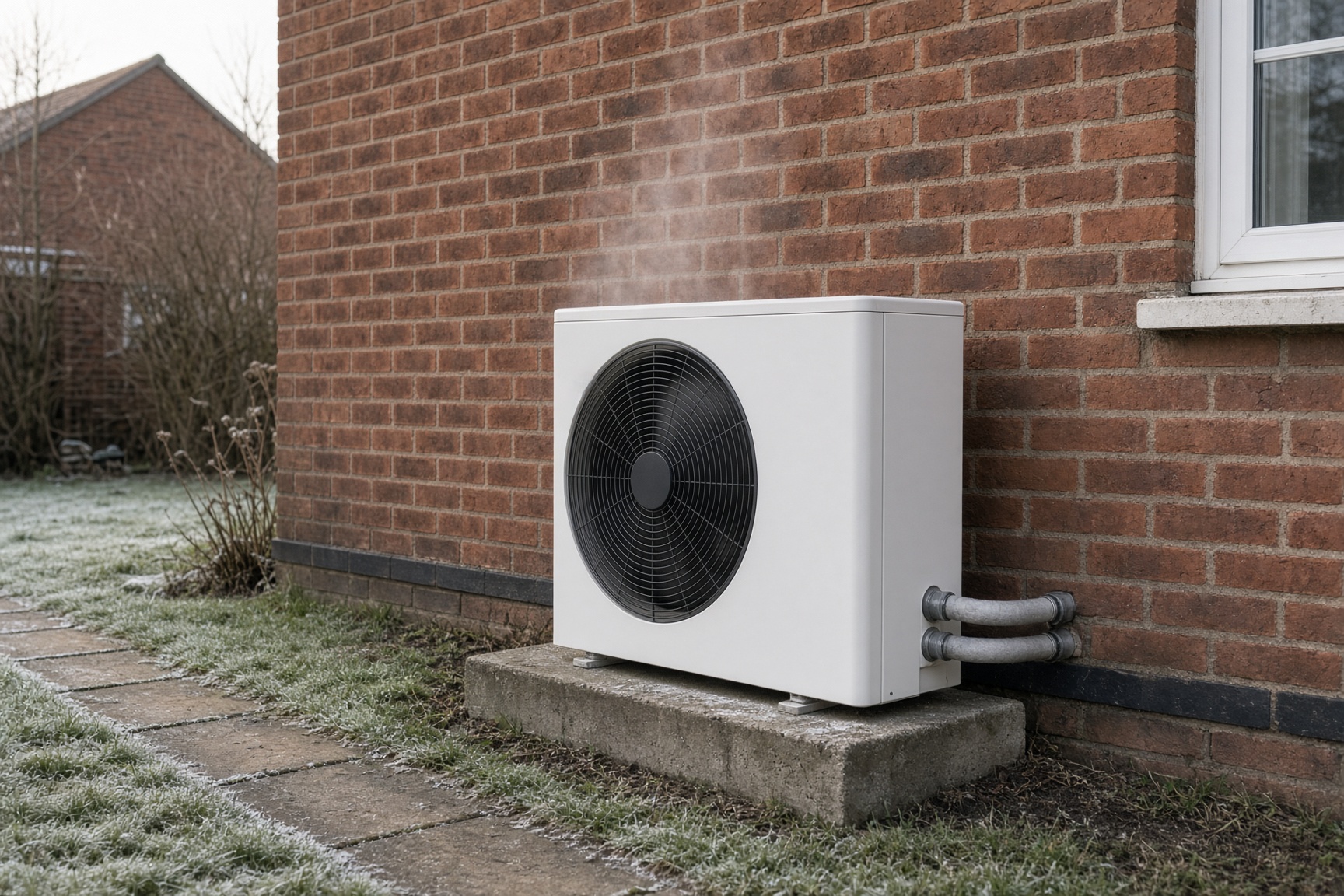
Air source heat pump outdoor unit on frosty ground beside a UK brick house on a winter morning
A heat pump moves heat in from the outside air, giving two to four units of heat for each unit of electricity, even on a cold day.

An air source heat pump replaces the boiler and runs your radiators and hot water. With an average real-world efficiency it costs about the same per unit of heat as gas at today's prices, and less once a system is designed well, runs at low flow temperatures or uses a heat pump tariff. In England and Wales the Boiler Upgrade Scheme takes £7,500 off the installed cost. Our heat pump vs gas boiler guide runs the full comparison, and the running cost calculator does it for your home.

A portable air conditioner with a heating mode

Some portable air conditioners heat as well as cool, and the better ones do it with a heat pump. The MeacoCool MC 9000 CH gives 8,100 BTU of heat, about 2.4kW, from 940W by Meaco's figures. That is about 25p an hour, against about 62p for a plug-in heater giving the same heat. It costs £399.99 and needs a window kit, so it makes sense if you also want cooling in summer, not as a heater on its own.

Check the heating is a heat pump. If the heating wattage is about the same as the heat output (say 2,000W in for about 2kW of heat), the unit uses a plain electric element and costs the same to run as a fan heater.
Expect less than the label. Most portable units have a single hose that pushes air out of the room, so cold air leaks back in through gaps around doors and windows. Real savings are smaller than the specification suggests, and they fall as it gets colder outside.

Our portable air conditioner guide covers the models that heat.

A fixed air-to-air heat pump
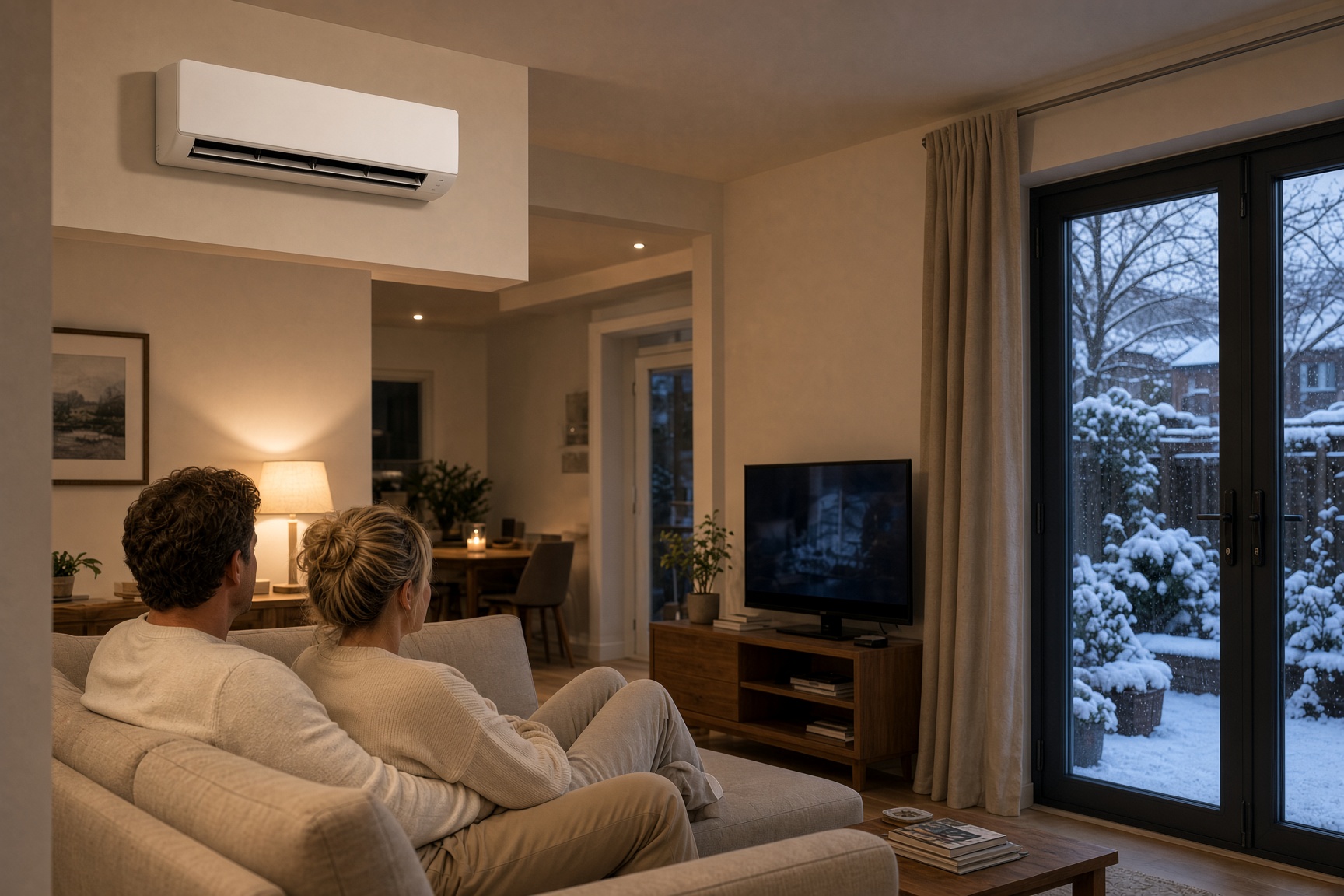
Wall-mounted split air conditioner heating a UK living room in winter, an air-to-air heat pump
A wall-mounted split air conditioner with a heating mode is an air-to-air heat pump. A £2,500 grant for these is on the way in England and Wales.

A wall-mounted split air conditioner, with the noisy part outside, is one of the most efficient ways to heat a single room or open-plan space with electricity. A unit with an A+ heating rating gets at least 3.8 units of heat from each unit of electricity, so heat costs about 6.9p per kWh or less, below the price of gas. It does not heat radiators or hot water, so it suits homes that want to cut the boiler's work rather than replace it. The Boiler Upgrade Scheme rules changed on 28 April 2026 to allow £2,500 towards an air-to-air system in England and Wales, but installers can't claim it yet because the certification behind it isn't finished. Ask your installer before you count on it. Our split air conditioner guide covers costs and brands.

Four common evenings, costed

These use a typical home that burns 11,500 kWh of gas a year (Ofgem's typical figure) with the heating on for 8 hours on a winter day. That works out at about 5.0 kWh of gas an hour while the heating is running, or 40p an hour. Heaters are on their thermostat, drawing about 70% of their full power on average.

A 4-hour eveningElectric optionWhole-house central heatingCheaper
One person, one room, one 2kW heater£1.47£1.59About the same
Two rooms, two 2kW heaters£2.95£1.59Central heating
One person, heated throw only13p£1.59Heater
One 2kW heater left on full power£2.11£1.59Central heating

The same evening in a smaller home using 7,500 kWh a year costs about £1.04 on central heating, so one heater only just breaks even. In a large home using 17,000 kWh it costs about £2.35, so a single heater in one room saves money. Put your own figures into the calculator to see where your home sits.

The one-hour meter test

Our calculator estimates how much gas your boiler burns an hour from your yearly total, but homes differ a lot. Measuring takes one evening and gives you the real figure.

1
Read the gas meter
Do it on a cold evening when the house is already warm and the heating is about to come on, or use the half-hourly readings in your supplier's app if you have a smart meter.
2
Run the heating for one hour
Leave the thermostat where you normally have it, and do not run a bath or the hot water during the hour.
3
Read the meter again
The difference is what your heating burns in an hour. Newer meters read in cubic metres: multiply by about 11.2 to get kWh.
4
Put the figure in the calculator
If it is more than about 4.6 kWh, one 2kW heater on its thermostat is cheaper per hour than your central heating at today's prices. If it is less, the central heating is cheaper.

What changes in January

Cornwall Insight forecasts the January to March 2027 price cap at 30.28p per kWh for electricity (up 15%) and 9.76p for gas (up 22%). Ofgem confirms the real figures by 25 November. Gas rising faster than electricity tips the sums slightly towards heaters: gas heat would cost about 11.5p per kWh, and electric heat would be 2.6 times that rather than 2.8 times.

In the typical home above, an hour of central heating would go from about 40p to 49p, and a 2kW heater on its thermostat from 37p to 42p. Our January price cap guide has the full forecast.

If a heater wins, which one to buy

Pick the smallest heater that keeps you warm, and make sure it has a thermostat, because that is what stops it running flat out. These are three of the picks from our best electric heaters guide, with prices checked on 10 October 2026.

Pro Breeze OmniWarm 2500W Oil-Filled Radiator

Best for an evening in the living room. Three power levels, so you can drop to 1,000W (26p an hour) once the room is warm. Digital thermostat with eco mode and a 24-hour timer.

£99.99
Check Price →

Pro Breeze ThermaCube 2000W Ceramic Fan Heater

Best for quick heat in a home office or spare room. Digital thermostat, eco mode, remote and a 12-hour timer.

£64.99
Check Price →

Pro Breeze Fleece Electric Heated Throw

The cheapest way to keep one person warm at about 3p an hour. Ten heat settings and a 9-hour timer.

£49.99
Check Price →

Frequently asked questions

Is it cheaper to use an electric heater or central heating?

Per unit of heat, gas central heating is cheaper: about 9.4p per kWh against 26.32p for an electric heater at the October 2026 price cap. A heater is only cheaper when it lets you heat much less of the house, such as one person in one room. For a typical home, one 2kW heater on its thermostat costs about the same per hour as the whole central heating, and two heaters cost more.

How much does central heating cost an hour?

It depends on your home and boiler. A typical home using 11,500 kWh of gas a year burns roughly 5 kWh an hour while the heating is on, which is about 40p an hour at 7.97p per kWh. A small flat may burn half that and a large house more. The one-hour meter test gives you your own figure.

How much does a 2kW electric heater cost per hour?

52.6p on full power at 26.32p per kWh. With a thermostat it switches on and off once the room is warm, so the average is often nearer 37p an hour.

Is it cheaper to leave the heating on low all day?

Generally no. The Energy Saving Trust advises using a timer and thermostat to heat your home only when you need it, rather than leaving the heating on low all the time. A home loses heat all the time it is warm, so keeping it warm when nobody is in costs more than reheating it.

Should I turn off radiators in rooms I do not use?

Turning the radiator valves down in unused rooms and closing the doors cuts the heating bill. Do not leave rooms completely cold for weeks, though, as cold walls attract condensation and mould. Our condensation guide explains how to avoid it.

Will the January price rise change the answer?

Slightly, in the heater's favour. Cornwall Insight forecasts gas rising 22% and electricity 15%, so electric heat would cost 2.6 times as much as gas heat rather than 2.8 times. Central heating would still be cheaper per unit of heat.

Are oil-filled radiators cheaper than central heating?

Not per unit of heat. A 2,500W oil-filled radiator on full costs 66p an hour, and a kWh of heat from it costs 26.32p against about 9.4p from a gas boiler. An oil-filled radiator only works out cheaper than gas central heating when it lets you heat one room instead of the whole house, and then mainly in larger homes. Use the calculator above with 2,500W, or 1,000W for its low setting.

Are electric heaters more efficient than central heating?

At the point of use, yes: a plug-in heater turns almost 100% of its electricity into heat, while a gas boiler turns about 85% of its gas into heat. But electricity costs over three times as much per kWh as gas, so central heating is still cheaper per unit of heat. Efficient is not the same as cheap to run.

What is the cheapest way to heat a room with electricity?

Use the smallest heater that keeps you warm, with a thermostat, in a room with the door closed, and set it a couple of degrees lower with a heated throw on top. A heated throw alone costs about 3p an hour. For a permanent fix, a heat pump is the cheapest form of electric heating.

What if I do not have mains gas?

If you heat with oil or LPG, put your price per kWh into the calculator's own-prices option. If your home is all-electric, a heater and electric central heating cost the same per kWh, unless you have storage heaters or a heat pump on a cheaper tariff. A heat pump is the one electric option that matches or beats gas on the unit price, because it moves heat in from outside rather than making it.

Is a heat pump cheaper than an electric heater?

Yes, by a long way. A plug-in heater gives one unit of heat for each unit of electricity, so heat costs 26.32p per kWh. An air source heat pump gives around 2.8 to 3.5 units over a year, so the same heat costs about 7.5p to 9.4p per kWh, roughly the same as or less than gas central heating.

Can I use an air conditioner as a heater?

Only if it has a heat pump heating mode, and many do. The Meaco MC 9000 CH portable unit gives 8,100 BTU of heat (about 2.4kW) from 940W by Meaco's figures, about 25p an hour, so its heat costs about 10.4p per kWh. Check the specification: if the heating wattage is about the same as the heat output, the unit uses a plain electric element and costs the same as a fan heater. A fixed split or air-to-air system is more efficient again.

What happens to my heating in a power cut?

Gas central heating stops, because the boiler needs electricity for its pump, fan and controls. Most boilers are hard-wired, so you can't simply plug one into a backup supply without an electrician fitting a plug or changeover switch first. A heated throw or electric blanket on a portable power station is the practical way to stay warm in a long cut.

Which kind of quote suits you?

Want to cut the heating bill for good? A heat pump uses electricity but delivers around three units of heat for each one, and in England and Wales the Boiler Upgrade Scheme takes £7,500 off the cost.

"I'd rather deal with one good installer" Get a quote from Blue Ape Renewables, the installer we work with. MCS-certified for heat pumps and registered for the Boiler Upgrade Scheme grant, fitting air source heat pumps across England, Wales and Scotland. Get a quote →

Tell us about your project and local installers will quote

Both are free and there's no obligation. We earn a commission if you go ahead with Blue Ape or with one of the installers you are matched with.

Published 13 October 2026. Prices use Ofgem's price cap for 1 October to 31 December 2026 (26.32p per kWh for electricity and 7.97p for gas) and Cornwall Insight's forecast for January to March 2027 (30.28p and 9.76p). Typical gas use of 11,500 kWh a year is Ofgem's typical domestic consumption value. Boiler efficiency of 85% and the share of gas used for heating are our assumptions; your boiler and home will differ, which is why we suggest the one-hour meter test. Heater prices checked on 10 October 2026.

Leave a comment

Your name and email are only used to show and manage your comment, and are checked for spam. Your email is never published. See our Privacy Policy.