Heat Pump Installation UK: What Happens, Step by Step
From the survey and heat loss calculation to the grant, the installation week and handover: how an air source heat pump is installed, how long it takes and what your home needs.
Published 11 October 2026
2–5 days
A typical air source installation
£7,500
Boiler Upgrade Scheme grant
£9,000
If you are replacing oil or LPG
3 months
To install once the grant is approved
Heat pump installation in brief
An MCS-certified installer surveys your home, works out the heat loss room by room and designs the system. You need an MCS installer to get the grant.
Your installer applies for the £7,500 Boiler Upgrade Scheme grant (£9,000 if you are replacing oil or LPG, until 31 March 2027) and takes it off your bill. Once approved, the voucher for an air source heat pump lasts three months.
A typical air source installation takes 2 to 5 days. You are usually without hot water for a day at most.
Most homes in England don't need planning permission, but the installer must check the noise rules and confirm where the outdoor unit can go.
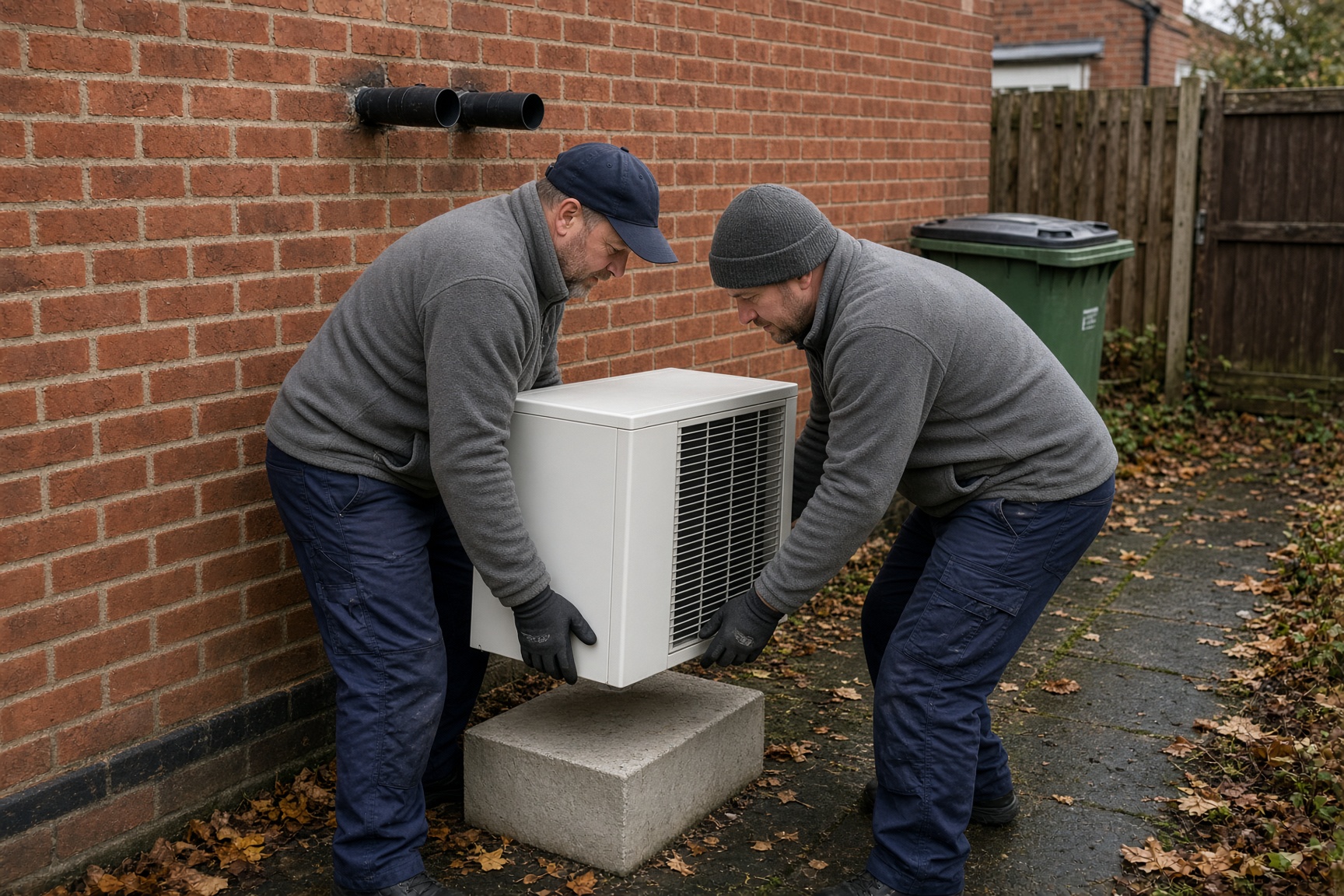
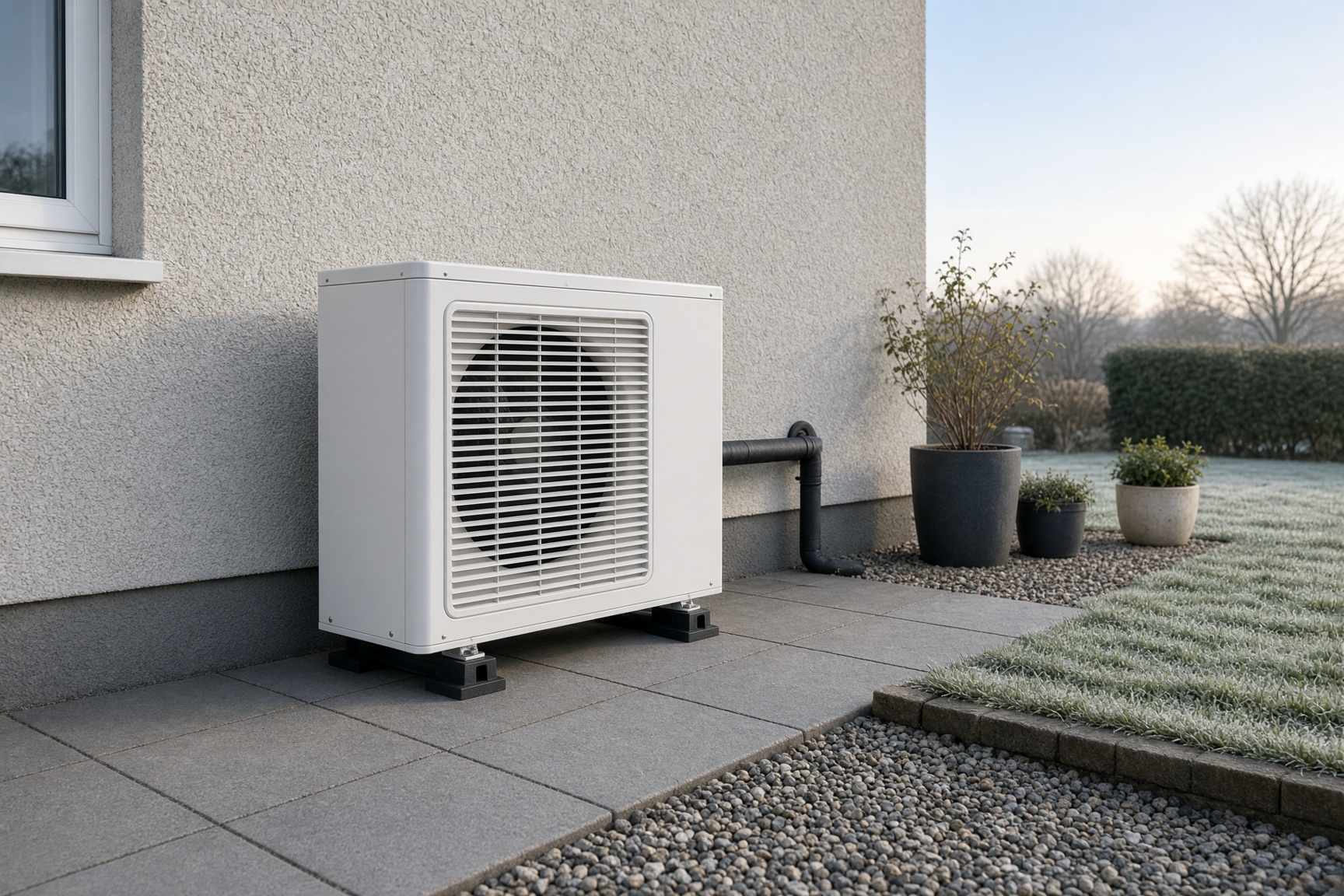
Fitting the outdoor unit is usually one of the first jobs in an air source heat pump installation.
Heat pump installation is less disruptive than most people expect, but it is a bigger job than swapping a boiler. Along with the outdoor unit there is usually a hot water cylinder to fit, some pipework to change, perhaps a few larger radiators, and new electrics and controls. This guide walks through how a heat pump is installed in a UK home, in the order it happens, so you know what to expect from the first phone call to the day you switch it on.
So how is a heat pump installed? For an air source heat pump replacing a gas, oil or LPG boiler, the process usually takes several weeks from first enquiry to switching on. Most of that is survey, design and paperwork; the installation itself is a few days.
1
Check it suits your home and get quotes
Look at your current heating bills, how well insulated your home is and where an outdoor unit could go. Then ask at least two or three MCS-certified installers to quote. Only MCS-certified installers can apply for the Boiler Upgrade Scheme grant.
2
The home survey
An installer visits for about two hours. They measure every room, window and radiator, check your insulation, pipework and electrics, look at where the outdoor unit and a hot water cylinder could go, and ask how you use your heating and hot water.
3
Heat loss calculation and system design
From the survey, the installer works out how much heat each room loses on a cold day. That sets the size of the heat pump in kW, the flow temperature, and which radiators need to be bigger. MCS standards require a room-by-room heat loss calculation, so be wary of a quote based only on the size of your old boiler.
4
The quote
A good quote shows the heat pump model and size, the cylinder, any radiator and pipework changes, electrical work, the noise and planning check, the grant taken off as a discount, and the expected efficiency (SCOP). Compare quotes on these points, not just the price.
5
The grant application
Your installer applies to Ofgem for the Boiler Upgrade Scheme grant on your behalf. Ofgem then contacts you to confirm you agreed to it, so look out for the email. Once the voucher is issued, an air source heat pump has to be installed within three months.
6
Installation
The installation itself usually takes 2 to 5 days for an air source heat pump. The day-by-day breakdown is below.
7
Commissioning and handover
The installer fills and tests the system, sets the flow temperature and controls, shows you how to use them, and gives you the MCS certificate, the Building Regulations compliance certificate and the warranty details. They also tell your electricity network operator about the heat pump.
8
The first few weeks
Expect a settling-in period while you and the installer fine-tune the settings. Heat pumps work best running steadily at a low temperature, rather than being switched on and off like a boiler.
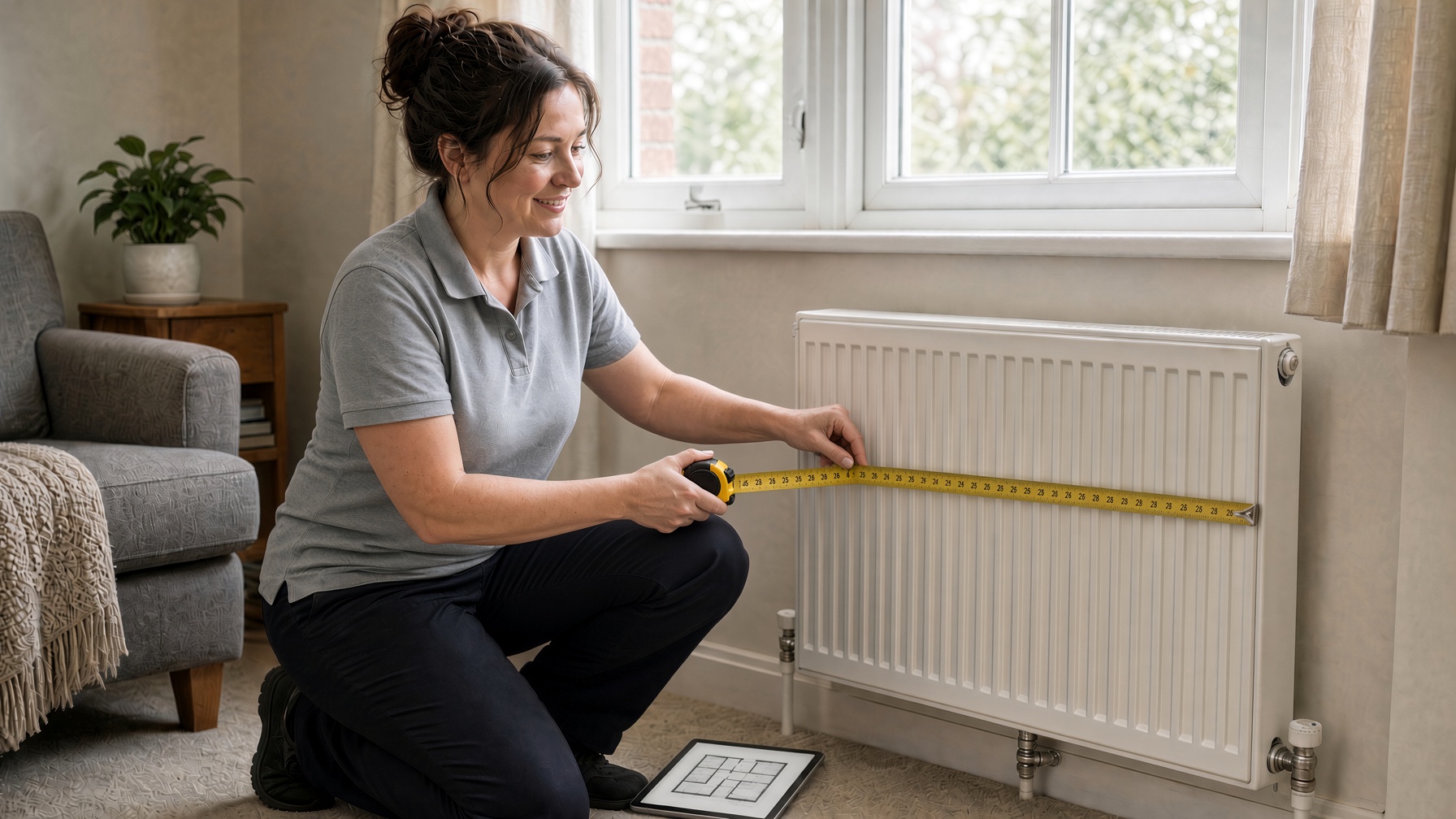
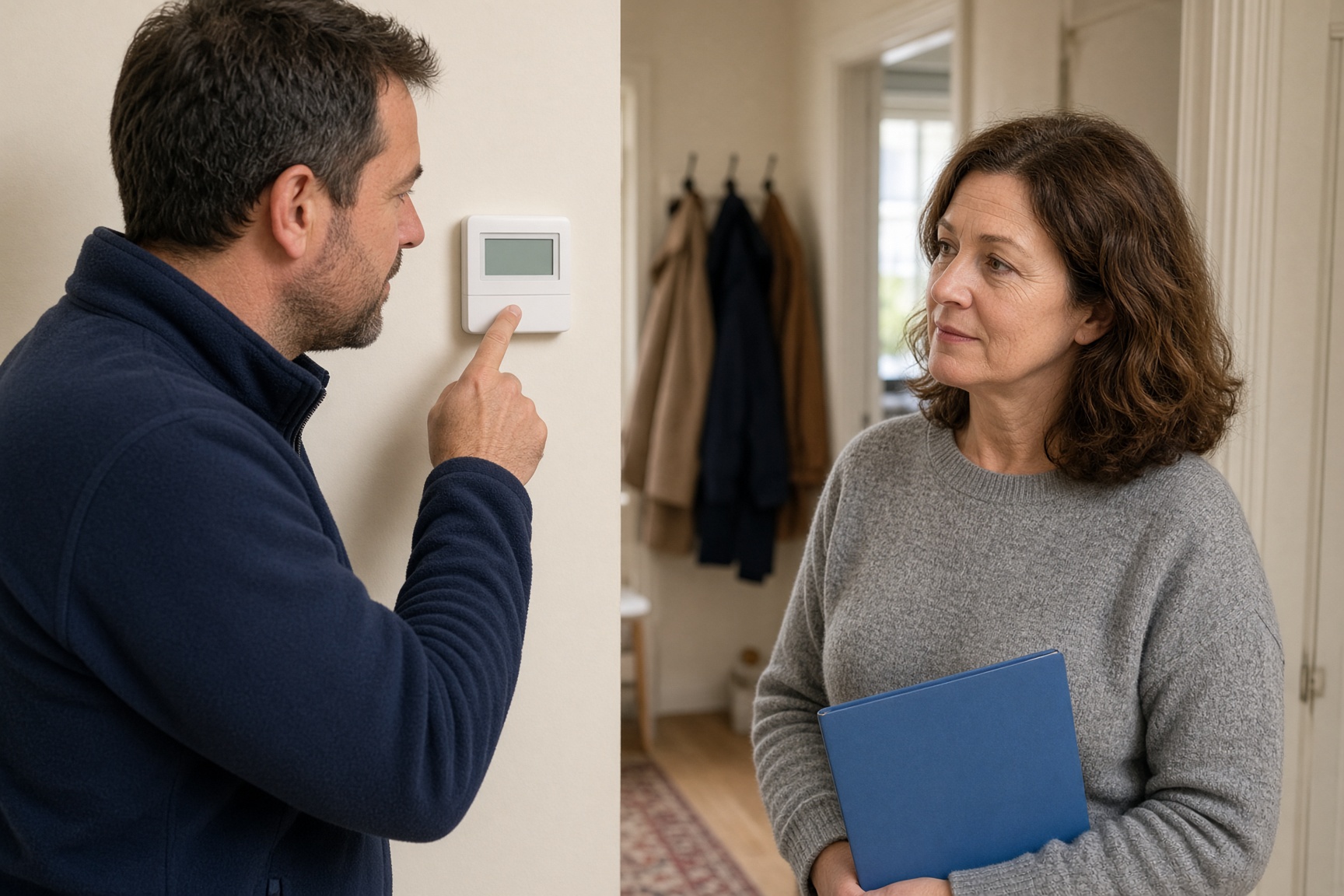
A proper survey measures every room and radiator so the installer can work out your heat loss room by room.
Heat pump installation requirements: what your home needs
Most UK houses can take an air source heat pump, but these are the things an installer checks before quoting.
Space outside for the unit. A typical outdoor unit is about the size of a large suitcase on its side, and needs a firm, level base with clear space around it for air to flow. It can go at the side or back of the house, on a wall bracket or, for some flats and terraces, on a flat roof or balcony if the rules allow.
Space for a hot water cylinder. Heat pumps heat a store of hot water rather than heating it on demand. If you have a combi boiler, you need room for a cylinder, roughly the size of a large fridge freezer, usually in an airing cupboard, loft or utility room.
Radiators big enough for low-temperature heat. A heat pump typically runs at 35°C to 55°C rather than a boiler's 60°C to 70°C, so some radiators may need to be larger. Our heat pump radiators guide explains how installers decide.
Reasonable insulation. You no longer need an Energy Performance Certificate to apply for the grant, but loft and cavity wall insulation still make a smaller, cheaper heat pump possible and cut running costs.
A suitable electricity supply. Some homes need a new consumer unit or a supply upgrade. The installer checks this at the survey.
Underfloor heating works very well with a heat pump, because it runs at the low temperatures a heat pump is most efficient at.
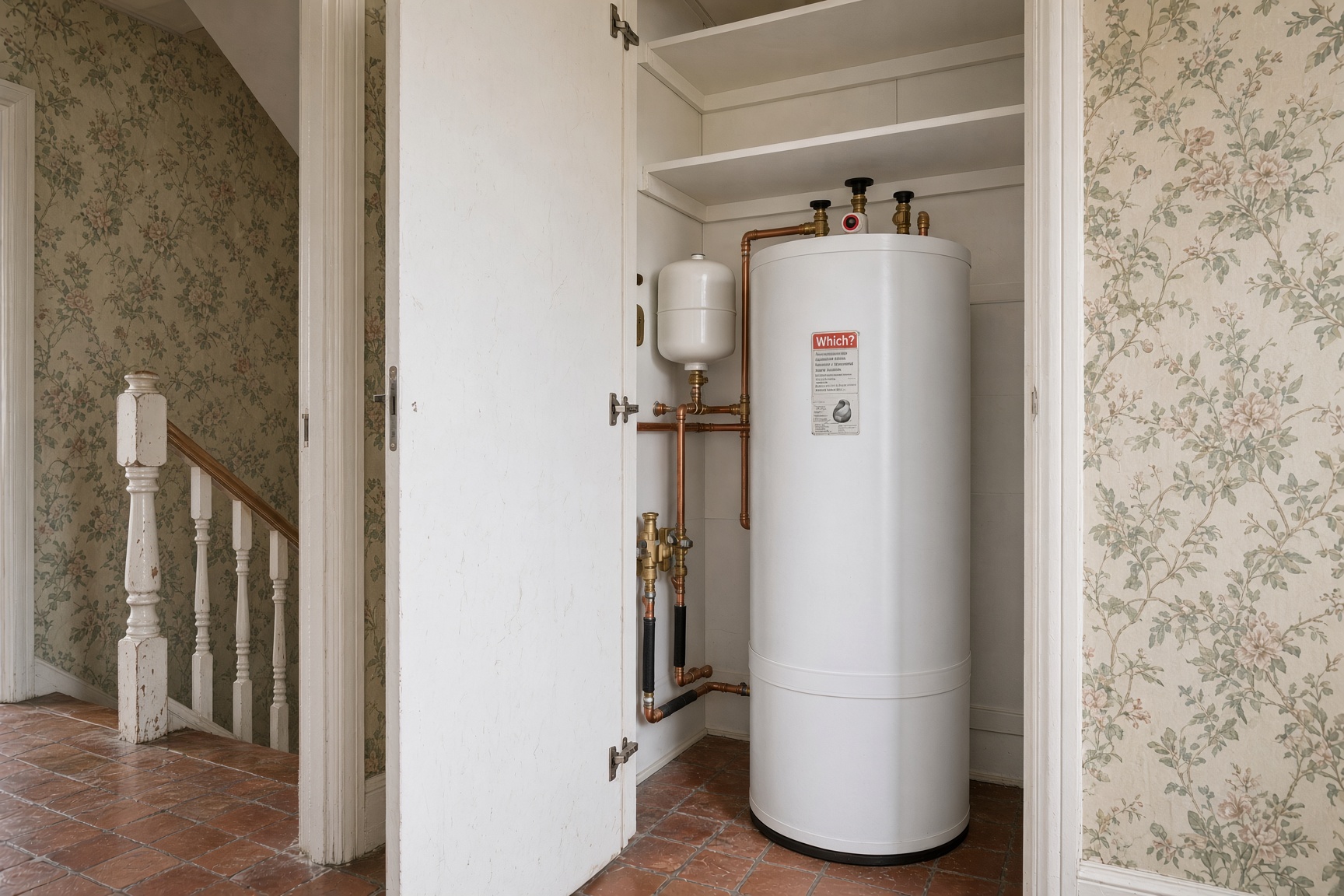
Heat pumps need a hot water cylinder. If you have a combi boiler, finding space for one is part of the survey.
The installation week, day by day
Every job is different, but a typical air source heat pump installation replacing a gas boiler in a three-bedroom house runs something like this. British Gas, for example, says its installations typically take five days with a team of heating engineers and an electrician.
Day
What usually happens
Heating and hot water
Day 1
Dust sheets down, old boiler drained and removed, base or brackets for the outdoor unit, holes drilled for pipework
Heating off. Hot water may be off
Day 2
Outdoor unit positioned, hot water cylinder fitted, main pipework run between them
Usually off, or on an immersion heater
Day 3
Radiators swapped or added where needed, pipework changes inside the house
Off
Day 4
Electrical work: new circuit, isolator, controls and any consumer unit upgrade
Off
Day 5
System filled, flushed and pressure tested, commissioning, controls set up, handover
Back on
Simpler jobs, such as replacing a system that already has a cylinder and suitable radiators, can be done in two or three days. Ground source heat pumps take longer because of the trenches or boreholes. If you are replacing a broken boiler in winter, ask the installer about temporary heaters or a temporary hot water supply for the week.
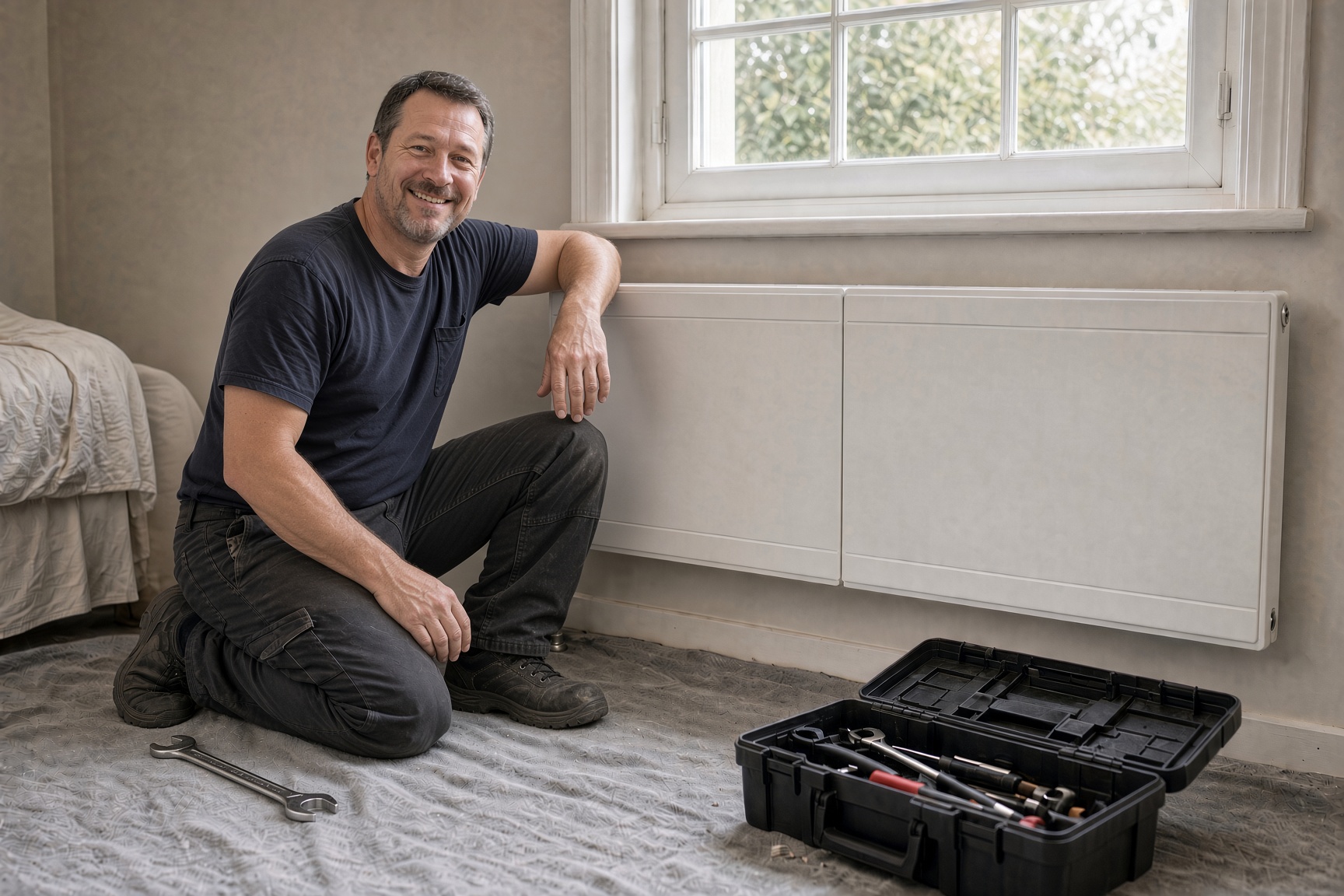
Some rooms need a larger radiator because a heat pump runs at a lower flow temperature than a gas boiler.
Do you need planning permission for a heat pump?
Usually not. In England, an air source heat pump on a house normally counts as permitted development. Since 2025 the rules allow a larger unit (up to 1.5 cubic metres), allow two units on a detached house, and no longer require the unit to be at least a metre from your boundary.
The condition that still matters is noise. Under permitted development the installation has to pass the MCS 020(a) noise calculation, which checks the sound level at your neighbours' nearest window. Your installer does this as part of the design. Listed buildings, some conservation areas and flats often need permission, and the rules are different in Wales, Scotland and Northern Ireland. Our heat pump noise and planning guide has the detail.
How the heat pump grant works during installation
In England and Wales, the Boiler Upgrade Scheme pays £7,500 towards an air source or ground source heat pump, or £9,000 if you are replacing oil or LPG and apply by 31 March 2027. It is not means-tested. Since April 2026 there is also a £2,500 grant for air-to-air heat pumps, and you no longer need an EPC to apply.
The installer applies, not you. They take the grant off your quote as an upfront discount, so you never pay the full amount and claim it back.
Ofgem checks with you. You will be asked to confirm you agreed to the application and that you received the discount.
The voucher has a time limit. For an air source heat pump it lasts three months from approval, so book the installation date before the application goes in.
In Scotland the grant comes from Home Energy Scotland instead: up to £7,500, or £9,000 with the rural uplift, plus an optional interest-free loan.
A fully installed air source heat pump typically costs £8,000 to £15,000 before the grant. Nesta's analysis of Boiler Upgrade Scheme data put the median installation at £13,041 in 2025/26, which is about £5,500 after the £7,500 grant. The main extras that push a quote up are radiator upgrades (typically £100 to £400 each) and a new hot water cylinder (£600 to £1,200) if you have a combi boiler.
A finished installation: the unit sits on anti-vibration feet with clear space around it for airflow.
How to choose a heat pump installer
The installer matters more than the brand. A well-designed system from a careful installer runs more efficiently, and costs less to run, than a premium heat pump that is badly sized or set up. Questions worth asking:
Are you MCS-certified for heat pumps, and can I see your number on the MCS register?
Will you do a room-by-room heat loss calculation, and can I have a copy?
What flow temperature and seasonal efficiency (SCOP) is the system designed for?
Which radiators need changing, and is that included in the price?
Have you done the MCS 020(a) noise calculation for where the unit will go?
How long is the warranty on the heat pump and on your workmanship, and who services it?
Be wary of any installer who sizes the system from your old boiler, won't put the design in writing, or asks you to pay the grant amount yourself.
Not in any way that makes sense for most people. To get the Boiler Upgrade Scheme grant the system has to be installed by an MCS-certified installer. The electrical work has to meet Building Regulations, and split systems that need refrigerant connecting can only be handled by an F-gas certified engineer. A DIY install would lose you the £7,500 grant, which is more than most installers charge for their labour, and probably the manufacturer's warranty too.
After installation: handover and the first few weeks
At handover the installer should set up the controls with you and leave the MCS certificate and paperwork.
1
Keep the paperwork
You should get the MCS certificate, a Building Regulations compliance certificate, the commissioning record, the heat loss calculation and the warranty registration. You will need these if you sell the house or make a warranty claim.
2
Leave it running steadily
Heat pumps are most efficient running at a low, steady temperature. Most installers set weather compensation, which adjusts the flow temperature to the outside temperature, so the system does the work without you switching it on and off.
3
Switch to a heat pump tariff
A tariff with cheaper electricity at certain times can cut running costs noticeably. Our Octopus tariffs compared guide covers Cosy and the other options, and our heat pump electricity use guide shows what to expect on your bill.
4
Ask for a follow-up
Many installers check in after a few weeks to adjust the settings once the house has settled. If rooms are too cold or the bills look high, call them back rather than turning the thermostat up.
Most air source heat pump installations take 2 to 5 days. The whole process, from first enquiry and survey to switching on, usually takes several weeks, mostly for the survey, design and grant paperwork. Ground source heat pumps take longer because of the groundworks.
What happens during a heat pump survey?
An installer spends about two hours measuring every room, window and radiator, checking your insulation, pipework and electrics, and looking at where the outdoor unit and hot water cylinder could go. They use this to calculate the heat loss room by room and design the system.
What are the requirements for installing a heat pump?
You need space outside for the unit with room for airflow, space indoors for a hot water cylinder, radiators that can heat rooms at a lower temperature (some may need upsizing), and a suitable electricity supply. Reasonable loft and wall insulation helps but is no longer a condition of the grant.
Do I need planning permission for a heat pump?
Usually not for a house in England, where an air source heat pump normally counts as permitted development as long as it passes the MCS 020(a) noise calculation. Listed buildings, some conservation areas and flats may need permission, and the rules differ in Wales, Scotland and Northern Ireland.
Will I be without heating and hot water?
Usually for a few days of the installation for heating, and for a day at most for hot water, though it depends on the job. If you are replacing a broken boiler in winter, ask the installer about temporary heating.
Do I need a hot water cylinder for a heat pump?
Yes, in almost all cases. A heat pump heats a store of hot water rather than heating water on demand like a combi boiler, so if you have a combi you will need room for a cylinder.
Can I install a heat pump myself?
Not if you want the grant. The Boiler Upgrade Scheme requires an MCS-certified installer, the electrical work must meet Building Regulations, and split systems need an F-gas certified engineer to connect the refrigerant.
Do I need an EPC to get the heat pump grant?
Not any more. Since 28 April 2026 a valid EPC is no longer required to apply for the Boiler Upgrade Scheme. If you have one, the installer will still use its number.
Who tells the electricity network about my heat pump?
Your installer does. For most homes they can connect the heat pump and notify the network operator within 28 days. Larger systems need approval from the network operator before they are connected.
How much does heat pump installation cost?
Typically £8,000 to £15,000 before the grant for an air source heat pump, with a median of about £13,000, so roughly £5,500 after the £7,500 Boiler Upgrade Scheme grant. Radiator upgrades and a new cylinder are the main extras.
Which kind of quote suits you?
Either way, the first step is a home survey and a room-by-room heat loss calculation, and the installer takes the grant off your quote.
Published 11 October 2026. Sources: Ofgem Boiler Upgrade Scheme guidance (version 5, applications from 28 April 2026); MCS guidance on notifying network operators and on MCS 020(a); England's permitted development changes for heat pumps (2025); installation timings published by British Gas; Nesta's analysis of Boiler Upgrade Scheme installation costs. Grant amounts and rules can change, so your installer will confirm what applies when you apply.
To provide the best experiences, we use technologies like cookies to store and/or access device information. Consenting to these technologies will allow us to process data such as browsing behaviour or unique IDs on this site. Not consenting or withdrawing consent, may adversely affect certain features and functions.
Functional
Always active
The technical storage or access is strictly necessary for the legitimate purpose of enabling the use of a specific service explicitly requested by the subscriber or user, or for the sole purpose of carrying out the transmission of a communication over an electronic communications network.
Preferences
The technical storage or access is necessary for the legitimate purpose of storing preferences that are not requested by the subscriber or user.
Statistics
The technical storage or access that is used exclusively for statistical purposes.The technical storage or access that is used exclusively for anonymous statistical purposes. Without a subpoena, voluntary compliance on the part of your Internet Service Provider, or additional records from a third party, information stored or retrieved for this purpose alone cannot usually be used to identify you.
Marketing
The technical storage or access is required to create user profiles to send advertising, or to track the user on a website or across several websites for similar marketing purposes.