
Heat Pump Radiators: Do You Need to Upgrade Yours?
The single most common reason UK heat pumps underperform isn't the brand, it's radiators sized for a gas boiler still doing the job.
Affiliate disclosure: Some links on this page may be affiliate links. If you buy through them we earn a small commission at no extra cost to you. This doesn't affect our recommendations.
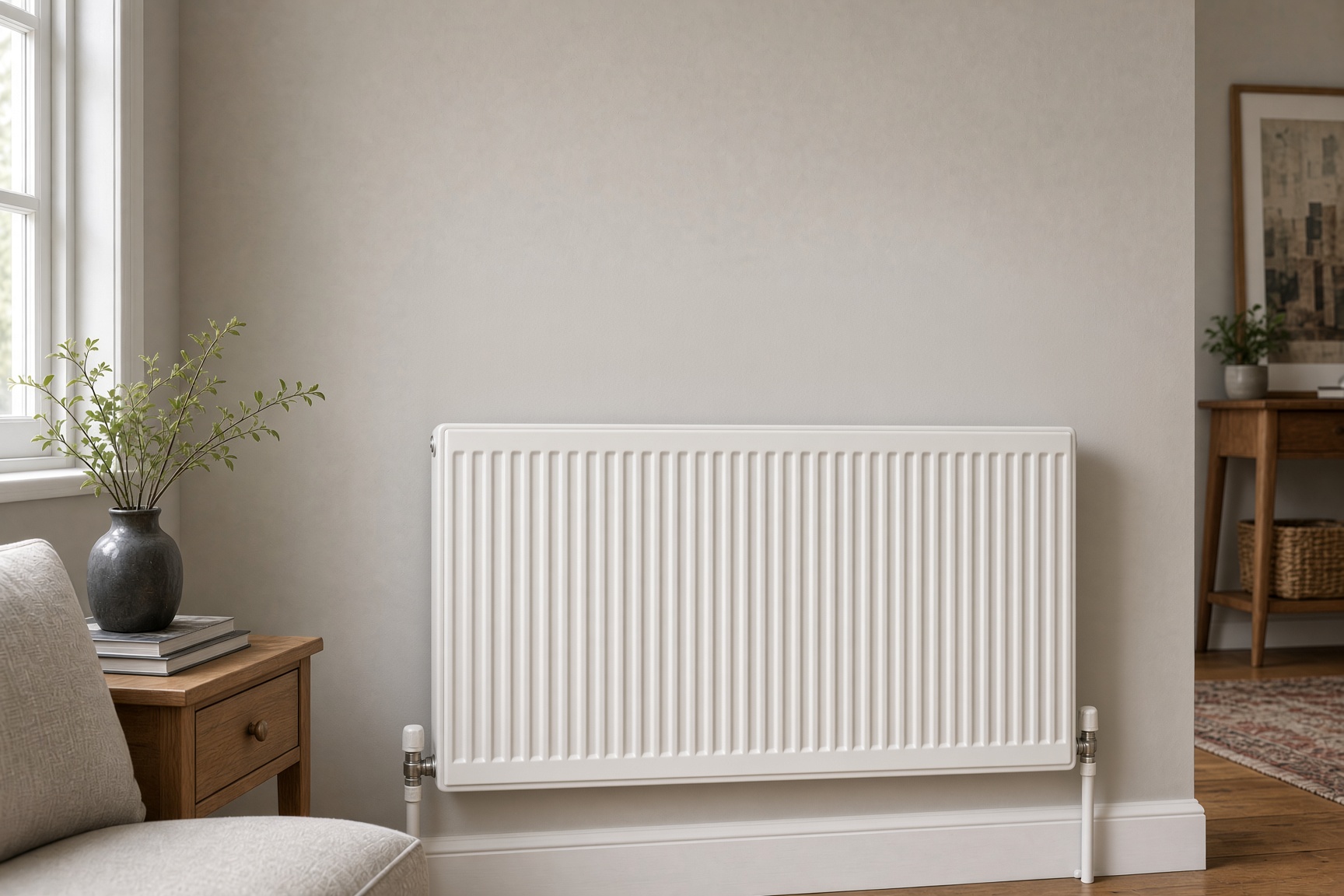
If you're getting quotes for a heat pump, there's a question that matters more than which brand ends up on your invoice: will your existing radiators actually work? This is consistently named by installers and heating engineers as the single most common cause of a heat pump underperforming after installation, not a faulty unit, not the wrong brand, but radiators sized for a gas boiler quietly struggling to keep up. For the full picture on heat pump types and costs, see our complete Heat Pumps UK guide.
Quick answer: Most UK homes need some radiators upgraded for a heat pump, but very few need a full house swap, typically 2-5 radiators, in the largest or coldest rooms. This is because heat pumps run at much lower water temperatures than gas boilers (35-55°C vs 70-80°C), and radiators output significantly less heat at those lower temperatures, meaning the same radiator that worked fine on your boiler may need to be physically bigger to deliver the same warmth.
Why This Matters More Than the Brand on the Box
A gas boiler heats water to 70-80°C and pushes it round your radiators quickly, then switches off: plenty of margin even if a radiator is slightly undersized, because the water's simply hot enough to make up the difference. A heat pump works completely differently: it runs at a much lower flow temperature, typically 35-55°C, for longer periods throughout the day. This lower temperature is exactly what makes a heat pump efficient, but it also means every radiator in the system needs enough surface area to release the same amount of heat from noticeably cooler water.
This is why installer forums and heating engineers repeatedly say the flow temperature and radiator design matter more than which manufacturer's name is on the outdoor unit: a well-sized Worcester Bosch at 45°C will outperform a poorly-sized Mitsubishi Ecodan running at 55°C just to compensate for undersized emitters.
What "Delta T" Actually Means: and Why Your Radiator's Rated Output Is Misleading
Every radiator has a published heat output figure, but that figure is tested under a specific standard condition called "Delta T 50," meaning a water temperature of 75°C against a room temperature of 20°C, a 50-degree gap. That's roughly what a gas boiler delivers, which is why the rated figure has always matched real performance for boiler systems.
A heat pump running at 45°C flow creates a much smaller gap, roughly Delta T 22-25, and radiator output falls sharply as that gap shrinks. Multiple independent technical sources converge on the same real number: a radiator delivers only around 42% of its rated output at a 45°C flow temperature compared to its Delta T 50 rating. A radiator rated at 2kW on a gas boiler might deliver less than 1kW on a heat pump running at that flow temperature.
A worked example
A radiator rated 1,500W under standard Delta T 50 conditions outputs roughly 630W at a 45°C heat pump flow temperature, around 42% of its rating. If that room's actual heat loss is 900W, the radiator is now undersized and needs upgrading, even though it worked perfectly well on the old gas boiler.
How Many Radiators Actually Need Replacing?
Here's the reassuring part: most UK homes don't need a full house swap. Radiators installed since around 2000 are often already somewhat oversized relative to what a gas boiler strictly needs, meaning there's real headroom before they become undersized for a heat pump. Most homes typically need just 2-5 radiators upgraded, usually in the largest rooms, rooms with the most external walls, or rooms that have always felt harder to heat.
There's no shortcut around a proper room-by-room heat loss calculation: the MCS installation standard for heat pumps (MIS 3005) specifically requires this for any installation claiming the £7,500 BUS grant, precisely because guessing leads to exactly the underperformance problem this article is about. A proper installer will measure every room and tell you exactly which radiators need upsizing and by how much, rather than replacing everything as a blanket precaution.
In practice, upsizing usually means the next size or two up in the same radiator range: a 600×1200mm double panel radiator might become 600×2000mm or 700×1600mm for the same room. It's rarely a specialist "heat pump radiator" product; it's usually just a bigger version of a standard radiator, which keeps upgrade costs more reasonable than the phrase "new radiators" might suggest.
What About Underfloor Heating Instead?
Underfloor heating is an excellent match for heat pumps: the whole floor acts as one enormous, low-temperature emitter, meaning it can deliver comfortable heat at flow temperatures as low as 30-35°C, even lower than well-sized radiators typically need. This is why new-build heat pump installations very often specify underfloor heating from the outset.
For an existing home, retrofitting underfloor heating throughout is a significantly bigger, more disruptive and more expensive job than upsizing a handful of radiators, only worth considering if you're already doing major renovation work that involves lifting floors anyway. A hybrid approach (underfloor heating downstairs, upgraded radiators upstairs) is also a realistic option many installers offer.
What to Check on Your Own Heat Pump Quote
- Was there a proper room-by-room heat loss survey?: not a quick walk-round, an actual calculation for every room
- What flow temperature is the system designed for?: lower is generally better for efficiency, but needs correspondingly larger emitters
- Exactly which radiators are being upgraded, and why?: a good installer can explain the specific rooms and the reasoning, not just a blanket number
- Is the quote suspiciously silent on radiators entirely?: an installer who hasn't mentioned radiators at all may not have done a proper heat loss calculation
This is exactly the kind of detail worth asking about directly if it's missing. See our heat pump brands guide for the wider context on why installation quality and correct sizing matter more than the brand itself.
Get a quote that includes a proper heat loss survey
Compare quotes from MCS-certified installers who'll assess your radiators properly before recommending anything. Free, no obligation.
Get Free Heat Pump Quotes →Frequently Asked Questions
Related Guides
Published September 2026. Technical figures based on standard UK radiator testing conditions (BS EN 442, Delta T 50) and MCS MIS 3005 heat pump design standards. Individual radiator and room requirements vary. Always get a full heat loss survey from an MCS-certified installer before finalising radiator specifications.
Which kind of quote suits you?
"I'd rather deal with one good installer" Get a quote from Blue Ape Renewables, the installer we work with. MCS-certified for heat pumps and registered for the Boiler Upgrade Scheme grant, fitting air source heat pumps across England, Wales and Scotland. Get a quote →Tell us about your project and local installers will quote
Both are free and there's no obligation. We earn a commission if you go ahead with Blue Ape or with one of the installers you are matched with.