Home Battery Installation UK: What Happens, How Long It Takes and the Paperwork
What happens from the first quote to switching on, how long each stage takes, when the network operator has to approve it first, and the certificates you should get at the end.
Published 20 October 2026
Half a day
Typical battery-only install
1–2 days
Solar and battery together
28 days
To notify the network on G98
0% VAT
On batteries until March 2027
Affiliate disclosure: some links on this page are affiliate links. If you buy through them we earn a small commission at no extra cost to you. It doesn't affect what we recommend.
The short answer
The install itself is quick. A battery on its own usually takes about half a day, adding one to existing solar about a day, and solar and a battery together one to two days.
The wait is usually the paperwork. Small systems go in first and the installer tells your network operator within 28 days. Bigger ones need the network operator's approval before they can be switched on, which often takes several weeks.
Where it goes matters more than ever. Since 15 October 2026, new batteries can't go in lofts or bedrooms, and outdoor ones need a metre of clearance from doors and windows.
Don't let anyone switch it on without the paperwork. You should get an electrical certificate, a Building Regulations certificate and proof the network operator has been told.
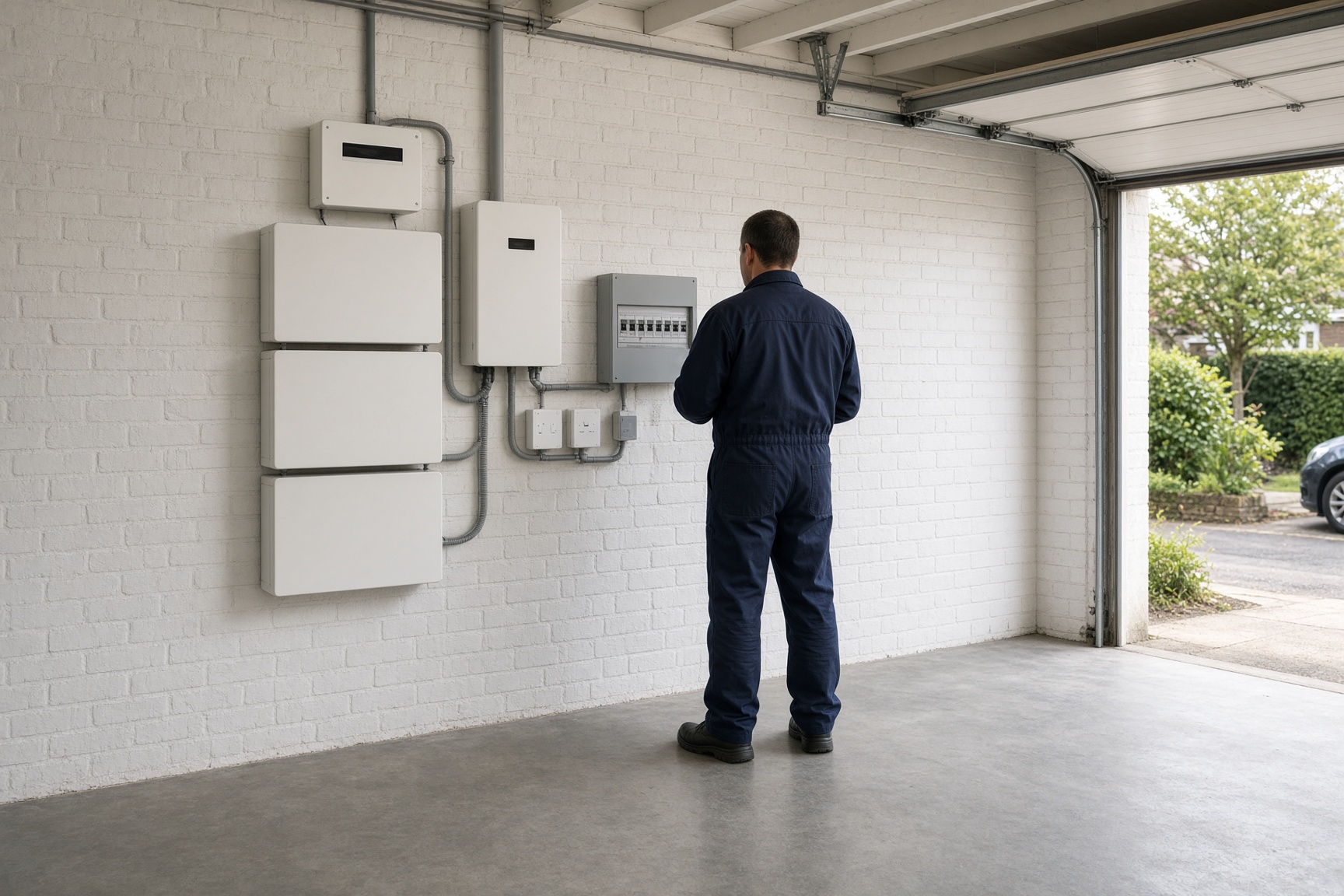
Most home batteries go on a wall in a garage, utility room or outside, and take about half a day to fit on their own.
The installation, step by step
Most home battery installs follow the same seven stages, whoever fits them.
1
Quote and survey
The installer looks at your electricity use, your meter and consumer unit, any solar you already have and where the battery could go. Some do this remotely from photos and your bills. Octopus Energy, for example, usually surveys remotely. Others visit.
2
Design and sizing
They choose the battery size and inverter, and decide whether it connects alongside your existing solar (AC-coupled) or replaces your solar inverter (a hybrid). Our guide to the two options explains the difference.
3
Network notification or approval
Depending on the inverter size, the installer either notifies your network operator after the install (G98) or applies for approval before it (G99). See G98 or G99 below.
4
Install day
The battery and inverter are fixed to a wall or a fire-resistant surface, cabled to your consumer unit, and fitted with isolators and labels. Expect the power to be off for part of the day.
5
Testing and commissioning
The installer tests the electrical work, sets the battery up in its app, connects it to your Wi-Fi and sets how it charges, for example overnight on a cheap tariff.
6
Notifying the network
For G98 systems, the installer must tell your network operator within 28 days of commissioning. For G99 systems, approval should already be in place.
7
Handover
You get the certificates, the warranty registration and a walk-through of the app. Check everything on the paperwork list before you pay the final balance.
How long does a home battery installation take?
Job
On site
Wait before install
Battery only, no solar
About half a day
None for most small systems
Adding a battery to existing solar
About a day
None for most small systems
New solar panels and a battery
1 to 2 days, plus scaffolding
Scaffolding booking, and network approval if it is G99
Any system that needs G99 approval
As above
Often 4 to 8 weeks for the network operator to approve
On-site times are typical figures from installer guides and vary with the system and your wiring. The G99 timescale is from Heatable's G99 guide, updated 24 August 2026.
Most of the delay, when there is one, comes before install day: waiting for a survey slot, for scaffolding if panels are going on the roof, or for network approval on a bigger system.
G98 or G99: does the network operator need to approve it?
Anything that can feed power into the grid has to be registered with your local network operator (also called the DNO). Which route applies depends on how much your system can export, and a battery counts towards that limit along with any solar.
G98
G99
Applies to
Systems up to 16A per phase, about 3.68kW on a normal single-phase home supply
Systems above that limit
When
Install first, then the installer notifies within 28 days of commissioning
The installer applies before the system is switched on
Wait
None
Often 4 to 8 weeks, sometimes longer
Cost to you
Normally included in the install
The application is usually free, but some installers charge an admin fee
This catches people out because many battery inverters are bigger than 3.68kW. A 5kW battery inverter, or a battery added to a 4kW solar system, can push the total over the G98 limit. Installers can often keep a system under G98 by limiting how much it exports, which avoids the wait. Ask which route your quote assumes, and whether the export is being capped to get there.
G98 limits and the 28-day rule are from SSEN's summary guide to G98. The combined limit includes all generation and storage at the property.
Want an installer to handle the paperwork?
A good installer sorts the network notification or approval for you and tells you up front which route your system needs. Get a fitted price from Blue Ape Renewables, the MCS-certified installer we work with, or compare prices from local installers.
No obligation. We earn a commission if you go ahead.
Where the battery can go
Since 15 October 2026, every new battery installation has to meet the battery chapter added to the wiring regulations (BS 7671 Amendment 4), alongside the fire safety specification PAS 63100:2024.
Usually fine: garages, outbuildings, utility rooms with fire separation, and outside walls.
Not allowed for new installs: lofts, bedrooms, hallways and stairwells, and small internal cupboards.
Outdoors: at least a metre from doors and windows.
The rules aren't retrospective, so a battery already fitted correctly under the old rules doesn't need moving. If a quote proposes a loft, or doesn't mention either standard, push back. Our guide to the new battery rules goes through them in detail.
The paperwork you should get
Ask for all of this at handover. Keep it with your house documents, because a buyer's solicitor will ask for it if you ever sell.
Electrical Installation Certificate (EIC). Confirms the work was designed, installed and tested to the wiring regulations.
Building Regulations compliance certificate. Adding a battery usually means new electrical work that must be notified. A registered electrician does this through their competent person scheme, and the certificate follows by post or email.
Network operator paperwork. A copy of the G98 notification, or the G99 approval.
MCS certificate, if the installer is MCS-certified for batteries under the MCS battery standard (MIS 3012). You can check an installer on the MCS website. Your energy supplier may ask for it before paying for exported power.
Warranty registration for the battery and inverter, in your name, plus the installer's own workmanship guarantee.
App login and settings, with a note of how the battery has been set to charge and discharge.
Tell your home insurer about the battery too, and check how it affects your cover.
Adding a battery to existing solar: what is different
The install itself is similar, but the installer needs more information first:
Your solar paperwork. Octopus, for example, asks for your MCS certificate and inverter details, and sometimes 12 months of generation data.
Your inverter's age and condition. If it's newish, an AC-coupled battery sits alongside it. If it's old or failing, a hybrid inverter replacing it can make more sense.
Feed-in Tariff payments. If you are on the old Feed-in Tariff, tell your FIT supplier before the battery goes in, and ask how it affects your payments.
A GivEnergy inverter. GivEnergy went into administration in April 2026 and its administrator won't honour hardware warranties. Our guide to adding a battery to existing solar covers the options.
What it costs, and how payment usually works
Fitted prices start at about £3,950 for a 5 kWh battery and run to around £11,500 for a 13.5 kWh Tesla Powerwall 3. A 10 kWh battery usually costs £5,300 to £7,500 installed. Our best home battery guide compares five systems with installed prices.
0% VAT applies to batteries installed in homes until 31 March 2027, with or without solar. A reputable installer applies it automatically.
A deposit is normal, paying everything upfront is not. Octopus, for example, takes £500 when you sign, which it says is non-refundable, and the rest after installation, according to its battery installation page. Ask whether your deposit is protected before you pay it.
Pay the balance after handover, once the system is working and you have the paperwork.
Not sure a battery pays for itself at all? Our battery storage calculator works out the payback for your usage and tariff.
Tell us about your project and local installers will quote
Both are free and there's no obligation. We earn a commission if you go ahead with Blue Ape or with one of the installers you are matched with.
Questions to ask your installer
Where exactly will the battery go, and does that meet BS 7671 Amendment 4 and PAS 63100? Can you confirm it in writing?
Is my system G98 or G99, and are you limiting the export to stay under G98?
Are you MCS-certified for batteries, and which competent person scheme will you notify the work through?
Who honours the battery warranty if the manufacturer goes out of business, and is your workmanship guarantee insurance-backed?
Will the battery keep any circuits running in a power cut? Which ones?
How much is the deposit, is it protected, and when is the balance due?
Red flags: a quote that puts the battery in a loft or bedroom, doesn't mention the network operator, asks for the full price upfront, or uses a brand with no clear UK warranty support.
Frequently asked questions
How long does it take to install a home battery?
Usually about half a day for a battery on its own, about a day to add one to existing solar, and one to two days for new solar panels and a battery together. If the system needs G99 approval from the network operator, add a wait of often 4 to 8 weeks before install day.
Do I need permission to install a home battery?
You don't normally need planning permission for a battery inside a garage or utility room, but the network operator must be told. Systems up to about 3.68kW on a single-phase supply are notified within 28 days of commissioning under G98. Bigger systems need approval before they are switched on, under G99.
Does my installer notify the DNO?
Yes. Your installer handles the G98 notification or the G99 application. Ask for a copy for your records.
Is installing a home battery notifiable under Building Regulations?
Usually, because it involves new electrical work. A registered electrician notifies it through their competent person scheme, and you receive a Building Regulations compliance certificate. Without one, you may need Building Control to approve the work, which costs more and takes longer.
Can a home battery go in the loft?
Not for new installations since 15 October 2026. BS 7671 Amendment 4 rules out lofts, bedrooms, hallways, stairwells and small internal cupboards. Garages, outbuildings, fire-separated utility rooms and outside walls are the usual locations.
Will my power be off during installation?
For part of the day, while the battery is connected to your consumer unit. Installers can usually tell you roughly when, so plan around fridges, freezers and working from home.
What certificates should I get after a battery installation?
An Electrical Installation Certificate, a Building Regulations compliance certificate, a copy of the network operator notification or approval, an MCS certificate if your installer is MCS-certified for batteries, and warranty registrations for the battery and inverter.
How much does a home battery installation cost?
About £3,950 for a 5 kWh battery up to around £11,500 for a 13.5 kWh Tesla Powerwall 3, fitted, with 0% VAT until 31 March 2027. A 10 kWh battery usually costs £5,300 to £7,500 installed.
Published 20 October 2026. G98 limits and the 28-day notification rule are from SSEN's summary guide to Engineering Recommendation G98. G99 timescales and application costs are from Heatable's G99 guide, updated 24 August 2026. Battery location rules are from BS 7671:2018+A4:2026 and PAS 63100:2024. Octopus survey, deposit and paperwork requirements are from Octopus Energy's battery installation page, checked 20 October 2026. Installed prices match our best home battery guide, updated 20 October 2026. On-site installation times are typical figures from installer guides. This is general guidance: your installer and network operator confirm what applies to your home.
To provide the best experiences, we use technologies like cookies to store and/or access device information. Consenting to these technologies will allow us to process data such as browsing behaviour or unique IDs on this site. Not consenting or withdrawing consent, may adversely affect certain features and functions.
Functional
Always active
The technical storage or access is strictly necessary for the legitimate purpose of enabling the use of a specific service explicitly requested by the subscriber or user, or for the sole purpose of carrying out the transmission of a communication over an electronic communications network.
Preferences
The technical storage or access is necessary for the legitimate purpose of storing preferences that are not requested by the subscriber or user.
Statistics
The technical storage or access that is used exclusively for statistical purposes.The technical storage or access that is used exclusively for anonymous statistical purposes. Without a subpoena, voluntary compliance on the part of your Internet Service Provider, or additional records from a third party, information stored or retrieved for this purpose alone cannot usually be used to identify you.
Marketing
The technical storage or access is required to create user profiles to send advertising, or to track the user on a website or across several websites for similar marketing purposes.