
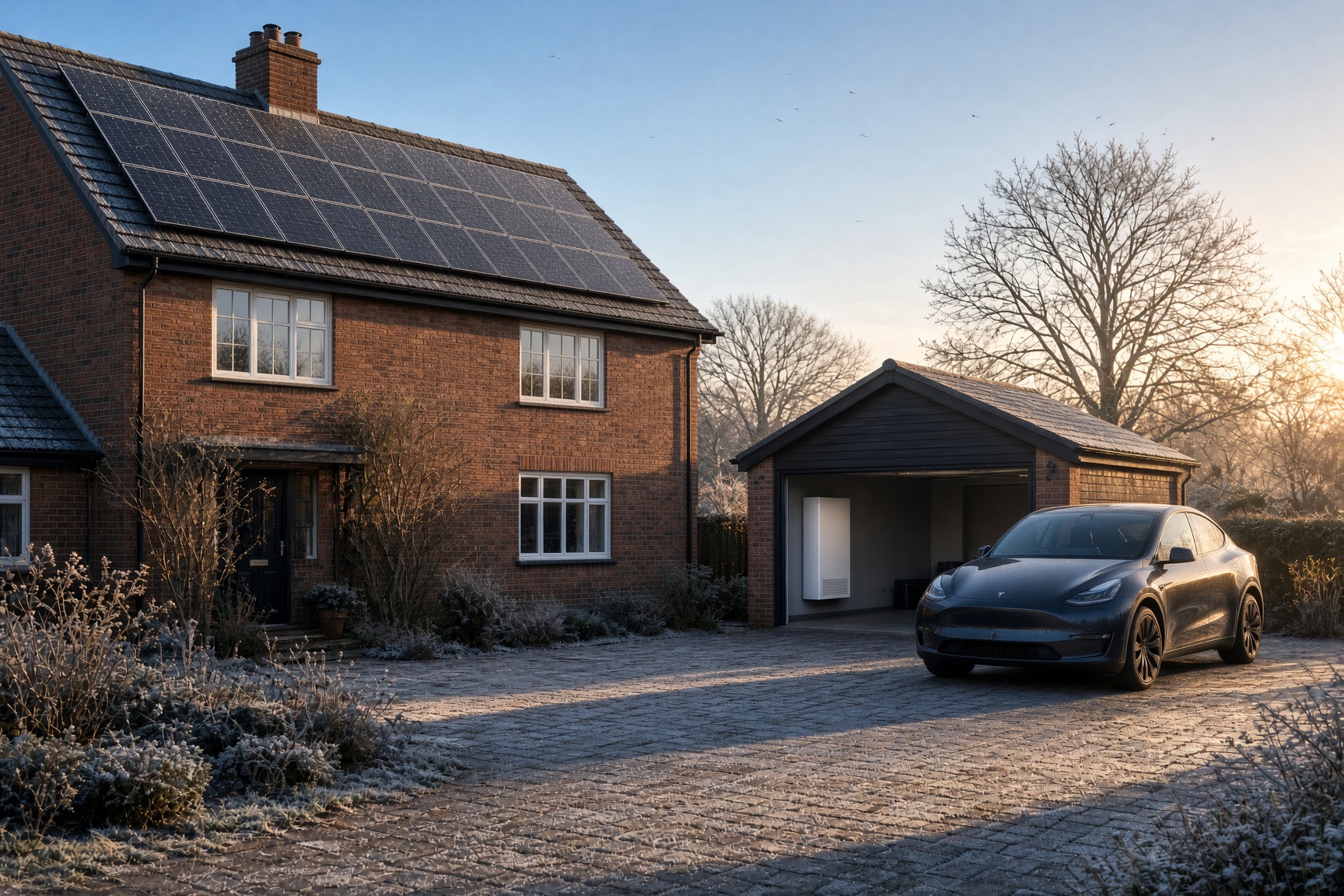
Battery Storage · Solar · Winter
Do Solar Batteries Work in Winter? What Changes, and What They Still Save
Your solar panels make a fraction of their summer output in December, so a battery that filled itself from the roof all summer now sits half empty. It still works, and it can still save money, but only if you change how it charges.
Published 3 November 2026
Affiliate disclosure: some links on this page are affiliate links. If you buy through them we earn a small commission at no extra cost to you. It doesn't affect what we recommend.
The short answer
On this page:
How much solar you get in a UK winter
Less than most people expect. We ran the EU's PVGIS solar model for a typical 4kW system facing south at a 35° tilt, using its 2005 to 2020 weather data, in four UK cities:
| Location | December, per day | July, per day | Share of the year from November to February |
|---|---|---|---|
| Exeter | 4.6 kWh | 16.4 kWh | 17% |
| London | 4.8 kWh | 16.1 kWh | 17% |
| Birmingham | 4.4 kWh | 15.4 kWh | 17% |
| Glasgow | 2.5 kWh | 14.3 kWh | 14% |
PVGIS (EU Joint Research Centre) estimates for a 4kW peak system, south-facing, 35° tilt, 14% system losses, SARAH2 weather data 2005 to 2020. Averages: a dull week can be far lower, and a frosty, clear day higher.
December gives about 3.5% of a year's output in Birmingham and only 2.3% in Glasgow. Ofgem's typical household uses 2,500 kWh of electricity a year, about 6.8 kWh a day on average and more in winter, so in December your panels cover a smaller share of what you use, not a surplus.
What happens to your solar battery in winter
In summer a battery fills up from the panels by early afternoon and powers your evening. In winter the panels mostly run whatever is on in the house during the few hours of daylight. On many days there's nothing left to send to the battery, so it sits near empty while you pay full price for your evening electricity.
In summer, when the battery fills early, a solar diverter can send the extra to your hot water instead of exporting it.
Left on its summer settings, a solar battery does little from November to February. That's why the "do solar batteries work in winter" question comes up: the battery works, but it has nothing to store.
The winter fix: charge it from the grid overnight
Most home batteries, and the inverters that run them, can charge from the grid at times you choose. In winter you set the battery to fill up in your tariff's cheap overnight hours, then run the house from it through the day and the expensive evening peak. Any solar you do get tops it up.
If you're adding a battery now, our guide to home battery installation covers how long it takes and the paperwork.
What a solar battery saves in winter
The saving is the difference between the cheap rate you charge at and the rate you would otherwise pay, minus about 10% lost in charging and discharging. This is what each kWh shifted saves on the main tariffs:
| Tariff | Cheap rate | You avoid paying | Saving per kWh shifted |
|---|---|---|---|
| Economy 7 (average rates) | 14.19p overnight | 32.65p day rate | About 16.9p |
| Octopus Flux (solar homes) | 15.4p to 16.9p, 02:00 to 05:00 | 35.6p to 39.2p, 16:00 to 19:00 | About 18p to 20p in the peak, about 8p to 9p at other times |
| Cosy Octopus (heat pump or electric heating) | 13.5p to 14.8p in three windows | 41.2p to 45.3p, 16:00 to 19:00 | About 26p to 29p in the peak, about 12p to 14p at other times |
| Intelligent Octopus Go (needs a compatible EV or charger) | 8p, 23:30 to 05:30 | Your day rate | Depends on your quoted day rate |
Economy 7 rates are MoneySavingExpert's averages across regions on 1 October 2026. Octopus rates are ranges across its 14 regions from its tariff data on 23 October 2026, as in our Octopus tariffs guide. Savings assume 90% of the energy you put in comes back out.
A worked example. A 10 kWh battery used for about 8 kWh a day, charged overnight on Economy 7 and used in place of the day rate, saves about 8 × 16.9p = £1.35 a day. From November to February, about 120 days, that's roughly £160.
Add whatever solar still reaches the battery, and it does better. If you're on a single-rate tariff with no cheap hours, grid charging saves nothing, because the electricity costs the same whenever you buy it. For the full-year sums, including batteries with no solar at all, see our home battery without solar payback guide.
Some suppliers also pay households to cut their use at busy times on cold winter evenings, through schemes such as Octopus's Saving Sessions. A battery lets you take part without switching things off. Check what your supplier offers this winter, as the schemes change from year to year.
Thinking about adding a battery?
Blue Ape Renewables, the installer we work with, fits home batteries and solar panels across England, Wales and Scotland, including batteries added to an existing solar system. MCS-certified and NAPIT-accredited. Book a solar or battery install through us and you get £250 off a qualifying installation. Batteries fitted by an installer are VAT-free until 31 March 2027.
Get a quote from Blue Ape →Free. No obligation. We earn a commission if you go ahead.
Do home batteries work in cold weather?
A properly installed home battery is designed for UK winters. Tesla's datasheet for the Powerwall 3, for example, gives an operating range of -20°C to 50°C. Batteries fitted indoors, in a garage or in a weatherproof outdoor case sit well within ranges like that through a normal winter.
If your battery is in an unheated garage or outbuilding, check its manual for any cold-weather limits on charging, and ask your installer if the app shows it charging more slowly on very cold nights.
Portable power stations in winter: backup, not savings
Portable power stations can do the same overnight trick: plug one in on a cheap rate and run a few things from it in the day. But the numbers are small. A unit like the Jackery Explorer 1000 v2 holds 1,070Wh, so even used fully every day on Economy 7 it shifts about 1 kWh and saves about 17p a day, or around £20 from November to February. At that rate, it would take many winters to pay back the price of the unit.
Where they earn their place in winter is power cuts. Winter storms can bring the power down for hours, and a power station will keep a router, phone, lamps or a fridge running for hours without fumes or noise. Paired with plug-in solar, it can also store a little free daytime power in spring and autumn.
Charge it indoors. Jackery recommends charging the Explorer 1000 v2 between 0°C and 45°C. Some newer models allow lower temperatures, but check your manual before leaving one to charge in a cold shed or car.
Our best portable power stations guide compares capacity, outputs and current prices.
Already got a solar or battery quote?
Check it free against hundreds of real UK quotes, with an instant score on price, equipment, savings claims and installer protection.
Solar batteries in winter: FAQ
Do solar batteries work in winter?
Yes. The battery works normally, but solar panels make much less in winter, about 4.4 kWh a day in December from a 4kW system in the Midlands, so there's often little left to charge it. Setting the battery to charge from the grid overnight on a cheap-rate tariff keeps it useful.
Should I charge my solar battery from the grid in winter?
If you're on a time-of-use tariff with a cheap overnight rate, usually yes. On average Economy 7 rates, each kWh charged at night and used in the day saves about 16.9p after losses. On a single-rate tariff there's no saving, because the price is the same at every hour.
How much does a solar battery save in winter?
It depends on the tariff and how much of the battery you use. A 10 kWh battery used for about 8 kWh a day on Economy 7 saves roughly £1.35 a day, or about £160 from November to February, before counting any solar it still collects.
How much do solar panels produce in winter in the UK?
Much less than in summer. PVGIS estimates a 4kW south-facing system makes about 4.4 kWh a day in December in Birmingham against about 15.4 kWh in July. November to February together give about 17% of the year's output in southern and central England and about 14% in Glasgow.
Do home batteries work in cold weather?
Yes, when installed properly. Tesla's Powerwall 3, for example, is rated to operate from -20°C to 50°C. If your battery is in an unheated garage or outbuilding, check its manual for any cold-weather limits on charging.
Can a portable power station save money in winter?
Only a little. A 1kWh unit charged overnight on Economy 7 and used in the day saves about 17p a day, around £20 over the winter. Its real value in winter is keeping essentials running in a power cut.
Related Guides
Published 3 November 2026. Solar output from the European Commission's PVGIS tool (version 5.2, SARAH2 data 2005 to 2020) for a 4kW south-facing system at 35° with 14% losses. Typical household use is Ofgem's Typical Domestic Consumption Value of 2,500 kWh from 1 July 2026. Economy 7 averages from MoneySavingExpert (1 October 2026). Octopus rates from Octopus Energy's tariff data on 23 October 2026. Battery temperature range from Tesla's Powerwall 3 datasheet. Portable power station capacity and charging temperature from Jackery UK. Some links on this page are affiliate links: we may earn a commission at no extra cost to you.