
Plug-In Solar · Safety
Are Plug-In Solar Panels Safe? UK Fire Risk and Home Checks
A legal kit is a low-powered device with safety limits built in. The risk sits in the house it is plugged into and the way it is connected. Here is what the evidence says, how to check your home, and what to fix first.
Last updated: 6 October 2026
Affiliate disclosure: some links on this page are affiliate links. If you buy through them we earn a small commission at no extra cost to you. It doesn't affect what we recommend.
Plug-in solar has been legal to fit yourself in the UK since 27 August 2026. Since then, two messages have run side by side. The government says a compliant kit is safe to plug into a normal socket. Five electrical trade and safety bodies say many homes are not ready for one. Both are describing the same thing from different ends, and this guide sets out where the line falls.
Quick answer: a kit that is on the official register, plugged straight into a sound wall socket in a home with modern RCD protection, is low risk. Government lab testing found nothing unsafe about the devices themselves on a UK ring circuit. The fire risk comes from three other places: old wiring or an old fuse box, extension leads and cables trapped in windows, and cheap kits that are not on the register. There are no UK fire figures yet, because the kits have only been on sale for six weeks. Check your home in five minutes.
On this page:
What the evidence says
Start with what nobody knows yet. There is no UK data on fires caused by plug-in solar. Self-install only became legal on 27 August 2026, and many kits ordered since then are still being delivered. Anyone who tells you the UK record is clean, or that it is alarming, is guessing.
What exists is testing, expert opinion and experience from abroad.
The government
The Department for Energy Security and Net Zero commissioned lab tests on kits sold in Germany. It reported nothing about them that would be unsafe in itself on a UK ring circuit. The product rules that followed cap the output, limit stray DC current and ban extension leads.
The electrical bodies
On 9 June 2026 the ECA, Electrical Safety First, the IET, NICEIC and SELECT warned together that sending power into circuits built only to draw it raises the risk of fire, mostly in older homes with altered or undocumented wiring.
Electrical Safety First since launch
In September its technical director, Luke Osborne, said "not every home will currently be suitable for plug-in solar". The charity advises an electrician's check before you buy, above all in older properties.
Germany
About 1.33 million plug-in kits were registered in Germany by May 2026. We found no official count of fires from them. German reporting describes such fires as rare, and the causes it lists are familiar: faulty sockets, old wiring, mismatched connectors and extension leads.
Two cautions on the German record. German sockets sit on 16 amp circuits with a different layout from the UK's 32 amp ring, so the comparison is not like for like. And the one hard figure often quoted, that about 0.006% of solar systems in Germany have caused a fire, comes from Fraunhofer research on all solar installations, not on plug-in kits.
How this compares with rooftop solar. UK fire services recorded 212 fires involving solar panels in 2025, across about 1.93 million installations, according to figures gathered by the insurer QBE. That is roughly one fire for every 9,000 systems in a year. The leading cause was DC cabling and connectors. Plug-in kits have far less DC cabling, but they add a risk rooftop systems don't have: they connect through a socket circuit that nobody has inspected.
How a plug-in kit could start a fire
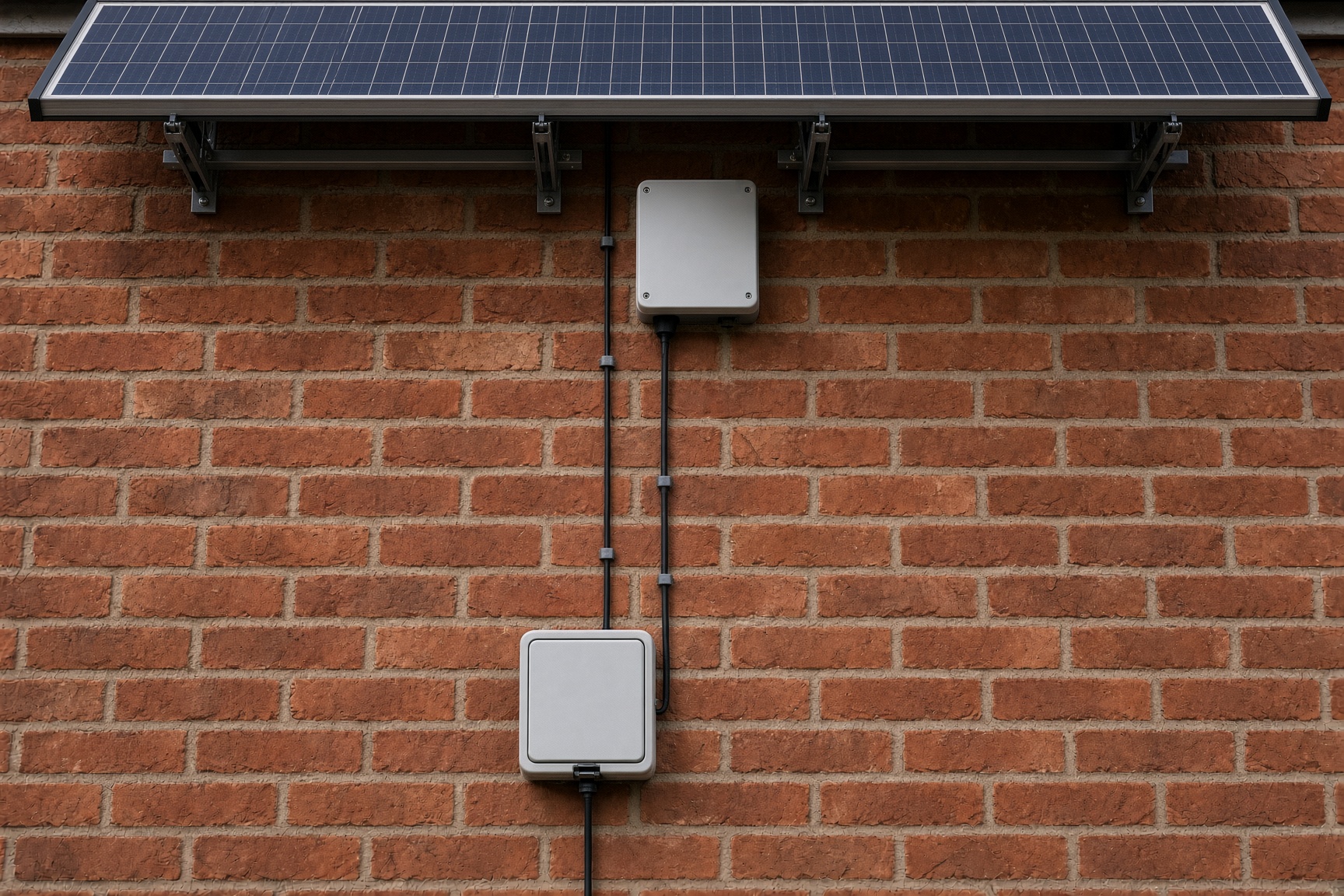
A legal kit can feed in no more than 800 volt-amps, which is 3.5 amps. A kettle draws about 13. So the kit itself is a small load. The problems come from where that current goes and what it passes through on the way.
| Route | What happens | Who is most exposed |
|---|---|---|
| Hidden load on the circuit | The breaker on a typical socket ring trips at 32 amps, but it only sees current coming from the grid. With a kit feeding in further along, parts of the cable can carry up to 35.5 amps before it trips. That is about 11% over what the breaker allows | Circuits that already run a kettle, washing machine and dryer together, and any circuit with old or damaged cable |
| An RCD that stops working properly | An RCD cuts the power when current leaks to earth. Older Type AC devices can be made less sensitive by the small DC current an inverter produces. The product rules cap that at 5 milliamps, and the government is running more tests on older RCDs | Homes with Type AC RCDs, and homes with no RCD at all |
| Extension leads and adaptors | Every extra plug and socket is a connection that can heat up. A kit runs for hours at a time on sunny days, which is when a poor connection gets hot. Flat cables made to pass under a door or through a window frame get crushed | Anyone without a socket near the panels |
| A worn socket or loose wiring | Loose terminals and tired socket contacts are a common cause of electrical fires with any appliance. A kit adds hours of steady current through whichever socket you choose | Older homes, and sockets that already feel loose or run warm |
| A kit that is not on the register | Imported kits sold on online marketplaces may lack the protection that shuts the inverter down when it is unplugged or when the grid goes off. Nobody has tested them against UK rules | Buyers chasing the lowest price |
| Where the panels are fixed | Panels on timber balconies or combustible cladding can help a fire spread up a building. Panels across an escape route get in the way of people leaving | Flats |
The first two are why the electrical bodies and the government disagree. The government's position is that the 3.5 amp cap and the 5 milliamp DC limit make a compliant kit safe on a sound circuit. The trade bodies' position is that nobody has checked whether your circuit is sound. Both statements are true. The product specification itself assumes a consumer unit with RCD or RCBO protection, and says an older fuse box needs checking first.
What about shocks from the plug? People worry that the pins are live when you pull the plug out, because the panels are still making power. A compliant inverter shuts down as soon as it loses the mains, so the pins should be dead by the time you can touch them. The IET has said this depends on the house wiring being suitable. It is another reason to buy only a registered kit, and to switch the socket off before unplugging.
Check your home in five minutes
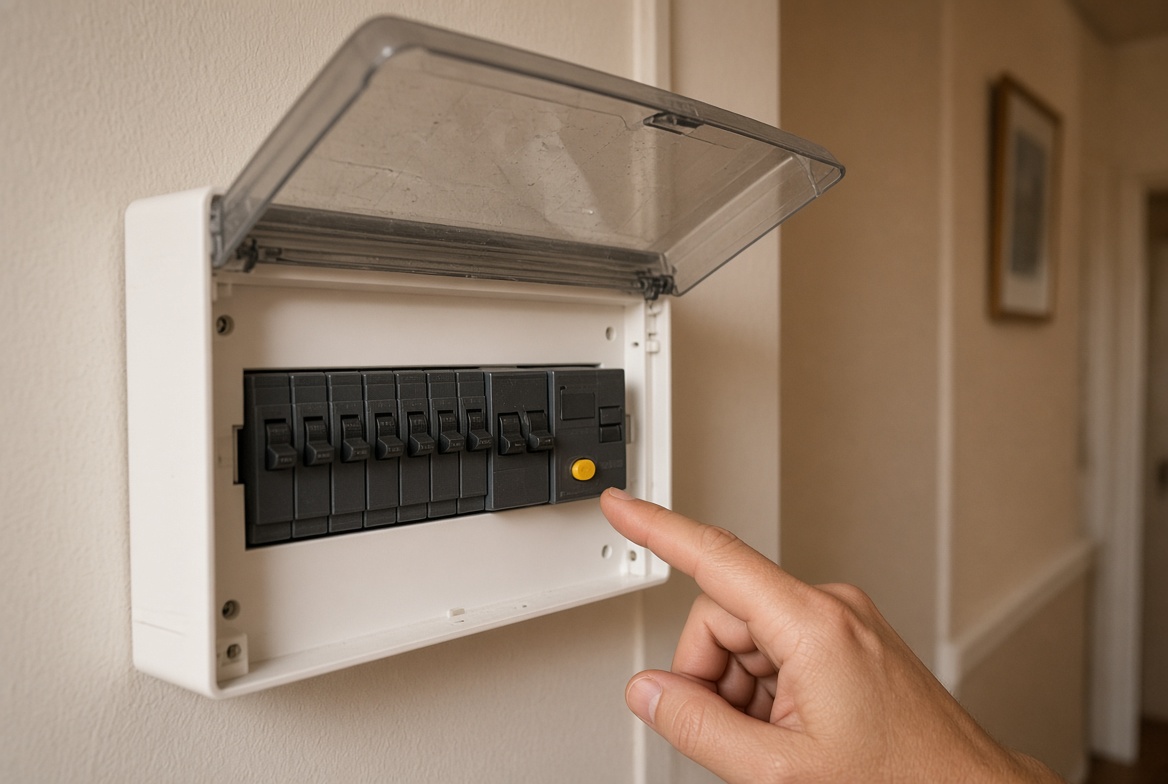
You can rule your home in or out for the price of a look inside one cupboard. Open the cover of your consumer unit, which most people call the fuse box. Don't remove any panels that need a screwdriver.
Type AC: one wave
An older design. Electrical Safety First says not to use plug-in solar on it until it has been upgraded.
Type A: a wave above pulses
The minimum Electrical Safety First recommends, and it should be a bidirectional one. An electrician can confirm that part.
| What you found | What to do | Likely cost |
|---|---|---|
| Modern consumer unit, Type A RCD or RCBOs, sound socket, cable route sorted | You meet the published advice. Ask an electrician to confirm the device is bidirectional if you want certainty | £0, or a short visit |
| Type AC RCD | Have the RCD or the whole board upgraded before you plug a kit in | A new consumer unit is £400 to £1,000 fitted. Swapping one device costs less, so ask for a quote |
| Old fuse box, no RCD | A new consumer unit, and usually an inspection first | £400 to £1,000, plus any repairs the inspection finds |
| No socket outside, and no way in without trapping a cable | An outdoor socket fitted by an electrician | Ask for a quote. The socket itself is a low-cost part |
| You can't tell, or the wiring is old | An Electrical Installation Condition Report, known as an EICR | £100 to £150 for a one-bed flat, £150 to £250 for a two or three-bed house, £250 to £350 for a larger one |
One rule from the specification is worth knowing here. If a kit has more than 960 watts of panels, the manufacturer has to advise you to get your wiring assessed first. Many two-panel kits sit just under or just over that line.
What to fix, and what it costs
Most of the risk comes down to five things, and each has a fix. Some are a job for an electrician. Some are a product you can buy. In order of how much they matter:
1. Buy a kit that is on the register
Type must read "Plug-in Solar" and status must read "Compliant"
This is the single biggest step. A registered kit has the output cap, the DC limit and the shut-down protection tested. As of 30 September, 84 kits were listed, from £336. Electrical Safety First advises buying from a known retailer and avoiding third-party sellers on online marketplaces. Our guide tracks the kits we have checked against the register, including EcoFlow's STREAM kits, Octopus Energy's own kits and the Thunder Bolt, which is £20 off with the code COOLPOWER20.
2. Get the wiring checked
An EICR from a registered electrician: £100 to £350 depending on the size of your home
An electrician tests every circuit, tells you which type of RCD you have and whether it is bidirectional, and flags loose connections and worn sockets. Use someone registered with a competent person scheme such as NICEIC or NAPIT. If you are getting an EICR anyway, tell them which socket you plan to use so they look at that circuit closely.
3. Upgrade the RCD or the consumer unit
£400 to £1,000 for a new board, fitted and certified
If you have a Type AC RCD or an old fuse box, this is the fix. A full RCBO board gives each circuit its own protection and costs £500 to £1,000. A dual-RCD board is £400 to £650. It is a lot to spend to enable a kit that saves £95 to £140 a year, so count it as a safety upgrade for the whole house that you would want anyway.
4. Fit a weatherproof outdoor socket
IP66 switched socket, fitted by an electrician
This removes the two worst habits in one go: the extension lead and the cable shut in a window. London Fire Brigade says an outdoor socket for plug-in solar should be rated at least IP65 and fitted by a competent person. The socket is cheap. The fitting is the cost, and it is a job for an electrician, not a DIY one.
5. Test the socket before you use it
A plug-in socket tester
A socket tester plugs in and shows by its lights whether the socket is wired correctly and has an earth. It will not tell you what type of RCD you have or what condition the cable is in, so it does not replace an electrician. It does catch a missing earth or crossed wires in ten seconds, and a kit should never go on a socket that fails.
6. Make sure your alarms work
Smoke alarm on every floor, heat alarm in the kitchen
This has nothing to do with solar and everything to do with surviving any electrical fault. Fire services advise at least one working smoke alarm on every level of a home. A sealed ten-year alarm needs no battery changes. If your consumer unit is in a hallway or under the stairs, that is a good place to have one nearby.
Two cheap extras help with the cable itself. Use outdoor-rated clips to keep the lead off the ground and away from sharp edges, and use only the brackets and fixings the kit maker supplies or recommends. London Fire Brigade lists both points in its advice.
The rules that keep it safe
Several of the legal rules for plug-in solar are fire rules in plain clothes. Follow them and you have dealt with most of the list above.
Warning signs once it is running
Check the plug and socket by hand after the first hour of strong sun, then again every few weeks through the first summer. It should feel no more than slightly warm. Unplug the kit and call an electrician if you notice any of these:
If there is a fire: get out, stay out and call 999. Tell the operator, and the firefighters when they arrive, that solar panels are fitted. Panels keep producing power in daylight even when the mains is off, and crews need to know.
Flats, balconies and renters
Fire in a block of flats is a different problem from fire in a house, and the advice is stricter.
One practical point: very few registered kits are rated for a balcony rail. Most are for walls, gardens and flat roofs. A panel tied to a railing with fixings it was not sold with is a falling hazard before it is a fire hazard.
Home insurance
Tell your insurer before you plug a kit in. Comparison site Go.Compare has warned that if you don't, and you later have an electrical fire or fault, the policy could be invalidated. A phone call or a note through your online account is enough. Keep a record of it.
Plug-in panels usually count as contents, not part of the building, according to Tesco Insurance. That matters for renters, whose landlord insures the building but not their belongings. Insurers quoted so far say a claim is at risk if the kit does not meet the government specification or was not fitted the way the maker says. An extension lead would very likely fall under that.
So, should you fit one?
| Your home | Our view |
|---|---|
| Modern consumer unit with Type A protection, sound wiring, a suitable socket near the panels | Yes. Buy a registered kit, plug it in directly, tell your network operator and your insurer |
| Older home, modern consumer unit, wiring history unknown | Probably, after an EICR. Budget £100 to £350 on top of the kit |
| Type AC RCD or an old fuse box | Not yet. Upgrade first. If the upgrade is only for the kit, the sums rarely work |
| The only way to connect is an extension lead or a cable through a window | No, until an outdoor socket is fitted |
| Flat in a tall block, or a building with cladding work pending | Speak to the building manager first. The answer may be no |
| You want a battery with it | Not as a self-install. That needs an electrician |
For a home that passes the checks, a plug-in kit is a small, low-powered appliance with more safety rules around it than most things you plug in. For a home that doesn't, the kit is not the problem, and the money is better spent on the wiring first. If a full rooftop system might suit you better, see plug-in vs installed solar.
Frequently asked questions
Ready to choose a kit?
We check every kit we list against the official register, with current prices and where to buy.
See the Compliant Kits →Related Guides
Published 6 October 2026. Product rules are from the DESNZ Plug-in Solar Device Interim Product Specification and SI 2026/848. Safety advice is from Electrical Safety First, London Fire Brigade, the IET's statement of 24 March 2026 and the joint statement of 9 June 2026 by the ECA, Electrical Safety First, the IET, NICEIC and SELECT. Rooftop fire figures are from QBE's freedom of information requests to UK fire services, published 10 August 2026. The German registration figure is from the Marktstammdatenregister as reported in May 2026. Electrician prices are typical 2026 guide prices and vary by region. The 35.5 amp figure is our own sum: a 32 amp breaker plus the 3.5 amp output cap. We have not tested any kit ourselves. This guide is general information, not an electrical inspection of your home.