
Damp · Dehumidifiers
Best Dehumidifier for Damp Walls UK: What Works, and When It Won't
A dehumidifier will dry out walls that are damp from condensation, the most common kind in UK homes. It won't fix rising or penetrating damp. Here's how to tell which you have, the four models worth buying for the job, and how long it takes.
Published 8 November 2026 · prices checked 6 November 2026
Affiliate disclosure: some links on this page are affiliate links. If you buy through them we earn a small commission at no extra cost to you. It doesn't affect what we recommend.
The short answer
On this page:
First, Check It's the Kind of Damp a Dehumidifier Can Fix
A dehumidifier takes moisture out of the air. That solves damp caused by moisture in the room settling on cold walls. It can't stop water coming through the wall from outside or from the ground. These are the four usual causes:
| Type | Typical signs | Will a dehumidifier fix it? |
|---|---|---|
| Condensation | Black mould spots in corners, behind wardrobes and around windows; damp on cold outside walls; worse in winter and in the mornings; water on the windows | Yes. This is what dehumidifiers are for. |
| Penetrating damp | Patches at any height that grow or darken after rain, often near gutters, downpipes, cracked render, pointing or window frames | No, not on its own. Fix the leak, then a dehumidifier speeds up drying. |
| Rising damp | A tide mark low on the wall, rarely more than about a metre high, with white salty deposits, crumbling plaster or rotting skirting, all year round | No. The cause needs finding, and it is often misdiagnosed, so get an independent survey. |
| Plumbing leak | A patch that stays wet whatever the weather, often near pipes, a bathroom or a kitchen | No. Find and fix the leak first. |
Our guide to damp patches on walls goes through each type in more detail, including the common causes of rising damp that turn out to be something else.
The foil test: a free way to check
Be careful with cheap moisture meters. They're useful for checking whether the same spot is getting drier over time, but they're designed for timber. Salts in old plaster can make a wall read as wet when it isn't, so a high reading on its own doesn't prove rising damp. Be wary of anyone who diagnoses it from a meter alone.
The Best Dehumidifiers for Damp Walls
Drying out a damp wall is a longer job than drying washing or clearing window condensation. Four things matter most:
| Model | Best for | Extraction | Running cost | Price |
|---|---|---|---|---|
| MeacoDry Arete One 20L | Most damp rooms | 20L/day | ~5.7p/hr | £259.99 |
| Pro Breeze 20L | Best value | 20L/day | ~8.2p/hr | £139.99 |
| Black+Decker 30L | Very damp house, after a leak | 30L/day | ~14p/hr | £265 at Dunelm |
| Pro Breeze 10L desiccant | Cold, unheated rooms | Up to 10L/day | ~16p/hr | £199.99 |
Extraction figures are the makers' own ratings. Running costs are at full power at the October to December 2026 price cap of 26.32p per kWh. Prices checked 6 November 2026 (the Pro Breeze 20L on 14 November, the Pro Breeze desiccant on 17 October). Ratings are our own, based on published specs, prices and warranties; we haven't tested these models.
Best for Damp Walls
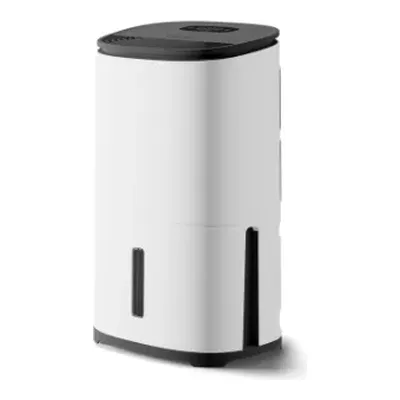
MeacoDry Arete One 20L Dehumidifier & Air Purifier
20L/day · 216W · 38dB · 4.8L tank · continuous drainage · 5-year warranty
Our rating: 4.5/5
The one we'd choose for a room with damp walls. Drying out a wall means running for days or weeks, so running cost and noise matter more than usual, and this is the cheapest 20-litre model on our list to run: 216W, about 5.7p an hour, or £1.36 for a full 24 hours flat out. Its humidistat holds the room at the level you set, and a continuous drainage option means it can keep going without you emptying the tank. In a heated room Meaco's figures show it removing about 8.5 litres a day; at 10°C that drops to about 3.4 litres, so keep the room warm. At 38dB it's quiet enough for a bedroom, and Meaco gives a 5-year parts and labour warranty.
Best Value
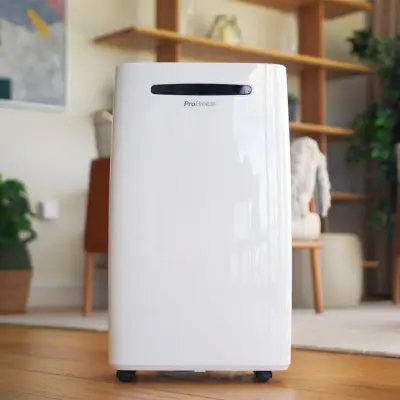
Pro Breeze 20L Dehumidifier with Laundry Mode
20L/day · ~310W · 5.5L tank · continuous drainage · auto mode 40–60%
Our rating: 4.5/5
The same 20-litre class for £110 less while Pro Breeze's Black Friday sale lasts. It has the biggest tank here at 5.5 litres and a hose for continuous drainage, so it can sit next to a damp wall for days without filling up. It costs a little more to run, about 8.2p an hour or £1.96 a day flat out, and it's louder: Pro Breeze rates it at up to 48dB, which is fine in a living room or spare room but can be noticeable in a bedroom at night. Auto mode holds the room between 40% and 60%.
For a Very Damp House
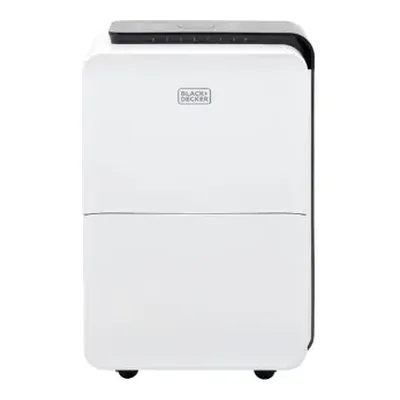
BLACK+DECKER 30L Dehumidifier (BXEH60008GB)
30L/day · 540W · 4L tank · drainage hose · humidity 30–80% · works 5–32°C
Our rating: 3.5/5
For a whole house that's damp, or a room drying out after a leak has been fixed, where extraction matters more than running cost. It's rated at 30 litres a day, has a continuous mode, a humidity setting you can adjust in 5% steps and a 24-hour timer, and a drainage hose comes in the box. The trade-offs: 540W is about 14p an hour (£3.41 a day flat out), it weighs 18kg, and Black+Decker doesn't publish a noise figure. For one damp room, a 20-litre model is the better buy.
For a Cold Room
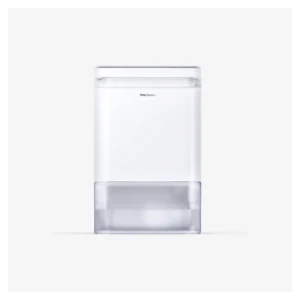
Pro Breeze 10L Desiccant Dehumidifier
Up to 10L/day · works down to 1°C · 620W · 3L tank · hose outlet · heating setting
Our rating: 4/5
Damp walls are often in the coldest rooms: an unheated back bedroom, a room over a garage, a north-facing extension. Below about 10–15°C a compressor dehumidifier removes far less water, while a desiccant model keeps working. Meaco's figures for its own desiccant DD8L Pro show 6.9 litres a day at 10°C against 8 at 20°C. The Pro Breeze is the desiccant you can buy now: it works down to 1°C, has a 3-litre tank and a hose outlet for continuous drainage. The catch is power: 620W, about 16p an hour. If you can heat the room a little and use a 20-litre compressor model instead, that's usually cheaper. Our desiccant dehumidifier guide compares the options.
Worth buying first: a £10 hygrometer
A dehumidifier's own humidity reading can be a few points out. A cheap digital hygrometer, like the TempPro TP50 on Amazon, tells you when the room is really in range and whether humidity creeps back up overnight. Put it on the far side of the room from the dehumidifier, at about head height.
For laundry, bedrooms and other jobs, our best dehumidifiers UK guide compares eight models side by side.
How to Dry Out a Damp Wall With a Dehumidifier
Cold walls keep causing condensation?
Insulating outside walls and lofts keeps internal surfaces warmer, so moisture doesn't settle on them. Some homes qualify for free insulation.
See Insulation Options →How Long Does It Take to Dry a Damp Wall?
It depends on how wet the wall is, not just the surface. Surface condensation dries quickly. A wall that's been soaked right through takes months.
| Situation | Rough time |
|---|---|
| Surface condensation and mould on a cold wall | A few days to a couple of weeks, then keep humidity at about 55% to stop it coming back |
| A damp house, first time using a dehumidifier | It runs almost non-stop for two to four weeks while walls, furniture and fabrics give up their moisture (Meaco) |
| Plaster that got wet from a leak | Several weeks to a few months, depending on thickness |
| A solid brick wall soaked through by a leak or flood | About a month for every 25mm of thickness in good drying conditions (LABC). A 225mm solid brick wall can take around nine months |
Don't rush to replaster or repaint. Sealing a wall that's still wet traps the moisture, and the paint will bubble or the mould will come back. If you have a moisture meter, take readings from the same marked spots each week: a steady fall tells you it's working, even if the numbers themselves aren't precise.
What It Costs to Run
These are full-power costs at the October to December 2026 price cap of 26.32p per kWh. Once the room reaches the humidity you've set, the humidistat switches it off, so real costs after the first couple of weeks are much lower. For how many hours a day to run it once the wall has dried, see our guide to how long to run a dehumidifier.
| Model | Power | Per hour | 24 hours flat out | Two weeks flat out |
|---|---|---|---|---|
| MeacoDry Arete One 20L | 216W | 5.7p | £1.36 | £19.10 |
| Pro Breeze 20L | 310W | 8.2p | £1.96 | £27.41 |
| BLACK+DECKER 30L | 540W | 14p | £3.41 | £47.76 |
| Pro Breeze 10L Desiccant | 620W | 16p | £3.92 | £54.83 |
Two weeks of the Meaco running flat out costs about the same as a takeaway, and far less than replastering a wall or replacing mouldy furniture. If your electricity bill is a worry, it's worth checking your tariff too.
Are you paying too much for your energy?
We've partnered with the experts at ismybillfair to give you a quick way to find out. Enter your postcode and they check your current tariff against your own supplier's best deals, so you could pay less without switching supplier.
If You Rent
Condensation is often blamed on tenants, but damp and mould can also come from disrepair, poor ventilation or a lack of insulation, which are your landlord's responsibility. The government's damp and mould guidance for landlords says landlords shouldn't simply blame lifestyle. Report damp in writing and keep photos. Our guide to Awaab's Law explains the repair deadlines it sets and when they apply to private landlords.
Damp Walls and Dehumidifiers: FAQ
Related Guides
Published 8 November 2026. Prices checked 6 November 2026, except the Pro Breeze 20L (14 November 2026) and the Pro Breeze 10L desiccant (17 October 2026). Running costs are our calculation at Ofgem's price cap for October to December 2026, 26.32p per kWh, from each model's rated power. Ratings are our own, based on published specs, prices and warranties. Sources: manufacturers' specifications (Meaco, Pro Breeze, Black+Decker via Currys); Meaco, "My dehumidifier does not turn off", and Meaco extraction figures at 20°C and 10°C; LABC, "Drying out buildings"; UK government, "Damp and mould: understanding and addressing the health risks for rented housing providers". Cool Power Co earns a commission on some links on this page, at no extra cost to you.