
Fixed Air Conditioning · Installation Guide
Air Conditioning Installation UK: Costs, Rules and What It's Like to Own One
What happens on installation day, where the outdoor unit can go, what the planning rules say, what breaks, and what a split system really costs to buy and run.
Last updated: 4 October 2026
A fixed air conditioner is two boxes joined by a pair of thin pipes: an indoor unit on the wall and an outdoor unit that gets rid of the heat. Fitting one takes a day. Living with one is mostly about where that outdoor unit went, and whether anyone sized the system properly first.
Quick answer: a single-room split system costs £1,500–£3,000 installed and takes an F-Gas certified engineer four to eight hours to fit. In England, a house usually doesn't need planning permission, provided the system can heat as well as cool and the outdoor unit passes a noise test at your neighbour's window. It costs about 8–13p an hour to run, needs a service once a year, and heats a room in winter for less than gas.
On this page:
What air conditioning installation involves
Most single-room systems go in within a working day, with no redecorating. This is the usual sequence.
Multi-room systems take two to three days, mostly because of the extra pipe runs. Our guide to split air conditioners compares the brands you are likely to be quoted.
The outdoor unit: what nobody tells you upfront
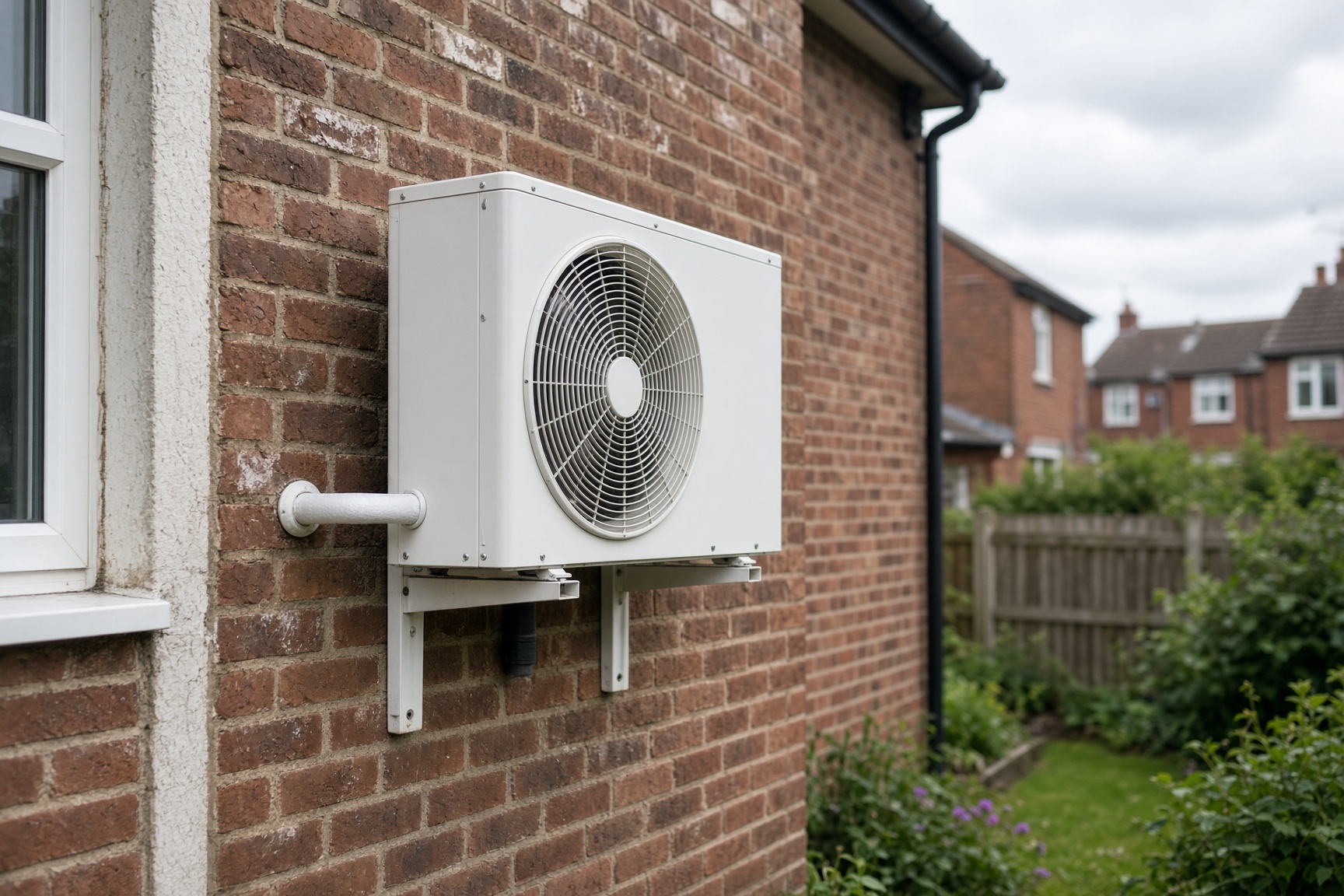
The outdoor unit is about the size of a large suitcase, and most people don't think about it until it is on their wall. It is worth deciding where it goes before you compare quotes.
Where it goes
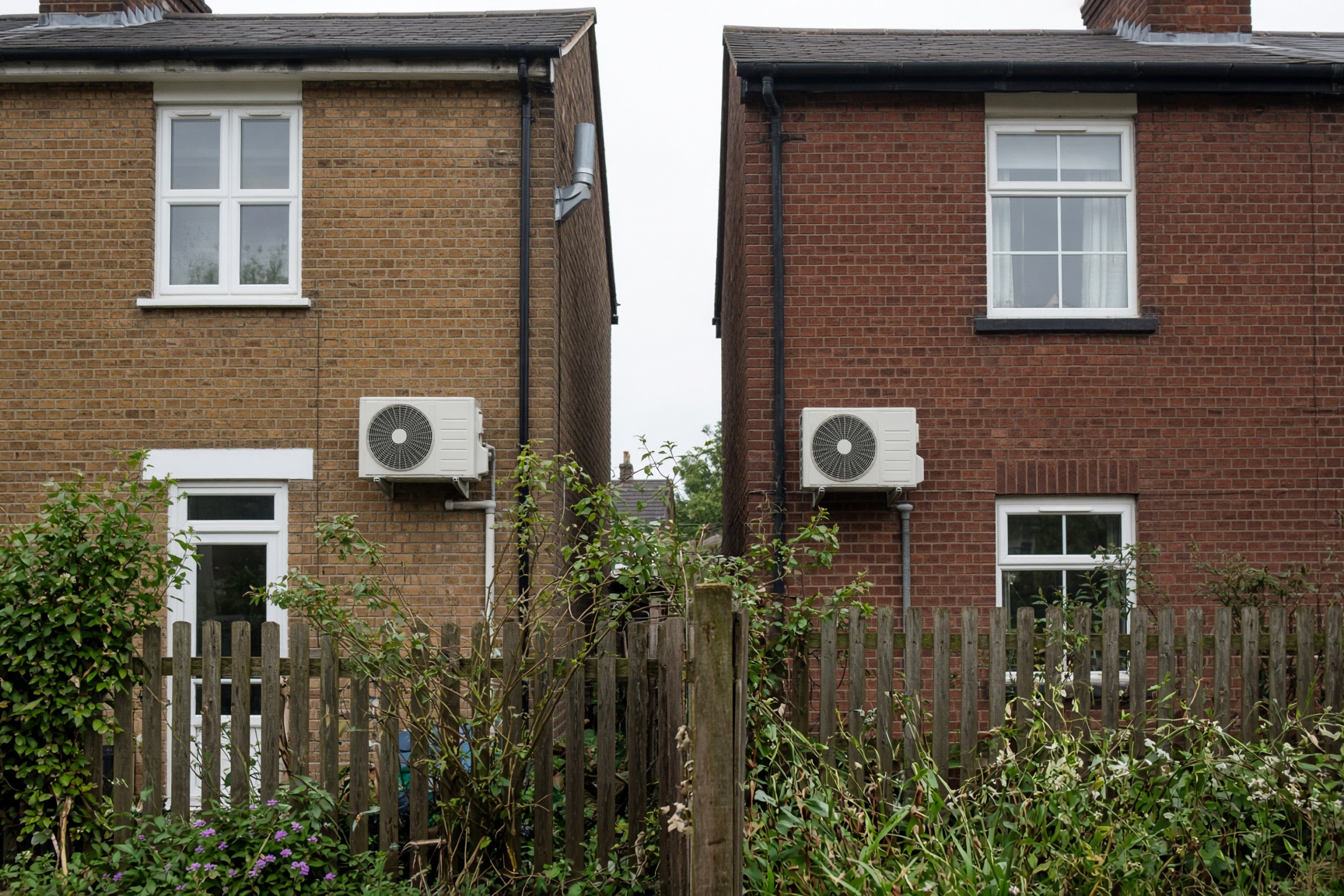
Most UK installs mount it on an outside wall on brackets. A slab at ground level is the alternative where a wall isn't practical or you'd prefer it out of sight. Either way it has to be within a sensible pipe run of the indoor unit. Beyond about 15 metres, cost rises and efficiency falls, which limits how far you can hide it.
Neighbours and leases
Will one unit cool the room you think it will?
A single-room system is designed for one room, not "the downstairs". Open-plan kitchen-diners often need a larger unit or two smaller ones. A survey with a heat load calculation catches this. An undersized unit that runs flat out and still can't cope on the hottest days is the most common cause of disappointment.
Do you need planning permission?
Usually not for a house in England, as long as the system can heat as well as cool. Since 29 May 2025, reversible air-to-air systems count as air source heat pumps for planning purposes and can be fitted as permitted development. Almost every split system sold today is reversible.
| Your home | What applies |
|---|---|
| House in England | Permitted development if the system is not cooling-only, the outdoor unit is no bigger than 1.5 cubic metres, it is the only one (two are allowed on a detached house), it isn't on a pitched roof, and it passes the noise test below |
| Flat in England | The outdoor unit limit is 0.6 cubic metres, and you will almost always need the freeholder's consent as well |
| Conservation area | Still possible, but not on a wall or roof that faces a road. In practice that means the back of the house |
| Listed building | Not permitted development. You need consent, so speak to the council first |
| Cooling-only unit | Not covered by this right. Ask your council before you order |
| Scotland, Wales, Northern Ireland | Each has its own rules. Check with your council |
The noise test. The calculated sound from the outdoor unit must be no more than 37 dB(A) at the nearest neighbour's door or window to a habitable room. It is worked out on paper under a standard called MCS 020(a), from the unit's rated sound power, the distance, and nearby walls that reflect sound. Older guides quote 42 dB, which was the figure under the previous version. Ask your installer for the calculation in writing. Our guide to the outdoor unit noise rules has more.
The old rule that the unit had to be at least one metre from your boundary was removed in the same change. The noise test now does that job.
What it costs
The price depends mostly on how many rooms you cool and whether they share one outdoor unit.
| System | Covers | Typical installed cost |
|---|---|---|
| Single split | One room | £1,500–£3,000 |
| Multi-split, 2 rooms | Two rooms on one outdoor unit | £2,800–£4,500 |
| Multi-split, 3–4 rooms | A whole floor | £4,500–£7,000 |
| Whole home | Five rooms or more | £7,500 and up |
Five things move a quote up or down within those ranges:
Want your own numbers?
Our free calculator estimates the installed cost for your rooms and region.
Use the Free Calculator →Running costs: cooling in summer, heating in winter
A split system uses far less electricity than a portable unit, because it moves heat outdoors through pipes and doesn't blow your cooled air out of a window. These figures use the October 2026 price cap of 26.32p per kWh.
| Cooling one room | Cost per hour |
|---|---|
| Split system, holding temperature | 8–13p |
| Split system, flat out on a hot afternoon | Up to about 20p |
| Portable air conditioner | 26–36p |
The same system runs in reverse as a heater, and this is where it earns its keep for the other nine months. It delivers 3 to 4 kWh of heat for each kWh of electricity.
| Heating one room | Cost per kWh of heat |
|---|---|
| Split system in heat mode | 6.6–8.8p |
| Gas boiler, 92% efficient, gas at 7.97p | 8.7p |
| Plug-in electric heater | 26.3p |
It suits a home office, a loft room or a cold extension. It heats only the room it is in and doesn't heat your water, so it works alongside central heating in most homes and doesn't replace it.
Choosing an installer
Anyone who handles refrigerant must hold a personal F-Gas qualification, and the company must hold an F-Gas company certificate from a body such as REFCOM. Both are legal requirements. You can look a company up on the certification body's public register before you invite it to quote.
Six questions to ask before you accept a quote
Installers are busiest from May to August. Booking in autumn or winter usually means a shorter wait, and you get the heating straight away.
What goes wrong, and the maintenance that prevents it
A split system is not fit-and-forget. Four things need attention over its life.
Skipped servicing
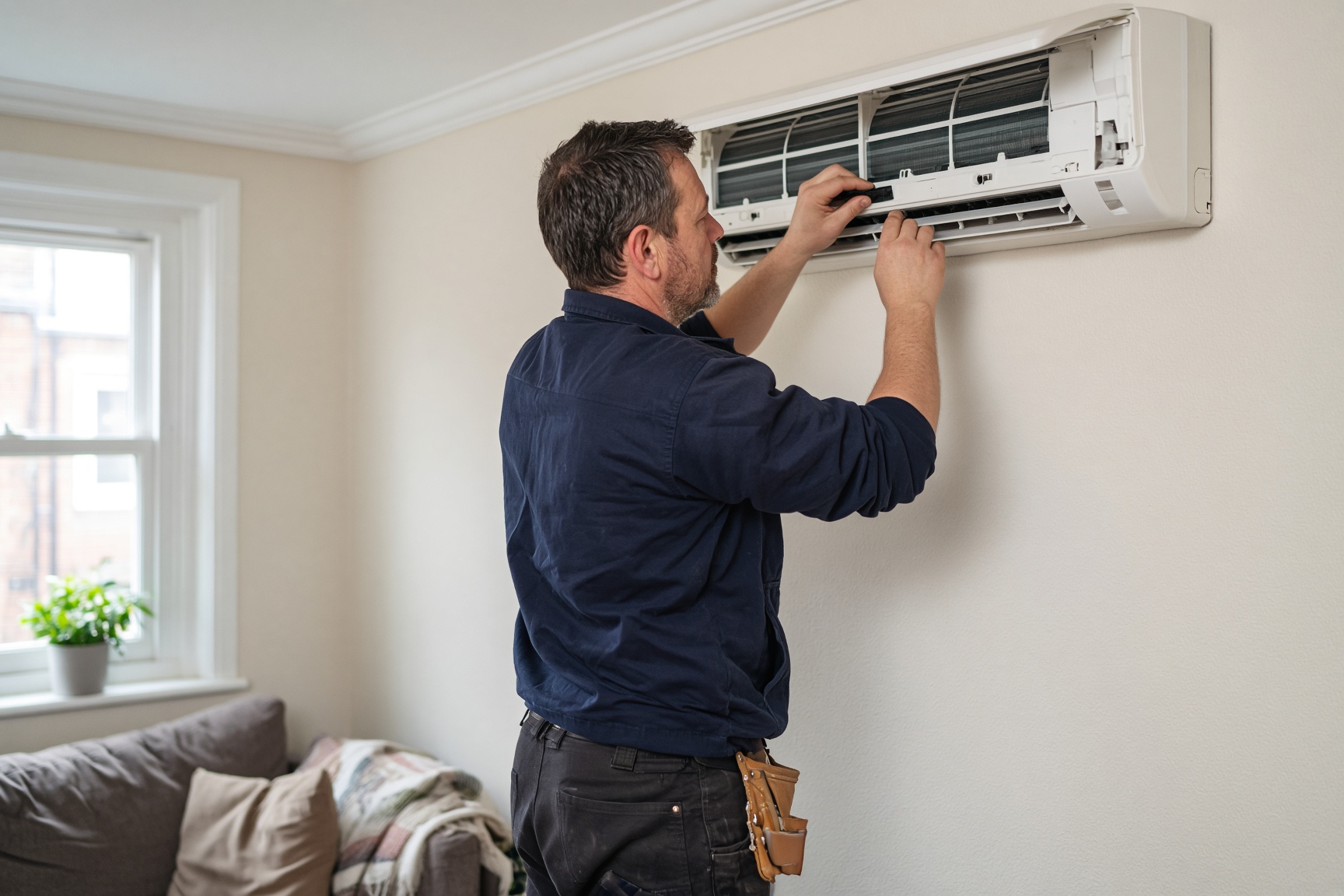
You can clean the filters yourself every few weeks in summer. A yearly service by a certified engineer also checks refrigerant pressure, drainage and electrical connections. Skipping it is the most common reason a system fades after two or three years.
Blocked condensate drain
The indoor unit makes condensation that drains through a small pipe. Algae or debris can block it, and water then drips indoors or the unit shuts down to protect itself. It is a cheap fix if caught early.
Slow refrigerant leak
A system that takes longer to cool than it used to, or never reaches the set temperature, may be losing refrigerant. Only an F-Gas certified engineer can legally find and fix it. Left alone, it damages the compressor, which is the expensive part.
Leak checks on large systems
Systems holding refrigerant equal to 5 tonnes of CO2 or more must have regular leak checks by law. That is about 7.4kg of R32, so a single-room system at around 1kg is well below it. Large multi-splits can reach it, so ask.
Budget for it: a yearly service typically costs £80–£150. Count it as part of the cost of ownership, and check whether your warranty depends on it.
Split system or portable air conditioner?
| Split system | Portable air conditioner | |
|---|---|---|
| Upfront cost | £1,500–£3,000 fitted | £250–£800 |
| Running cost | 8–13p an hour | 26–36p an hour |
| Noise indoors | Quiet. The compressor is outside | Loud. The compressor is in the room |
| Maintenance | Yearly service, £80–£150 | Filter cleaning only |
| Moves with you | No | Yes |
| Heats in winter | Yes, cheaply | A few models, expensively |
If you own your home and will use it every summer, a split system earns back its higher price through lower running costs, and it heats in winter. If you rent, want to try air conditioning first, or can't alter the outside of the building, a portable unit is the lower-commitment choice. There is also a middle route you fit yourself with no installer, covered in our guide to air conditioning without a hose.
The £2,500 air-to-air heat pump grant
Since 28 April 2026 the Boiler Upgrade Scheme in England and Wales has included a £2,500 grant for air-to-air heat pumps, which is what a reversible split system is. It is a grant for replacing your heating, though, and not for adding cooling.
Check before you rely on it. Trade guides reported in September 2026 that no installer had yet completed MCS certification for air-to-air systems, so few if any grant-funded installs had happened. Ask any installer who offers the grant to show you their certificate. If you only want one room cooled, the grant doesn't apply, however the system is marketed.
For whole-home heating with radiators and hot water, the larger £7,500 grant for air-to-water heat pumps is covered in our heat pumps guide.
Frequently asked questions
Related Guides
Get Free Installation Quotes
Compare quotes from F-Gas certified local installers. Free, no obligation.
Free · No obligation · F-Gas certified installers only
Last updated 4 October 2026. Running costs use the October 2026 Ofgem price cap of 26.32p per kWh for electricity and 7.97p for gas. Planning rules are those for England under the General Permitted Development Order as amended on 29 May 2025, and the noise limit is from MCS 020(a). Grant details are from the Boiler Upgrade Scheme rules in force from 28 April 2026. Costs are typical UK ranges and your quote will depend on your home. This is general guidance and not a substitute for a survey.